
Part 6 · Food, Work and Ecology
Chapter 33 of 48
Pitha, Sweets and the Festival Kitchen
Ingredients techniques and the foods people share
A turmeric leaf opens to reveal a pale pitha. Elsewhere, a cake has browned slowly in its vessel, ready to be cut. Odisha’s festival kitchen works through such differences in texture, heat and time. Rice, pulses, coconut, jaggery and fresh chhena become foods whose preparation can be as memorable as their taste.12
This chapter follows the work behind those foods: grinding, filling, wrapping, steaming and baking. Festival associations give them a place in the year, while family versions and new adaptations keep the repertoire moving. The story belongs to the people who make the food as well as those who receive it.
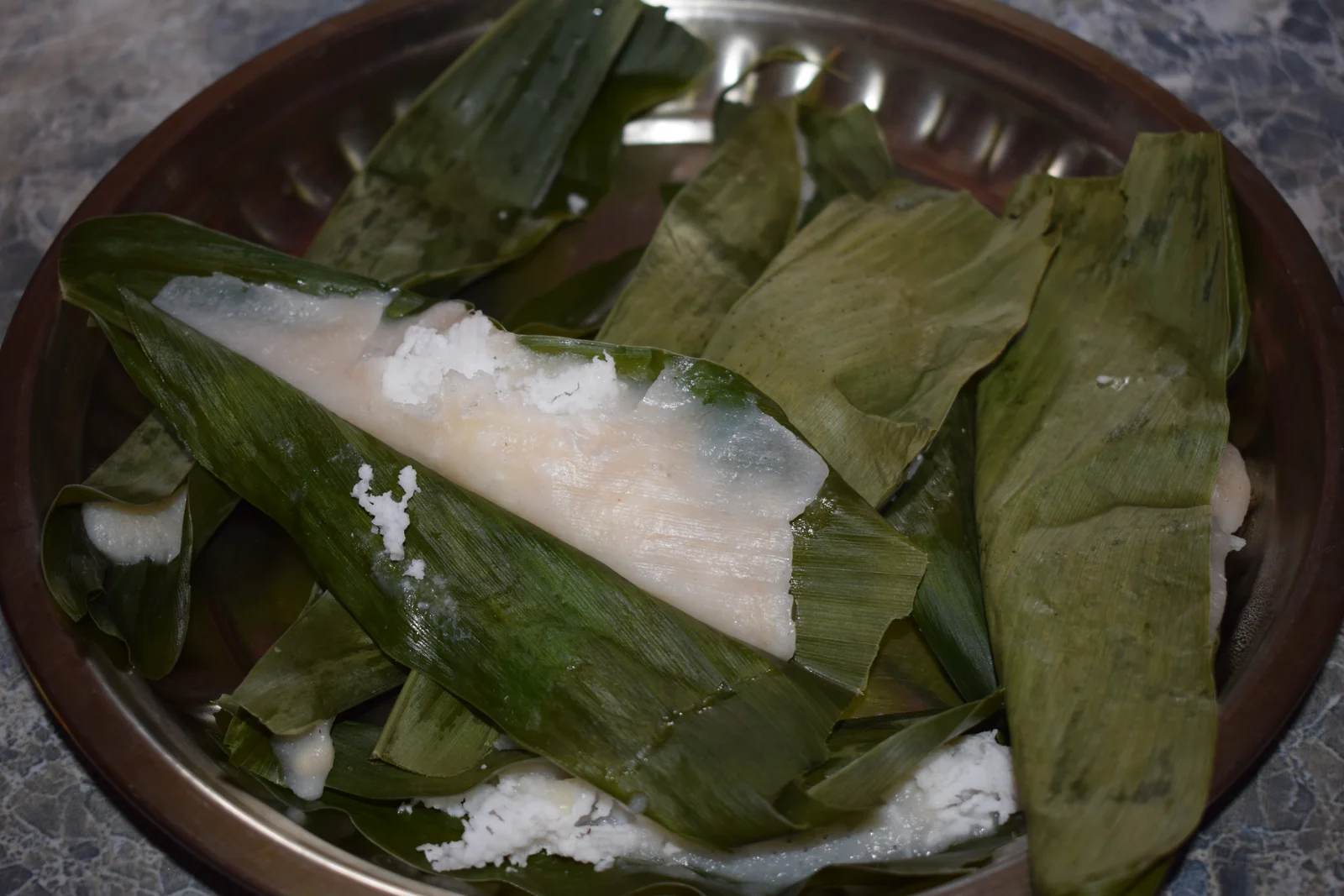
Enduri pitha photographed on Prathamastami, 20 November 2019.
Sangram Keshari Senapati. Source · CC BY-SA 4.0.

A family of techniques
Pitha is a broad family of preparations, not one kind of cake. Lipi Das’s Traditional Rice Foods, published by ICAR’s Central Rice Research Institute in 2015, documents several ways to transform rice. In its enduri recipe, rice and black gram form a fermented batter, wrapped in turmeric leaves around a sweet filling and steamed. Its manda recipe instead makes a rice-flour dough, encloses a coconut filling and steams the shaped pieces.1
These two methods ask different things of the cook. Batter must spread without escaping its leaf; dough must close around a filling without splitting. The ingredient list records what goes in, but the sequence reveals the work. Soaking and grinding precede shaping, and preparing the filling is another task within the larger preparation.
Other pithas move to a hot pan or oil. Odisha Tourism describes chakuli as a thin pan-cooked preparation and gives a semolina, coconut and cardamom version of fried kakara.2 A name can therefore identify a familiar food without settling every choice of flour, filling or thickness. The recipe belongs to a particular practice, not to an unchanging statewide formula.
Jagannath Dash’s survey of rice culture links enduri with Prathamastami and includes poda pitha among Raja foods. It also records pitha varieties across different cultural regions.3 These associations connect the kitchen to the calendar discussed earlier in this edition. Here, the emphasis is on what an occasion asks someone to prepare: leaves to find, grain to grind, filling to cook, and portions to shape.
Palm fruit and the slow cooked cake
Poda pitha draws attention to sustained heat. Odisha Tourism describes a version in which fermented rice batter, covered with sal leaves, cooks slowly in an earthen pot.2 The name also accommodates variation. The tala poda pitha photographed below brings palm fruit into the preparation; its photographer identifies it as a rainy-season food.4
Palm fruit can lead to another texture altogether. A 2016 Oriyarasoi recipe combines its extract with rice flour and a little semolina to make fried tala pitha. The writer separates the labour of extracting and straining the fruit from the shorter task of frying the batter.5
That distinction is easy to lose when food is described only by its final cooking time. A finished slice or fritter conceals the earlier work of turning an ingredient into something usable. The photograph invites a slower look: browned surfaces and a dense yellow interior record a preparation quite different from the leaf-steamed enduri.
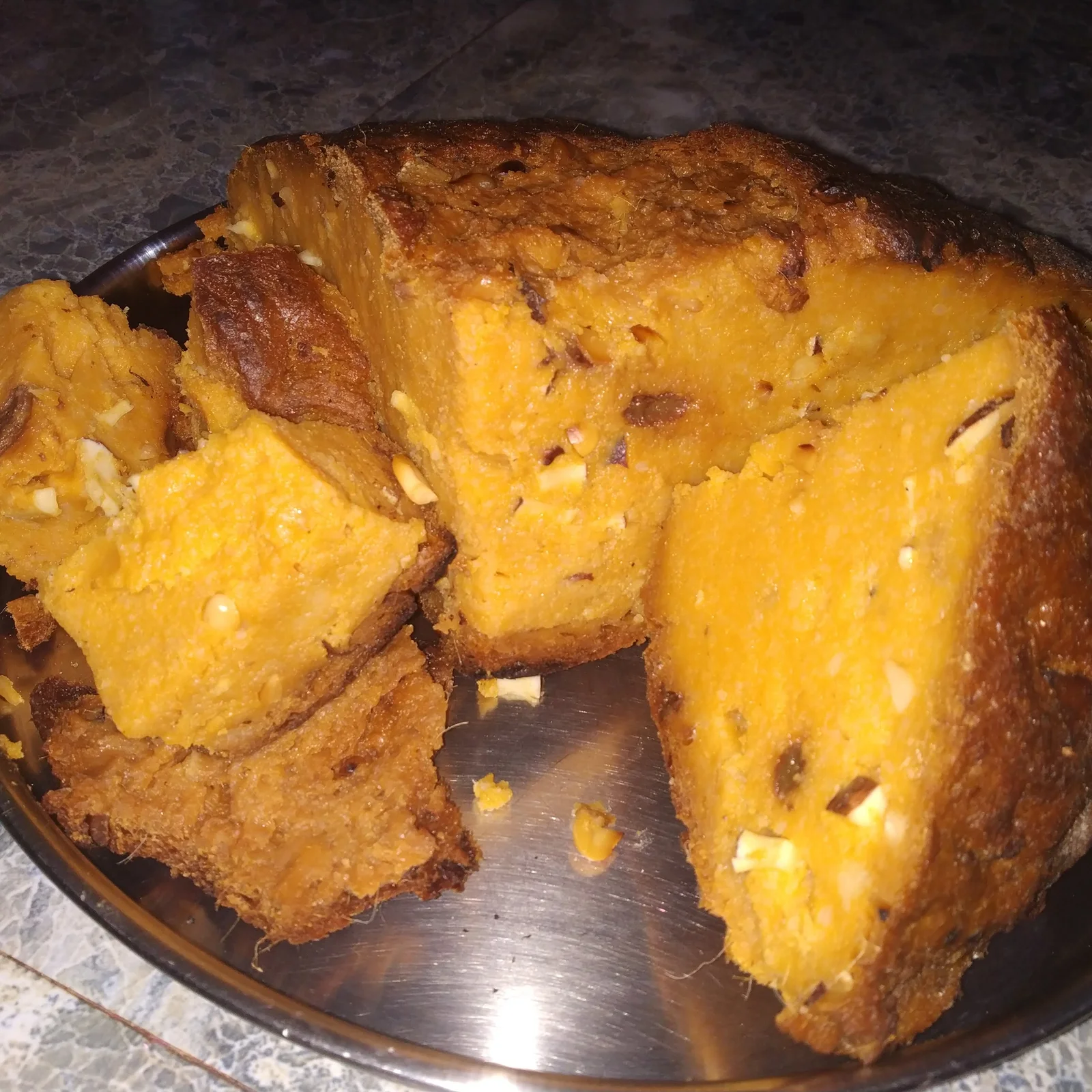
Tala poda pitha, 2019. The photographer identifies this as a palm-fruit preparation.
Sangram Keshari Senapati. Source · CC BY-SA 4.0.

Chhena and the sweet shop landscape
Chhena poda shifts the centre of attention from grain to fresh curd cheese. Odisha Tourism describes sweetened chhena baked with sal leaves in an earthen oven; its culinary trail associates the sweet with Nayagarh. The same trail connects chhena jhili with Nimapada and lists syrupy rasagola and layered khaja among Odisha’s sweets.26
These foods make a geography of taste. A place name can guide a journey or recall a purchase, but it should not erase differences between makers. The chhena poda shown here is a photographed presentation from Puri, with cut pieces and garnishes. Its appearance records one serving, not the only form in which the sweet is eaten.
Contemporary cooks add further versions. In 2021, Chef Michael published a chocolate chhenapoda recipe that mixes chocolate into the chhena before baking.7 It is explicitly an adaptation. Naming the change allows a reader to recognise both the established sweet and the cook’s experiment, without presenting a modern flavour as an old festival requirement.
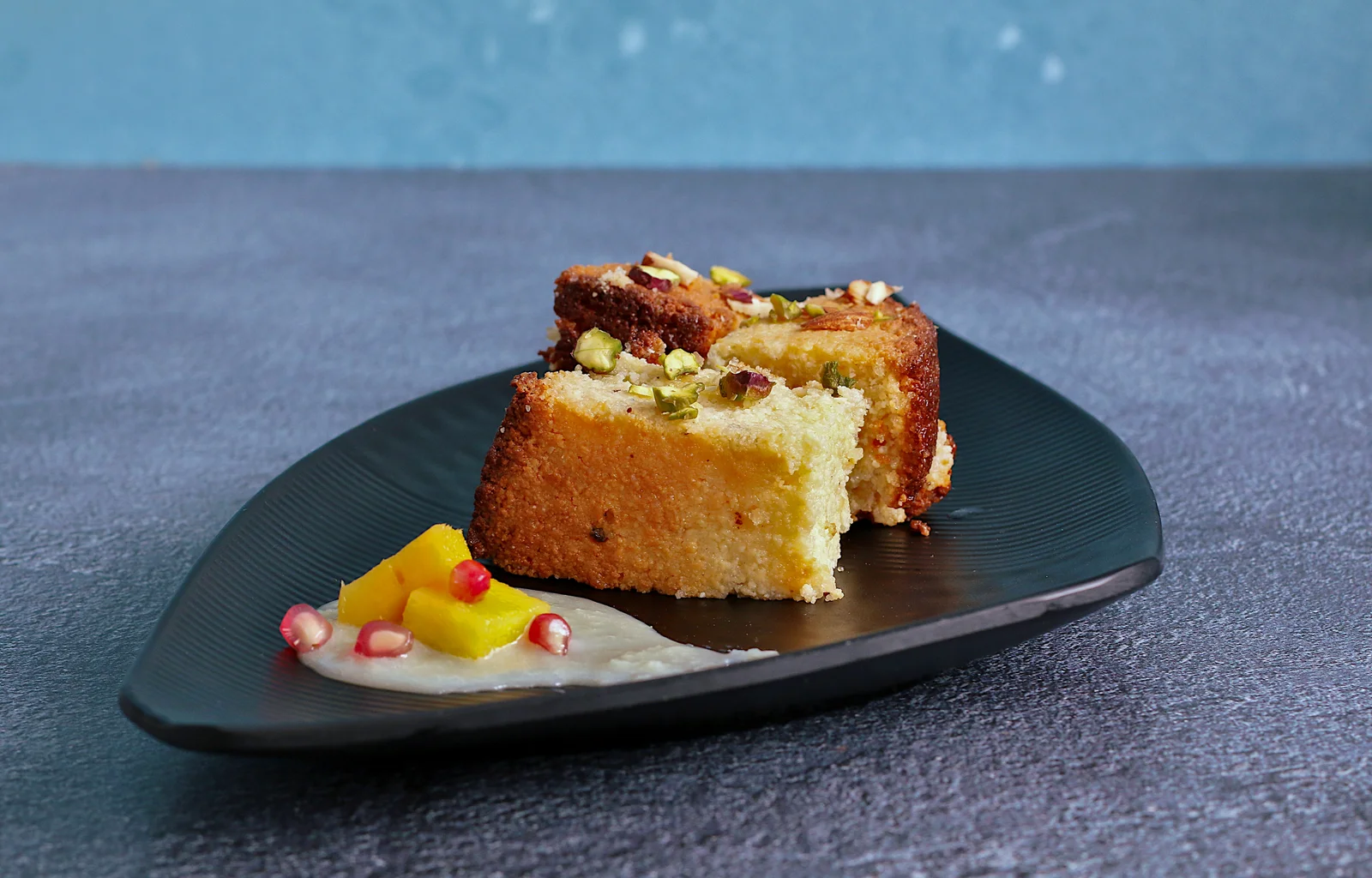
Chhena poda photographed in Puri, 2022. A plated presentation with garnishes.
Subhransuphotography. Source · CC BY-SA 4.0.

What travels between kitchens
Food can travel before it is fully made. The Oriyarasoi writer remembers a grandmother receiving extracted palm fruit from the family’s village in steel milk cans. The grandmother found the extraction physically difficult; someone elsewhere had already done that work. Years later, finding ripe palm fruit in a Bengaluru market brought the preparation back into reach.5
This is one family’s memory, but it opens a useful perspective on sharing. The thing passed on may be an ingredient, a prepared filling, a finished sweet or the knowledge needed to make it. A gift of food can carry labour as well as flavour. To describe it adequately, we should ask who prepared it, who sent it, and what the recipient knew to do next.
A festival kitchen also depends on practical choices. The ICAR collection’s enduri instructions allow either a steamer or a pot fitted with cloth over the water.1 Different equipment can serve the same cooking purpose. Keeping a preparation alive need not mean reproducing every vessel or fuel arrangement exactly; it does mean understanding which steps give the food its character.
Printed recipes preserve part of that knowledge. Photographs preserve another part: the fold of a leaf, the surface of a cake, the way a sweet has been cut. Neither can replace the cook’s judgment completely. A useful family record would include the maker’s name, the occasion, the ingredients actually used and the signs by which the maker knows the food is ready.
The festival kitchen is renewed through repetition with attention. Each batch offers another chance to learn how a filling should feel, how a leaf should close, or how a browned edge should taste. Pitha and sweets remain cultural knowledge because people continue to make, share and recognise them, while leaving room for the next cook’s circumstances.
Footnotes & Sources
- Lipi Das · Traditional Rice Foods. ICAR-Central Rice Research Institute, 2015. Printed pp. 19 and 24: enduri and manda methods. Specific documented recipes, not universal formulas. ↩
- Odisha Tourism · The Taste of Odisha. Pitha and Chennapoda sections; pan cooking, frying, sal-leaf cooking and fresh-cheese sweet preparation. ↩
- Jagannath Dash · Rice Culture in the Little Traditions of Odisha. South Asian Anthropologist 21(1), 2021, pp. 31–51. Tables 9–10, printed p. 47, on festival associations and regional preparations. ↩
- Sangram Keshari Senapati · Tala Poda Pitha. Photograph, 20 August 2019. Uploader identifies palm fruit and a rainy-season association. ↩
- Oriyarasoi · Talaa Pitha. 20 September 2016. First-person family memory and a fritter recipe. Used for preparation and remembered ingredient sharing. ↩
- Odisha Tourism · Cuisine and Culinary Trails. Sweet Trail section: Nayagarh and Nimapada associations, rasagola and khaja. No precise invention date inferred. ↩
- Chef Michael · Chhenapoda. 29 July 2021, Odisha Tourism. Named contemporary chocolate adaptation; origin anecdote not adopted as established history. ↩
All three photographs are reproduced full-frame, resized without content alteration, under CC BY-SA 4.0. Creator, source and licence links appear in each caption. Images document particular preparations and presentations. Sources checked 13 November 2026.
Suggest an update
Share a correction or source for this chapter. GitHub submissions are public. Please omit private contact details and consent documents.