
Part 3 · Languages, Literature and Oral Memory
Chapter 16 of 48
The Craft of the Poem
Sound comparison and the voices within a song
A poem gives us more than a subject to remember. A consonant returns; a comparison turns joy into something imaginable; a name enters a lyric just as we think we know who is speaking. These small decisions shape the experience of reading and listening.
This chapter brings together three ways into Odia poetic craft: the alphabetic and dramatic design of Champu, sound and comparison in Upendra Bhanja, and the poet’s signature within a song. Brief original phrases appear beside literal English glosses. The glosses explain a local meaning; they do not recreate the music of the verse.
The pictures invite a related kind of attention. Who listens, who persuades and what does a printed page preserve? Following these questions makes craft visible without turning the poem into a catalogue of technical terms.
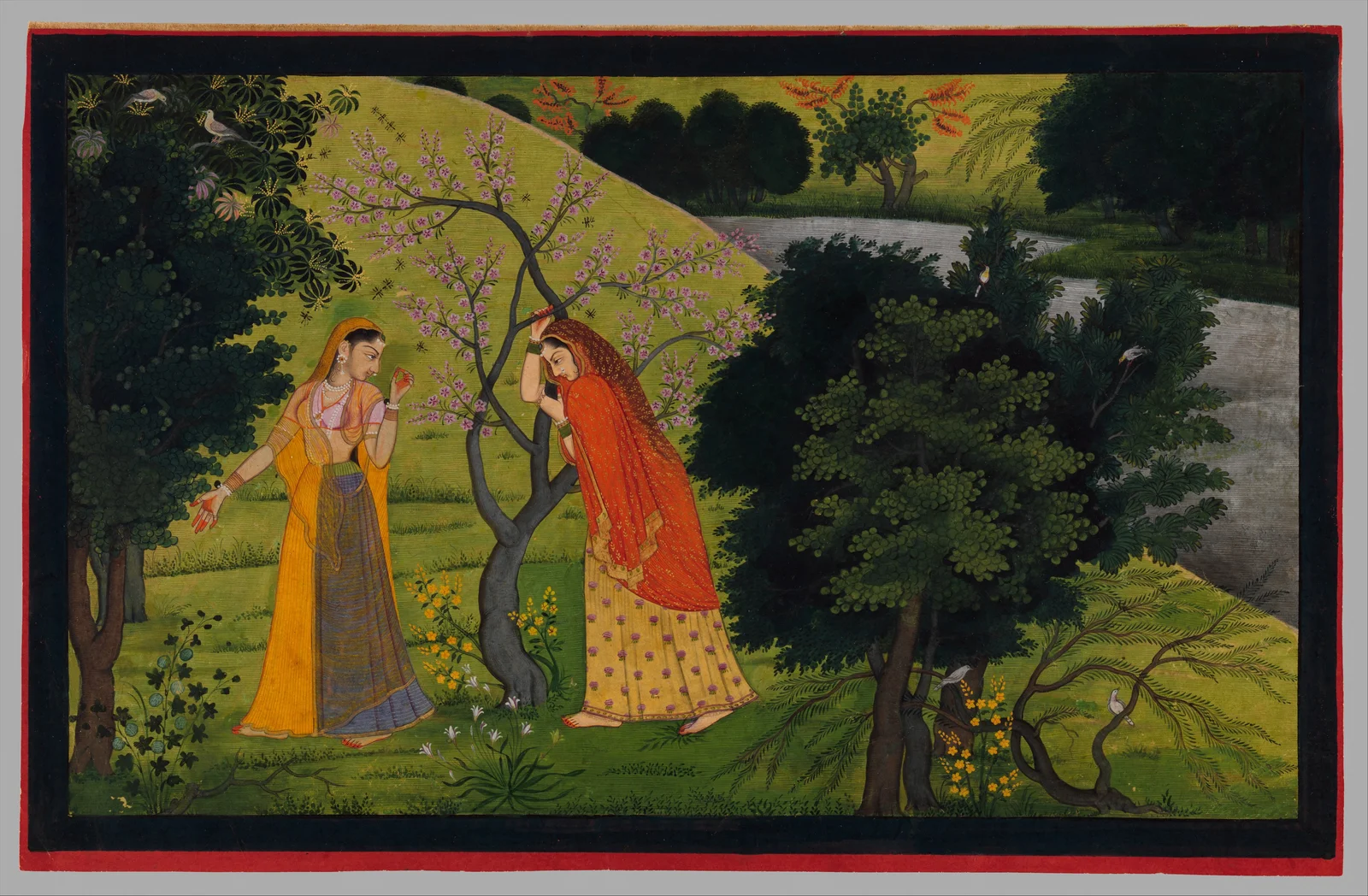
Radha with Her Confidant, Pining for Krishna, c. 1775–80. Gift of Steven Kossak, The Kronos Collections, 2020; 2020.383. This Pahari painting interprets the Gita Govinda, not Baladeva Rath’s Champu.
The Metropolitan Museum of Art. Source · Public domain.
The alphabet becomes a composition
Kavisurya Baladeva Rath’s Kishorachandrananda Champu joins literary design to a sung tradition. In his account of Odissi music, Kalicharan Pattanaik describes Sanskrit prose alongside verse governed by raga and tala, and songs organised through initial letters from ka to ksha. He also recalls arranging Champus for his stage in 1932. A composition and a later dramatic presentation are connected, but distinct.1
The alphabet supplies a constraint, not the entire experience. It cannot tell a singer where to place every emphasis or a listener how to understand every reply. The digital contents on Odia Wikisource offer a practical route into individual songs. Its editorial note also explains an exception to alphabetical sequence, placing sa before sha with the retroflex sound, in order to preserve the emotional progression. That explanation belongs to this edition and should be read as such.2
A confidante can change the direction of a scene by listening or persuading. The painting below makes that agency visible in a different work, Jayadeva’s Gita Govinda. The Cleveland Museum identifies Krishna twice: preparing leaves at the right and watching Radha from among the trees. Beside Radha, her sakhi urges a meeting. The image shows how several actions can occupy one painted space; a song must unfold them through time.3
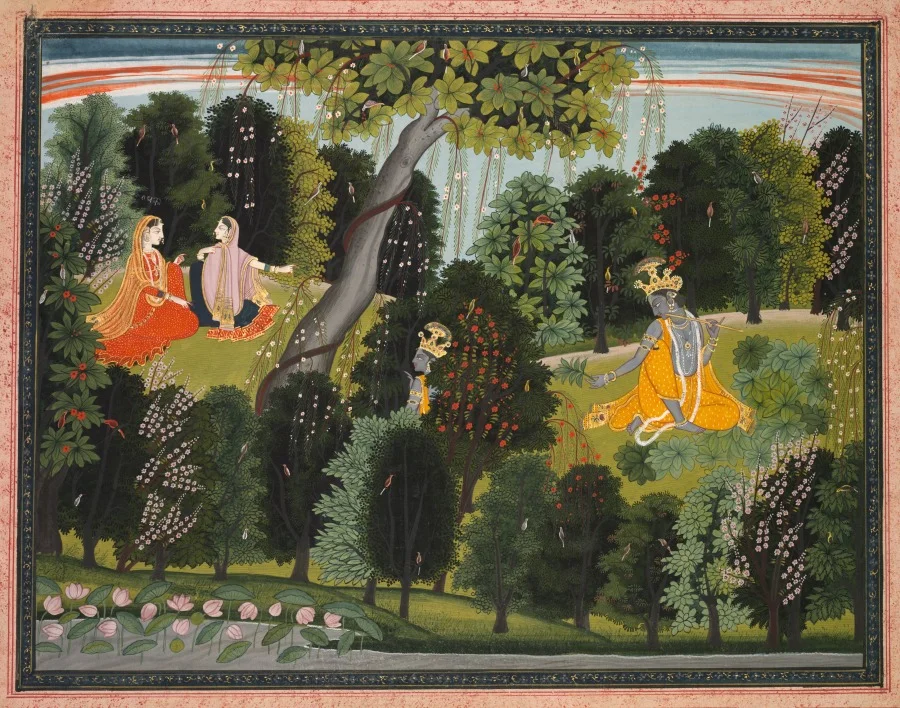
Sakhi persuades Radha to meet Krishna, c. 1820–25, attributed to Purkhu. Bequest of Mrs. Severance A. Millikin, 1989.334. A Gita Govinda illustration from northern India.
Hear the returning consonant
Begin with a small observation in the eighteenth chhanda of Upendra Bhanja’s Baidehisha Bilasa. In the consulted transcription, its first two lines open with the following words:4
ବନ୍ୟା · ବିଟପ
Both begin with the consonant conventionally named ba. The attached vowels differ, so these are not identical spoken syllables. The pattern is something the reader can see before the whole sentence is understood. Read the openings aloud, then return to the passage and notice how sound accompanies the developing scene.
A constraint can become a resource for invention. It asks a poet to find words that satisfy the pattern while carrying an action or feeling. Yet the discovery of repetition does not settle every technical classification. Bhandaram Vani’s introduction to Dandin’s Kavyadarsha distinguishes figures operating through sound from those working through sense; it treats yamaka as a more specific pattern of repeated sounds. A returning initial consonant should not automatically receive that label.5
A comparison makes feeling tangible
Later in the same chhanda, amid reunion involving Rama, Bharata and their assembled company, stanza 36 offers a compact comparison:4
ଦରିଦ୍ର ଧନ ଲଭିଲା ପରି
Literal gloss: “like a poor person finding wealth.”
The word pari means “like” in this phrase. It brings the happiness of reunion alongside an experience of gaining something deeply needed. The comparison supplies more than another word for joy: it gives the feeling a situation that a reader can imagine.
This is the usefulness of a term such as upama, or simile. It directs attention to what is compared and what likeness makes the comparison work. Naming the device is only a beginning. We still need the surrounding scene to understand its force, and the Odia words to hear how it is expressed.5
When the poem names its craft
Bhanja’s Subhadra Parinaya makes technical vocabulary part of its own speech. On printed page 2 of the 1939 fourth edition, the first chhanda’s stanzas 16–18 include terms such as shlesha, yamaka and anuprasa. The page is evidence that the poem names devices; explaining each one still requires a particular example.6
The facsimile also reminds us that a poem reaches us through an edition. The verse, explanatory notes, printing and later digitisation are separate layers of work. Preserve their distinctions when comparing a printed witness with an online transcription.
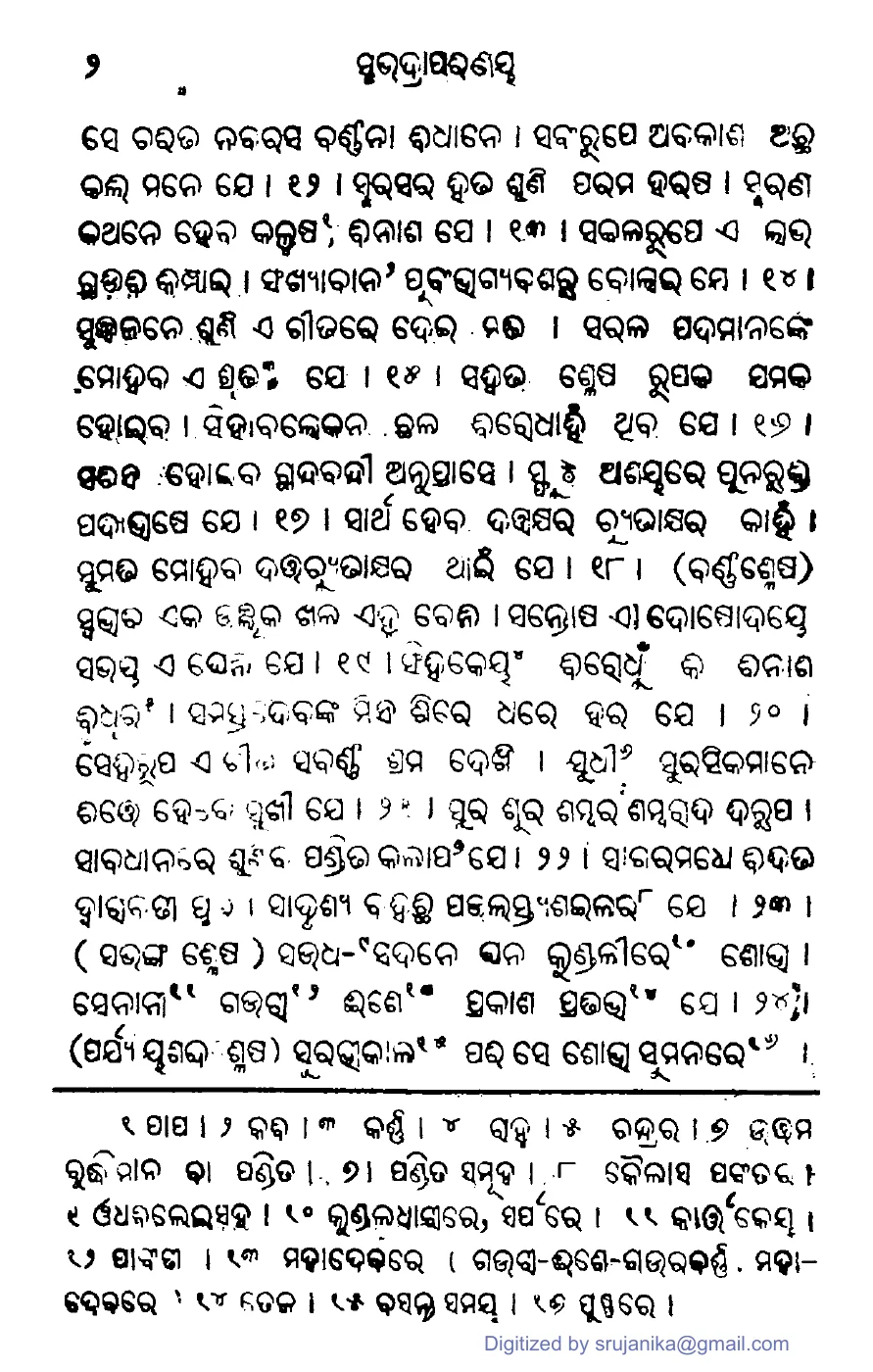
Subhadra Parinaya, fourth edition, 1939, printed p. 2 (PDF p. 7). Editor: Sheikh Nazir Muhammad, as catalogued by Odia Bibhaba. Scan bears the digitiser’s credit.
Odia Bibhaba scan. Source · Historical facsimile.
When the poet enters the song
A character speaks, a poet composes and a performer gives the words a voice. A name inside a lyric asks us to notice another relationship between these roles. In his study of Vidyapati, Ramanath Jha uses bhanita for a poet’s name in a song’s closing couplet. He also describes signatures being altered, added or omitted in that corpus. A signature is therefore useful evidence, but cannot alone settle authorship.7
An Odia example appears in Utkal Sangeet’s transcription of Ramani Ratana, attributed there to Bhanja’s Lavanyanidhi. A woman addresses a cloud concerning her absent beloved. The final stanza includes:8
ଭଣେ ଉପଇନ୍ଦ୍ର
Literal gloss: “Upendra says.”
The spelling follows this transcription. The phrase places the named poet within the verbal composition, rather than only in a heading above it. The woman’s longing and the poet’s named presence remain distinguishable. Neither should be confused with the biography of the singer who performs the lyric.
Listen again after finding the signature. Does its arrival frame what came before, or invite a change of emphasis? These are questions for an identified rendition. A printed transcription cannot establish that every singer uses the same wording, and a poet’s name cannot supply missing credits for music or performance.
Keep the words within reach
A useful reading begins with a short, located passage. Identify its speaker, notice a repeated sound, and ask what a comparison makes imaginable. Keep the original beside the gloss. An English explanation may clarify the sense while leaving the sound pattern behind.
Access itself has makers. The Centre for Internet and Society’s interview with Prateek Pattanaik documents his work bringing the Champu to Odia Wikisource. Such work allows a reader to locate and revisit a passage; it does not remove the need to compare editions.9
The craft of a poem becomes clearer through these returns. Read, listen and look again. A familiar line may disclose a new choice of sound, a different relation between speakers, or a detail that the first hearing passed over.
Footnotes & Sources
- Kalicharan Pattanaik, Odissi Music. Journal of the Music Academy Madras, XXIX (1958; published 1959), printed p. 87 (PDF p. 93). Historical account of Champu form and staging. ↩
- Kishorachandrananda Champu. Odia Wikisource, contents and editorial note. The sequence exception is attributed to this digital edition; no full manuscript collation is claimed. ↩
- Sakhi persuades Radha to meet Krishna. Cleveland Museum of Art, 1989.334. Object description supplies the reading of repeated figures and persuasion; image CC0. ↩
- Upendra Bhanja, Baidehisha Bilasa, eighteenth chhanda. Odia Wikisource transcription, stanzas 1 and 36. Original public-domain text; brief literal gloss by Project Odisha, not a full verse translation. ↩
- Bhandaram Vani, Kavyadarsha. INFLIBNET, Indian Literary Criticism and Theory. Teaching account of Dandin, especially the sections on figures of sense and sound. ↩
- Upendra Bhanja, Subhadra Parinaya, fourth edition, 1939. Odia Bibhaba catalogue record 580; editor Sheikh Nazir Muhammad. S. S. Book-Stall, Cuttack. Printed p. 2, first chhanda, stanzas 16–18, visually checked in the project’s retained scan. Facsimile reproduced for textual discussion; no license for modern editorial material is asserted. ↩
- Ramanath Jha, Vidyapati. Sahitya Akademi, first published 1972; 2017 reprint, printed p. 39 / PDF p. 41. Signature discussion checked in the existing project research. Its transmission evidence concerns Vidyapati, not proof of a disputed Bhanja attribution. ↩
- Ramani Ratana. Utkal Sangeet, posted 5 July 2015, updated 17 March 2016. Attribution table and stanzas 1 and 4; accessible transcription, not a critical edition. Original public-domain phrase with a literal Project Odisha gloss. ↩
- Interview with Prateek Pattanaik on digitising the Champu. Centre for Internet and Society, interview by Subhashish Panigrahi. Used for the digitisation contribution, not as certification of each reading. ↩
Museum images are credited and linked in their captions and retain their public-domain or CC0 status. They are reproduced full-frame and resized for the page. The 1939 printed page is a historical source facsimile, not a reconstructed manuscript; its printed and digitisation credits remain visible. The Odia quotations are brief passages from historical works; the English glosses are literal explanations prepared for this chapter. Source review: 10 November 2026, alongside the project’s retained research.
Suggest an update
Share a correction or source for this chapter. GitHub submissions are public. Please omit private contact details and consent documents.