
Part 3 · Languages, Literature and Oral Memory
Chapter 17 of 48
Dhaga, Dhamali, Riddles and Everyday Wit
The pictures and judgements carried by everyday speech
A lemon pressed too hard. An answer that volunteers more than anyone asked. A rice-pounder travelling all the way to heaven, only to resume its familiar work. A few words can call an entire scene into a conversation.
The expressions gathered under dhaga and dhamali offer an entry into this compact art. This chapter selects a few sayings from Project Odisha’s Words We Carry collection and follows their credited witnesses. It then turns to a published example of Kui riddling, keeping the language and source distinct. These are selected readings, not a survey of everything spoken across Odisha.1
The pleasure lies partly in recognition. We see the object, hear the mismatch or find the answer. But the occasion matters too: the same familiar saying may offer affectionate advice in one conversation and become a cutting rebuke in another.
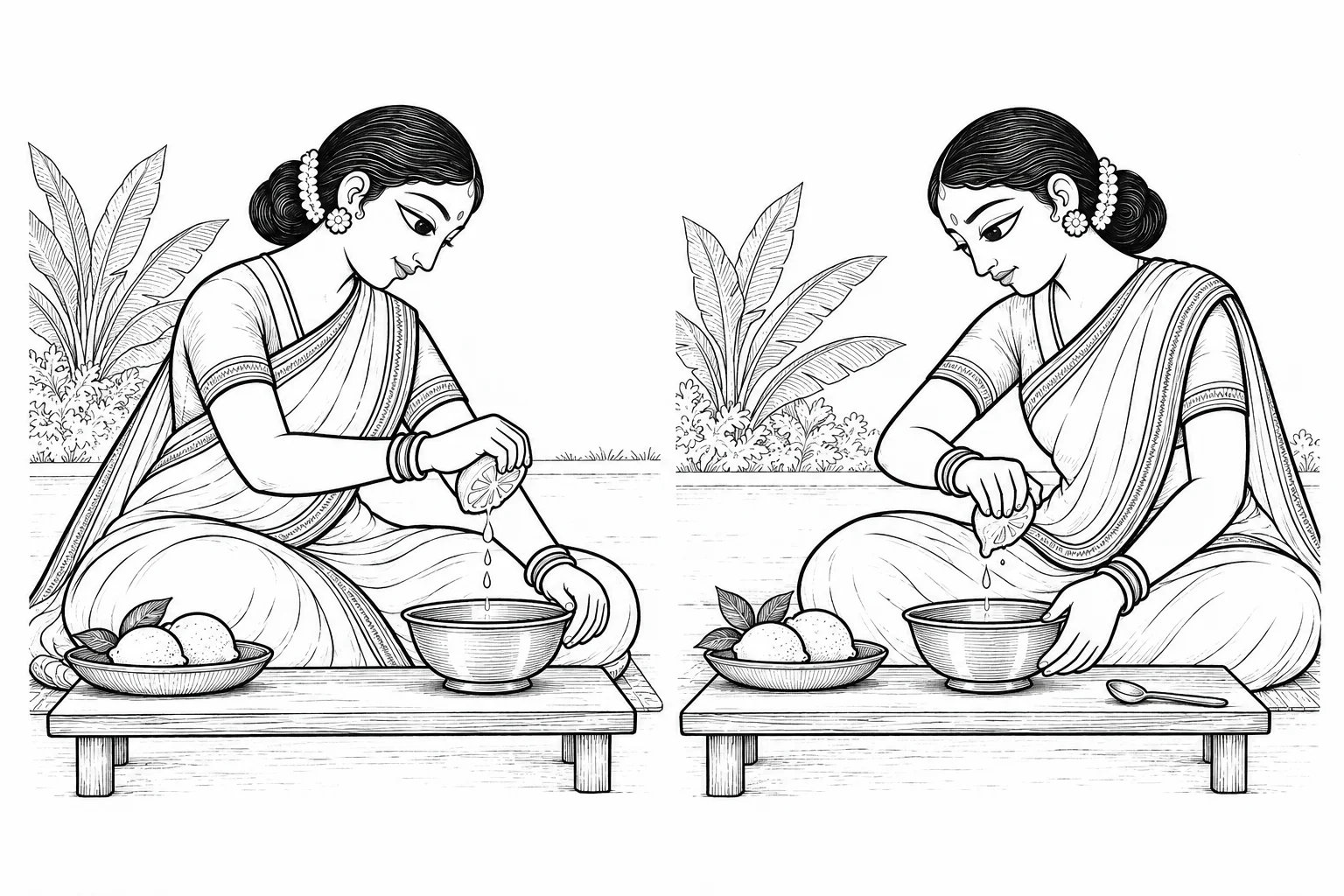
Two stages of squeezing a lemon, interpreted for Words We Carry.
Project Odisha. Source · CC BY-SA 4.0.
When too much turns bitter
ଅତି ଲେମ୍ବୁ ଚିପୁଡ଼ିଲେ ପିତା ।
Literal rendering: “If you squeeze a lemon too much, it turns bitter.”2
The action begins usefully and ends by undoing its benefit. That reversal makes proportion easy to imagine. In an invented example, someone has agreed to help with a small task, but the requests keep multiplying. The saying could remind the asker to stop before goodwill is exhausted.
The answer arrives before the accusation
ଠାକୁର ଘରେ କିଏ ରେ? ନାଁ ମୁଁ କଦଳୀ ଖାଇନାହିଁ
Literal rendering: “Who is in the shrine room? Well, I have not eaten the bananas.”3
The question asks who is there; the reply introduces an act that nobody mentioned. The listener completes the little drama. This is the comic force of excess information, rather than a reliable test of dishonesty. A nervous or defensive answer alone cannot establish guilt.
The saying’s scene is a verbal invention, not evidence of an actual incident or of a particular temple custom. In a new, imagined setting, someone asked who moved a notebook might immediately insist that they never read it. The surroundings change while the mismatch between question and answer remains.
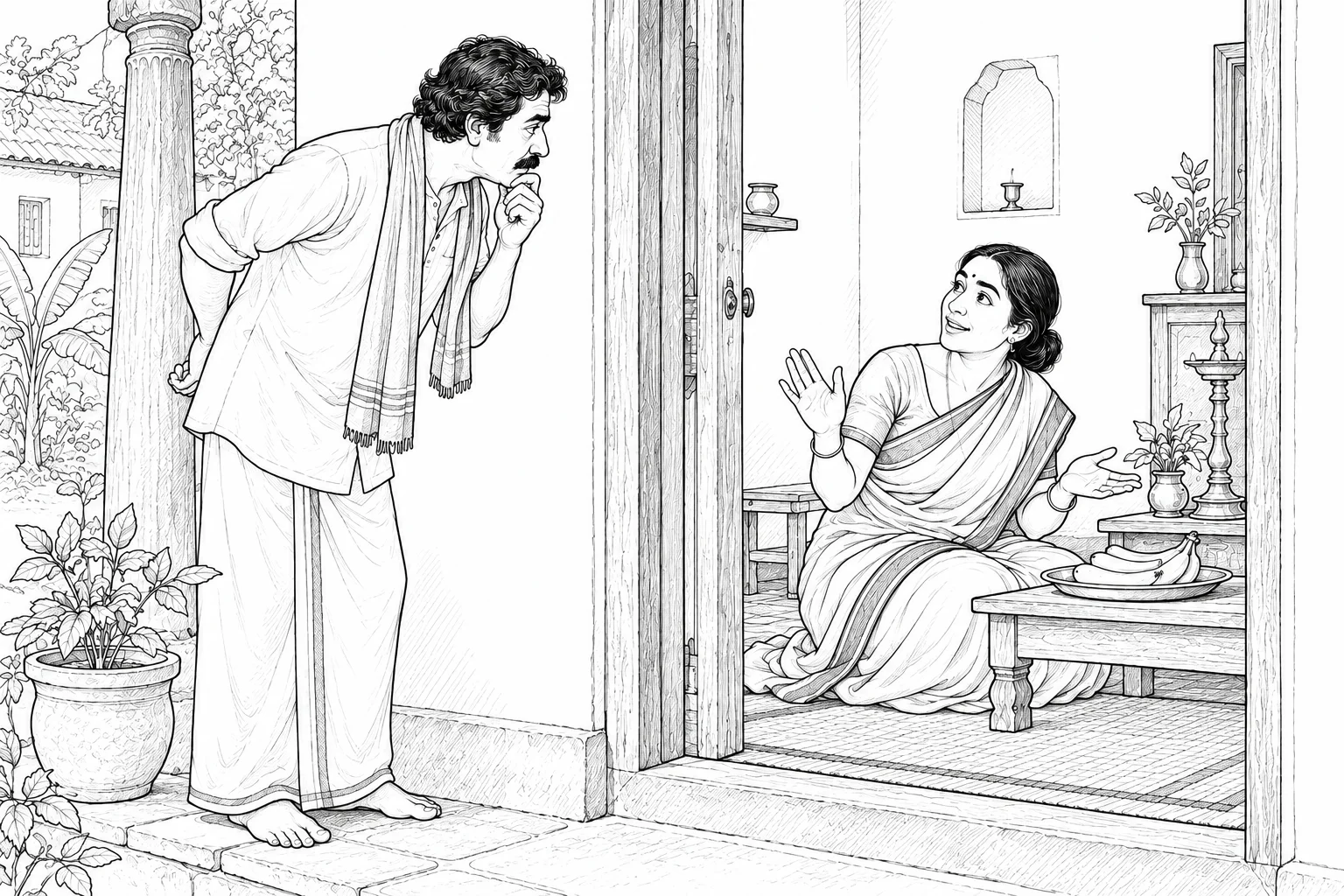
An imagined exchange at a shrine-room doorway. The genders and setting are the illustrator’s choices, not details established by the saying.
Project Odisha. Source · CC BY-SA 4.0.
The same work in a new place
ଢିଙ୍କି ସ୍ୱର୍ଗକୁ ଗଲେ ବି ଧାନ କୁଟିବ
Literal rendering: “Even if the dhinki goes to heaven, it will still pound paddy.”4
A dhinki is a traditional rice-pounding implement; paddy is rice still in its husk. The joke sends a workaday object to a magnificent destination while leaving its task unchanged. The contrast makes an established habit visible.
Imagine a holiday on which the family organiser is still arranging everybody’s timetable. A friend might recall the saying with a smile. That is an editorial example, not a collected conversation. The image can tease an unaltered habit without declaring that people cannot learn, change work or escape an inherited occupation.
A riddle asks us to look again
A proverb can illuminate a situation; a riddle asks the listener to discover something concealed in a description. Anuja Mohan Pradhan’s study of Kui riddles in Kandhamal and adjoining areas gives this example in Roman transcription:5
Badigara tani kradi Dosamane.
His English rendering is: “A tiger is sleeping inside the cave.”
Pause before reading the answer: the tongue, resting inside the mouth. The familiar body becomes a landscape, with the possibility of sudden movement. The wording and answer belong to Pradhan’s published account; this chapter does not present them as an Odia saying or as a newly collected performance.
Another example in the study describes a vessel departing hungry and returning satisfied: a water pot. Both descriptions ask the listener to move between an ordinary object and an unexpected likeness. Pradhan emphasises the roles of tone, gesture and exchange in riddling. On a printed page we receive the puzzle, while much of the encounter remains outside the record.
A saying already in print
A version of the lemon saying appears in Dhagamalika, first part, published in Cuttack in 1893. On the page reproduced below, it occurs in the sixth text line, after the first saying on that line. The page provides a dated witness; it cannot tell us who first spoke the expression.6
The title page identifies Gobinda Rath as publisher and Victoria Press as the press. Neither a catalogue heading nor the survival of a printed book should turn the publisher into the inventor of the sayings. The modern wording used earlier follows a separately credited digital witness. We retain that distinction rather than silently modernising the old page.
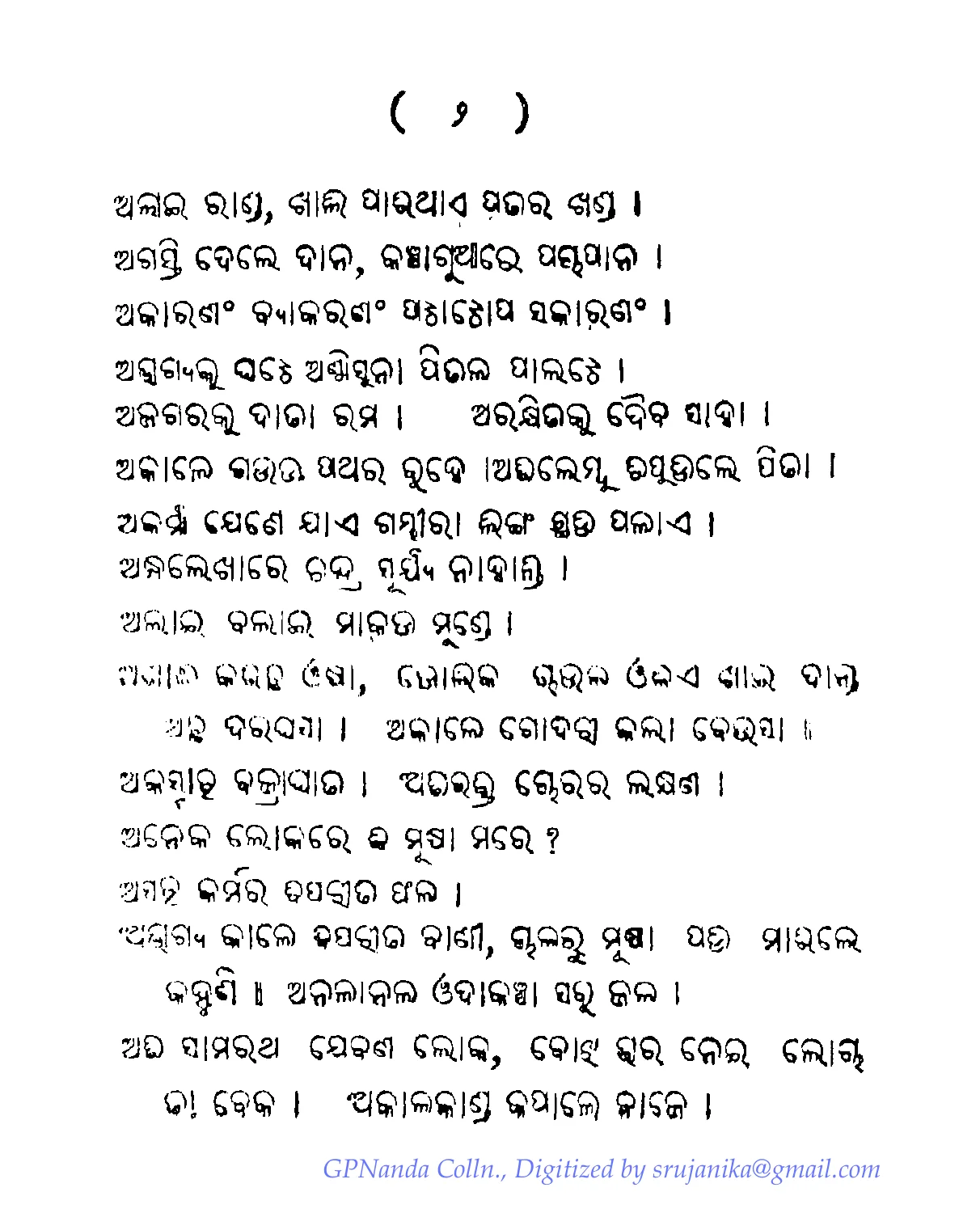
Dhagamalika, first part, 1893, printed p. 2 / PDF p. 3. The scan retains the G. P. Nanda collection and Srujanika digitisation credit.
Srujanika / Odia Bibhaba, via Internet Archive. Source · Historical facsimile.
What we inherit can be questioned
ନାହିଁ ମାମୁଁ ଠଉଁ କଣା ମାମୁ ଭଲ
Literal rendering: “A one-eyed maternal uncle is better than no maternal uncle.”7
The practical thought concerns accepting some help when the ideal is unavailable. Yet its bodily comparison treats disability as a deficiency in a person’s worth. Understanding an inherited expression does not oblige us to repeat that judgement. We can explain the historical wording and choose another way to express the useful thought.
This is part of reading with care. A proverb’s age does not make it fair in every situation. Nor should a witty line close a discussion simply because people recognise it. Ask who is being described, who is allowed to laugh, and whether the person addressed can answer back.
Keep the occasion with the words
The lemon image is not an instruction to abandon effort. Nor does it decide how much effort a situation needs. Its compactness leaves that judgement to the people speaking. The English rendering carries the picture; hearing the Odia gives access to the phrase’s own movement and sound.
A family notebook can hold more than a list. Record the exact expression, the person who shared it, the place and date, and the situation in which they would use it. If they remember a different wording, preserve that version beside the printed one. Ask permission before recording or publishing their voice.
An English gloss helps a reader enter the scene, but it cannot preserve every echo or social relationship. A performance note might record a pause before the punch line, a change in tone or an answering joke. Such details should come from an actual encounter, not from an editor’s imagination disguised as fieldwork.
The examples here invite that next encounter. Try a saying on your own conduct before directing it at someone else. Let a riddle remain unanswered long enough for another person to find a different possibility. Everyday wit stays alive when words can be remembered, questioned and used with attention to the people listening.
Footnotes & Sources
- Project Odisha, Words We Carry. Retained project records for entries 001, 043, 048 and 036 supply the selection and earlier explanations. Adapted here; no new oral field collection is claimed. ↩
- Wikimedia Incubator contributors, Bibidha Dhagadhamali. Lemon saying, unnumbered bullet. Displayed wording follows this credited witness. CC BY-SA 4.0; English rendering and interpretation by Project Odisha. ↩
- Odia Wiktionary contributors, na. Question-and-reply connective, sense 4: shrine-room and banana dialogue. CC BY-SA 4.0. Current page also consulted; no first origin established. ↩
- SCERT Odisha, Word Book, 2024. Printed/PDF p. 139, proverb pair 13. Wording retained from the project’s visual source inspection. Brief Odia quotation for commentary; textbook English pairing not reproduced and no open license asserted. ↩
- Anuja Mohan Pradhan, Riddles: An Informal Method of Tribal Education. Orissa Review, June 2008, pp. 70–73. Tongue example p. 71; water-pot example p. 72. Roman transcription and short English quotation follow Pradhan; second example paraphrased. Kui is kept distinct from Odia. ↩
- Dhagamalika, first part, 1893. Cuttack: Victoria Press; Gobinda Rath, publisher. Srujanika / Odia Bibhaba scan, printed p. 2 / PDF p. 3. A dated attestation, not proof of coinage. Historic spacing is not silently substituted for modern wording. ↩
- Odia Wiktionary contributors, mamu. Proverb item 2. Wording preserved in Project Odisha entry 036, including its spelling; CC BY-SA 4.0. Literal translation and critical discussion by Project Odisha. ↩
The two line drawings are existing Project Odisha illustrations, reused under CC BY-SA 4.0. They interpret sayings; they are not archival pictures or works attributed to traditional artists. The 1893 page is a historical facsimile with its digitisation credit preserved. All images retain their full frames and are resized for this chapter. The chapter’s adapted text and original English explanations are offered under CC BY-SA 4.0, with Wikimedia contributors credited above. This does not relicense the separately quoted SCERT or Pradhan material. Source review: 10 November 2026.
Suggest an update
Share a correction or source for this chapter. GitHub submissions are public. Please omit private contact details and consent documents.