
Odia cinemaFilms and Filmmakers
ଆଦିମ ବିଚାର (Aadim Vichar): whose understanding of justice?
In this article
A court, an older man and a story of community values connect Sabyasachi Mohapatra’s film with writing and theatre.
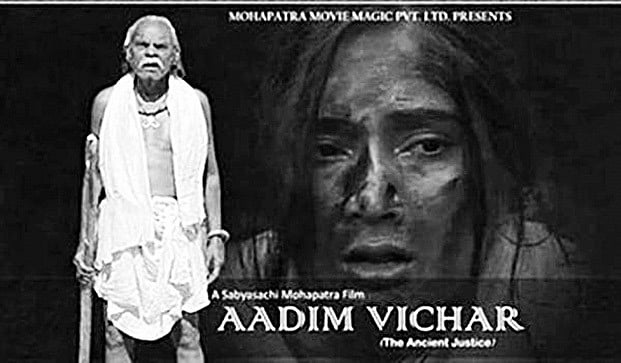
At an IFFI press conference in November 2014, Atal Bihari Panda spoke about acting as a search for truth through illusion. The official account introduced him as an octogenarian with nearly seven decades in theatre. Beside the film’s director, Sabyasachi Mohapatra, was a performer carrying a long life on the stage into the conversation about cinema.1
In a 2013 interview, Panda recalled theatre around trees, without a raised platform. Spectators preferred to sit in a circle rather than have a separate stage.2
ଆଦିମ ବିଚାର (Aadim Vichar) brings those forms of storytelling together. Its protagonist faces a court, but the film asks viewers to consider a question that extends beyond a verdict: whose understanding of justice is being heard?
An older man before the court
The official festival account describes a righteous tribal man implicated in a case, whose candid defence surprises the judge. Mohapatra presented the film as an argument for the value of traditional justice.1 This is the director’s artistic argument within a fictional story, rather than a description of all Kandha communities.
The character’s voice, and the authority listening to him, invite viewers into the question. How is a person heard when the language of an institution meets the values by which he has lived?
From a written story to a shared performance
The Indian Panorama catalogue credits Kapileswar Prasad Mohapatra with the story and Sabyasachi with screenplay and direction. Its cast includes Atal Bihari Panda, Tapaswini Guru and Sushree Smita Panda.3
Speaking to Ashok Palit about the planned sequel to Sala Budha, Sabyasachi identified its source as his father’s short story Adim Bichar.4
Panda recalled Kapileswar as his classmate, and Sabyasachi as a young man who had played a small part in his play Phata Mardala. Before Aadim Vichar, Sabyasachi asked him to help adapt his father’s stories for ଶଳାବୁଢ଼ା (Sala Budha), then invited him to play its lead. For Aadim Vichar, Panda remembered winter filming in Kandhamal and the research and practice he undertook for the demanding role.5
In a 2019 interview, Sabyasachi described his usual way of working with family collaborators: he would tell the story to his brothers, nephews and nieces, then hear their individual views. Debate could bring useful suggestions. He welcomed those contributions while keeping the final decision with himself.6
Selection and award
The film appeared in Indian Panorama at IFFI 2014. It subsequently received Best Odiya Film for 2014 at the 62nd National Film Awards, announced on 24 March 2015.37
Return from the award to the older performer at the press conference: Panda brought decades of theatre to the role. The court in the story gives that voice an authority to confront; the performance gives us a person to listen to.
Explore the film
The official Indian Panorama catalogue, printed page 31, provides the synopsis and credits. This is a film reference, not a viewing link. An authorised full-film player has not been verified for this page.
Footnotes & Sources
-
Press Information Bureau, IFFI press conference on Adim Vichar, 26 November 2014. Filmmaker testimony and synopsis. ↩ ↩2
-
Jonathan Rodrigues, Atal Bihari Panda on opportunity to get on the silver screen, The Times of India, 28 November 2013. ↩
-
Directorate of Film Festivals, Indian Panorama 2014 catalogue, printed p. 031, Adim Vichar entry. Indexed catalogue text. ↩ ↩2
-
Ashok Palit, Salabudha is a tribute to senior citizens: Sabyasachi Mohapatra, Odisha Diary; sequel question. ↩
-
Diana Sahu, Age is all About a Number, The New Indian Express, 28 November 2014; Panda’s recollection. ↩
-
ସବ୍ୟସାଚୀଙ୍କ ଆଦିମ ବିଚାର, The Nabaneeta, 18 May 2019, question 10. ↩
-
Press Information Bureau, 62nd National Film Awards results, 24 March 2015, Best Odiya Film. ↩
Credit: Aadim Vichar publicity image via The New Indian Express. Source ↩
Further reading
Suggest an update: share a credit, publication record or precise correction. GitHub submissions are public; omit private contact details and consent documents.