
Living culture · A listening journey
Sounds
of Odisha.
Listen as closely as you look. Follow a voice, a breath, a rhythm—and the people who give them meaning.
Begin with a voice ↓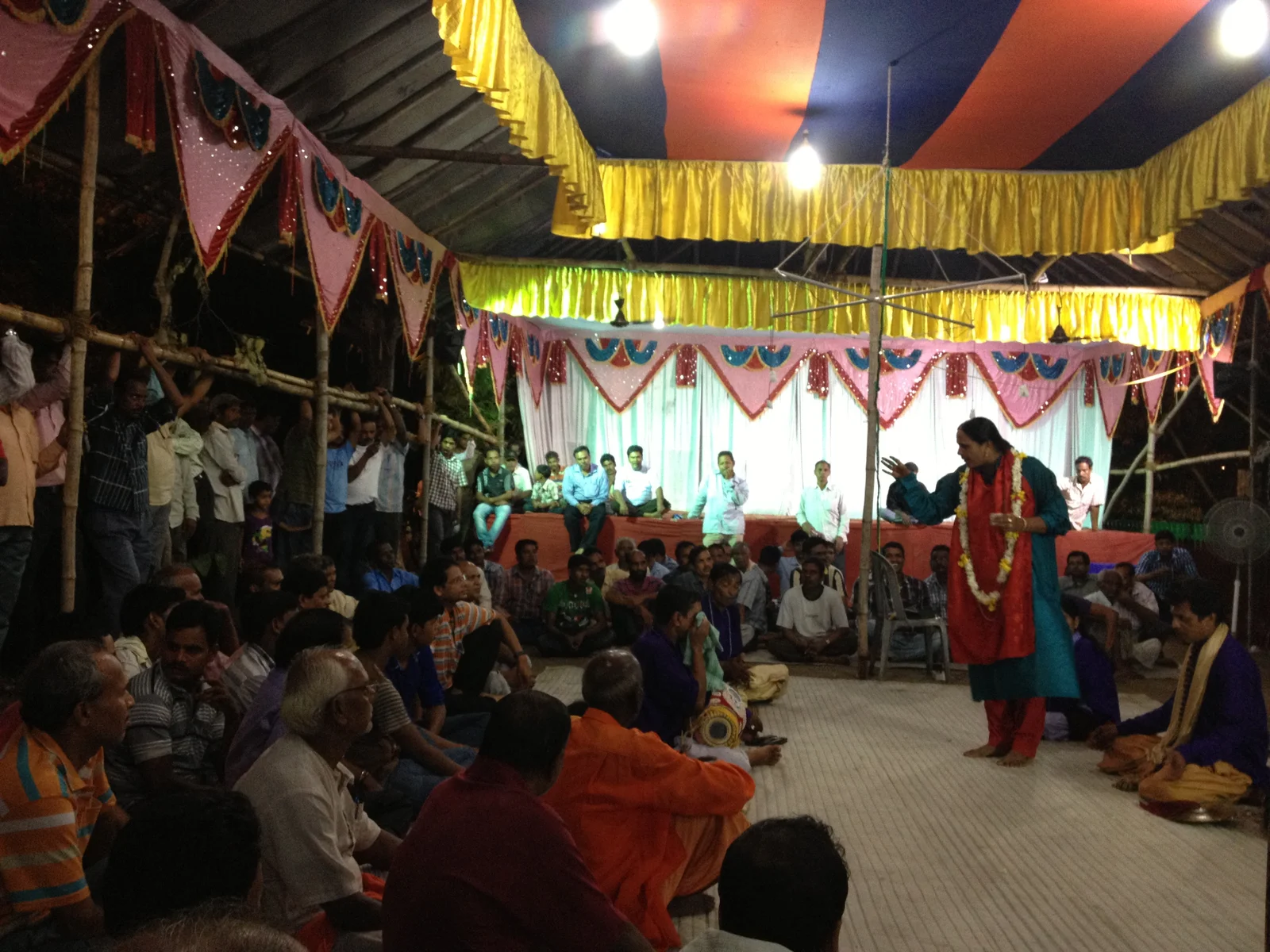
A sound belongs to an occasion, a place and the people making it. These eight introductions offer a way to begin listening. The opening invitations are imagined scenes; the named accounts are documented sources.
Take a listening notebook with you →
Huluhuli · ହୁଳହୁଳି
A voice at the threshold
Close your eyes and imagine a wedding threshold: a conch sounds, and above it rises a bright, rippling voice. This is an imagined invitation into huluhuli, the ululation documented in Odia settings of welcome and worship.
Edgar Thurston’s 1906 account records women making huluhuli during a Ganjam marriage. It shows the practice was documented then; it does not establish when it began. Devotional meaning and a proven historical origin are different questions.
Sankha · ଶଙ୍ଖ
A breath that carries
A single conch phrase and an ensemble performance invite different kinds of attention. The 2012 Republic Day programme’s Ganjam Thakurani Jatra description connects conch playing with movement and accompanying instruments.
Jodi Sankha and Sankha Badya also appear in AIR Cuttack’s artist roster. Those records describe a performance category and dated entries, not today’s complete artist population or an invitation to a ceremony.
Mardala
The conversation beneath the dance
Follow the musician as closely as the dancer. Mardala introduces a way to notice rhythm as skilled accompaniment: a phrase, a response, a relationship.
The Sangeet Natak Akademi’s 2003 citation for Banamali Maharana supplies a named learning history. A documented teacher’s life helps us meet a tradition through people; it does not give the instrument an invention date.
Dalkhai
A song belongs to an occasion
Dalkhai brings song, movement and festive life into the same story. Sambalpur’s culture account connects it with named communities and occasions, including Dussehra and Bhaijuntia.
A regional description is an introduction, not a fixed ensemble or a single explanation of every refrain. The place, singers and occasion belong beside the name.
Daskathia
Two voices, a story told aloud
Imagine following a story through a voice and its answering companion. The imagined scene leads into Daskathia’s documented pairing of narration with wooden rhythm.
Basista Kumar Behera’s 2012 account describes the lead Gayak or Gahana and the Palia’s responses. Its devotional explanation is cultural meaning; the origin theory in that article is not treated here as proven history.
Ghanta and ghanti
The hands behind the ringing
A metallic pulse can reach you before you see its player. Behind the player is another story: the hands that made the instrument.
A 2004 Odisha craft account distinguishes ghanta, a gong, from ghanti, a bell, in its product descriptions. Kalahandi’s culture table records Ghanta Vadya group playing around Bhawanipatna and Kesinga. These are scoped descriptions, not universal terminology or a current troupe census.
Pala
Poetry with people around it
A poem can be read alone. In Pala, ask what happens when literary reading meets performers and a gathering of listeners.
Jagannath Behera’s 2009 Akademi citation describes reading across five languages and bringing literary quotations into performance. Kalahandi’s local description names Gayak, Bayak and Palias; the lead voice is not the whole evening.
Dhemsa
A rhythm held in company
Imagine a line of dancers moving together. Before learning the pattern, notice the company. Then ask for the community, place, occasion and musicians’ names.
The District Council of Culture’s 2016 Koraput Odyssey connects Dhemsa with several named communities and linked group movement. SCSTRTI’s Gadaba profile adds community context. Neither source gives every performance one fixed form or tells us a particular song’s language.
Listen with care
A visit begins with an invitation.
Confirm that an occasion welcomes visitors. Follow the host’s directions and ask separately before photographing, recording or sharing. A ceremony or family gathering does not become a tourist performance because someone arrives with a camera.
This is a reading collection. Audio recordings are still to come; no current performance or booking is promised.
Further reading: Gotipua, beyond the acrobatic moment →
Further reading: Odia lullabies and the songs of childhood →
Further reading: Listening to craft through Kotpad →
Follow voices into Odia literature →Share a public source or suggest a correction. GitHub submissions are public; leave out private contact details and permission documents.
Sources, photograph & reading notes
A sourced introductory collection, prepared with AI assistance. Practitioner and community review remain open. No recordings, current event bookings or universal origin claims are presented. Desk review: 2026-10-12.
Huluhuli · ହୁଳହୁଳି
Sankha · ଶଙ୍ଖ
Mardala
Ghanta and ghanti
Photograph
Subhashish Panigrahi · Pala performance at Nalconagar, 2013. CC BY-SA 3.0. Resized and converted to WebP; derivative remains CC BY-SA 3.0. The performer is not identified here. No audio licence follows from this photograph’s licence.
