
Sounds of Odisha · ହୁଳହୁଳି
Huluhuli.
A voice of welcome.
A voice can turn an arrival into a welcome. Follow huluhuli into tradition, community memory and the questions its history leaves open.
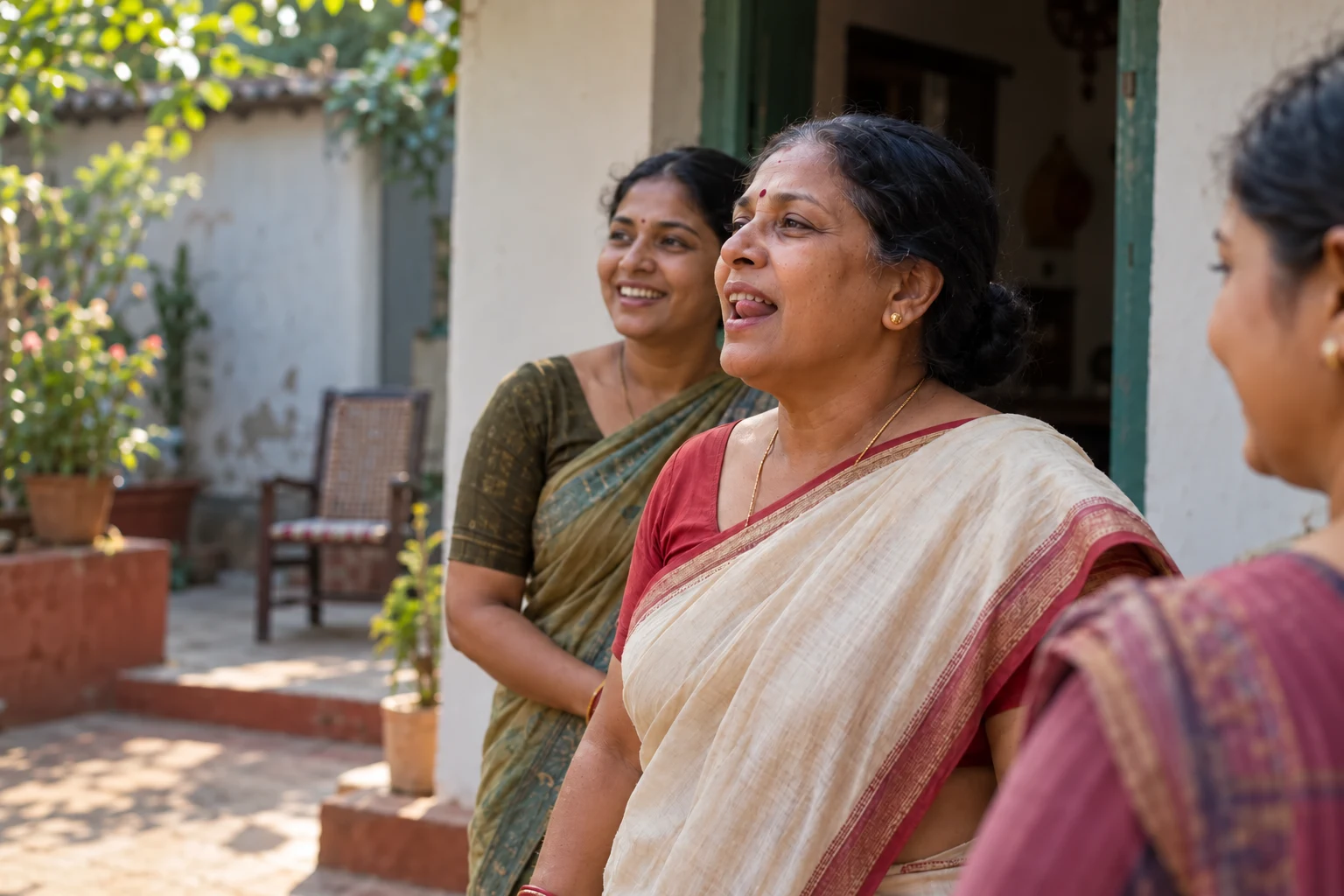
Close your eyes and imagine a wedding threshold. A conch sounds. Above it rises a bright, rippling voice, then another. The room seems to lift.
In Odisha, that sound has a name: huluhuli, also written hulahuli, ହୁଳହୁଳି. It is a form of ululation—a sustained vocal sound with a rapid trill, made through movements of the tongue. In the Odia settings documented here, women use it to welcome, celebrate and mark an auspicious moment. The voice itself becomes part of the ceremony. The trill comes from rapid tongue movement; simply opening the mouth does not create huluhuli.
Listen to Odisha as closely as you look at it.
The sound and its meaning
Calling huluhuli a “cry” catches its intensity but can miss its intention. Calling it a “song” can suggest words and melody that are not required. Ululation describes the broad kind of sound; huluhuli names it within an Odia cultural world.
The distinction matters. A sound can resemble another sound while carrying a different social meaning. In worship, huluhuli can be an offering of auspiciousness; at a wedding, a welcome. The conch, bells, spoken invocations and women's voices make different contributions to the same moment. Dina Krishna Joshi's account of Sabitri Brata describes hulahuli alongside haribol in religious gatherings and identifies it as an auspicious sound made by women during worship.
“Sacred” here describes devotional meaning. It does not imply that every performance is religious, or that the sound has a scientifically established power to purify a room, heal the body or change events.
An old tradition without a known birthday
Who first made huluhuli? The records examined for this article do not answer that question. No defensible single inventor, starting century or birthplace emerges from them.
There is, however, a clear historical foothold. In Edgar Thurston's 1906 Ethnographic Notes in Southern India, a passage on marriage among Badhoyis and other communities in Ganjam describes women of the bride's party making huluhuli when the groom reaches the house. Conch shells and recited verses accompany his arrival. The passage appears on printed pages 24–25.
That tells us the named practice was documented in a Ganjam marriage setting by 1906. It does not mean huluhuli began in 1906. Nor does one colonial account describe every community in Odisha. Its terminology and social classifications belong to the period in which it was written.
This is the difference between an origin and an attestation: an origin explains how something began; an attestation shows that it was already there.
Claims that the practice travelled into Odisha from a particular ancient civilization need a chain of evidence. Similar sounds, shared names and a map of present-day customs cannot supply that chain by themselves.
From the wedding threshold to worship
The Ganjam account gives us a particularly evocative setting: the moment of arrival. Read as a scene, huluhuli helps turn a person approaching a house into a guest being received by a family.
Household worship provides another setting. In the Sabitri tradition, the story of Savitri and Satyaban concerns devotion and the recovery of a husband's life from Yama. Joshi's account places hulahuli within the devotional gathering. The narrative is religious tradition; it is not an explanation of who invented the sound.
A contemporary Odia cultural essay by Srinibash Samal associates huluhuli with Manabasa worship in Margasira and with Khudurukuni observances. It offers a useful account of cultural meaning, but its sweeping statements about all households should not be read as a survey of Odisha. Its historical-origin claims need separate verification.
The most useful question at a real ceremony is therefore specific: What does huluhuli mean here, and why is it made at this moment? A family's answer may be richer than a universal explanation.
Odisha contains more than one sound tradition
Huluhuli is also named in a government description of Gadaba Dhemsa. The Ministry of Tribal Affairs' ADI KALAKAR entry for a 2022 dance festival says the dance begins with a chorus of hulahuli, alongside its description of women's group dancing and instrumental accompaniment.
This expands the picture beyond a single household or wedding tradition. It does not make Gadaba practice identical to coastal Odia worship, establish the performers' own preferred term in every village, or prove one practice descended from another.
A cultural account becomes more interesting when those differences remain visible. Who leads the sound? Is it an invocation, a signal to begin, an expression of joy, or several things at once? Which language do the performers use to explain it? Those are questions for the people carrying the tradition.
Women's voices and the work of celebration
Women are central to the records assembled here. Their contribution is audible and active: they help make an occasion auspicious rather than simply attend it.
That deserves recognition without turning a cultural skill into a test of womanhood or Odia identity. A person who cannot ululate has not failed to belong. Familiarity, willingness and opportunity vary, and the available material does not measure participation across ages, districts or communities.
Nor is the history entirely about spontaneous joy. In her 2005 account of the Ranpur Prajamandala movement, historian Binodini Das mentions Hulahuli Jagir, explaining it as land granted for performing hulahuli. The article places this institution within a discussion of obligations and oppressive practices under princely rule.
This is an attributed historical account, not a verified reconstruction of every grant or performer's life. It nevertheless asks us to look beyond the beautiful sound: who had to provide it, under whose authority, and on what terms?
A sound that travels with people
Odisha's cultural memory can travel without an instrument case. A voice goes wherever its speaker goes.
A Michigan chapter report in the Odia community magazine Utkarsa in 2013, credited to Swati Mishra, records sankha and hulahuli at a Ganesh Puja gathering. It is a small, concrete example of the practice continuing overseas.
Seen this way, huluhuli can be a portable piece of home. That is an interpretation of the reported event, not a claim that all diaspora families practice it or feel the same emotion.
Public cultural events also give the sound another stage. A 2015 OrissaPOST report describes a hulahuli competition at Ekamra Haat in Bhubaneswar. The report connects participation with assertions of Odia identity; it does not establish how widespread competitions are, or whether participation in everyday rituals is increasing or declining.
Odisha and a wider family of voices
India Video lists related regional names: uruli in Assam, kulavai in Tamil and kurava in Kerala. It is a useful comparative introduction, not an authoritative genealogy of the traditions.
Beyond India, the publisher's description of Remapping Sound Studies identifies Zulu ululation among its subjects and lists an “Ululation” chapter by Louise Meintjes. That places ululation within a wider field of cultural sound research.
Odisha's connection with that wider world is a question worth exploring. It is not evidence that traders carried huluhuli along a specific maritime route, or that a single ancient culture gave it to all the others. We can celebrate resemblance while continuing to investigate history.
How to listen when you visit
If you encounter huluhuli at an invited wedding, a public cultural performance or a permitted ritual, give it the attention you would give an unfamiliar language. Notice when it begins, which voices join, and what changes around it.
Ask a willing participant what the sound means in that setting. Let them choose whether to demonstrate it. Ask before recording, and follow the rules of the household, venue or shrine. A private ceremony is not automatically a visitor experience.
An audio archive should preserve the speaker's explanation alongside the sound: their preferred name for it, the occasion, locality, language and permission for reuse. A generic sound effect—or a synthetic voice—cannot stand in for a documented local performance.
Huluhuli reminds us that heritage is sometimes something a person does for a few seconds, with their own breath. To understand Odisha, we should make room for those seconds.
A sourced reader story. Practitioner/language review remains open; no audio recording or current performance booking is provided.
Explore Odia literature → · Meet Dhemsa →
Sources, artwork & reading notes
Desk-researched reader story; practitioner, language and specialist review remain open. No recording, current event or exact origin claimed. Desk review: 2026-10-12.
- Ethnographic Notes in Southern India
- Sabitri Brata by Dina Krishna Joshi, Odisha Review June 2013
- ADI KALAKAR National Tribal Dance Festival 2022 event description
- The Prajamandala Movement in Orissa: Ranpur in Retrospect, Binodini Das
- Utkarsa 2013 Michigan Chapter Report, Swati Mishra
- Sound of Kurava or Ululation, India Video
- Huluhuli: An Auspicious Sound Art Form of Odisha, Srinibash Samal
- Remapping Sound Studies, Duke University Press
- An assertion of Oriya identity, OrissaPOST
The 2022 festival description and 2015 competition account retain indexed-source limits. The personal cultural essay is attributed context; the publisher synopsis is comparative reading, not diffusion evidence. Origin and literary-edition research remain open.
Artwork
Original Project Odisha editorial artwork created and revised with AI assistance using Human Natural’s Documentary Natural approach. Revised after the Founder noted that the tongue creates the trill. Imagined people and setting, not a field photograph or verified demonstration; a still image cannot show rapid tongue movement. Mouth/jaw expression edited from original illustration; PNG converted to WebP, no crop.
Suggest a correction or a public source. GitHub submissions are public; omit private contact details and consent documents.