
Sounds of Odisha · Rhythm & dance
Mardala.
The conversation beneath the dance.
Listen beyond the dancer. Follow the musician, teacher and rhythm composer into the story of Mardala.
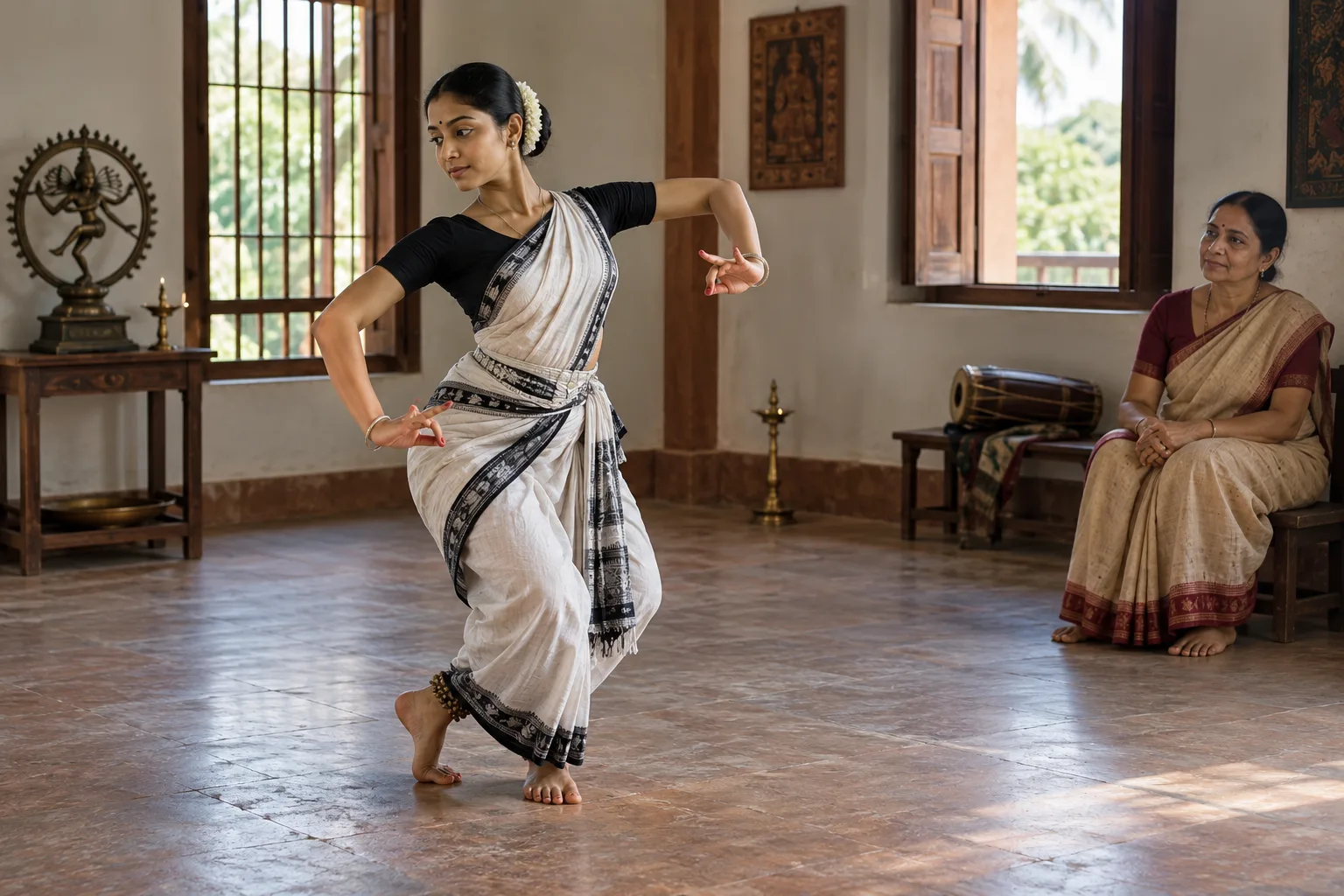
Imagine watching a dancer's hands while listening with your eyes closed for a moment. The gesture disappears. Rhythm remains. When you look again, ask a different question: who is making the movement's musical world possible?
This is an invitation to listen, not a report of a performance we attended. Mardala brings the musician into the foreground of our Odisha story. A drum can be seen as an object; a rhythm asks us to notice a player, a teacher and a creative decision.
A person behind the pulse
A useful doorway is Banamali Maharana. His Sangeet Natak Akademi award citation, headed Awards 2003, records his birth in Raghurajpur in 1941. It traces learning from khol and dholak to training in tabla and Mardala with Singhari Shyamsundar Kar and Kshetramohan Kar. Work with Kelucharan Mohapatra encouraged his systematization of Mardala playing in Odissi music and dance.
That is a story of learning across instruments and people. It does not supply a date when the instrument was invented. Nor does one celebrated musician stand in for every lineage. But it gives us something better than an unsupported claim of timelessness: a named route by which knowledge was taught, developed and passed on.
The citation also records teaching at Kala Vikash Kendra in Cuttack and Utkal Sangeet Mahavidyalaya in Bhubaneswar, retirement in 1999 and preparation of a seven-year course. These are historical details, not a current course advertisement.
Raghurajpur, Cuttack and Bhubaneswar therefore enter this story as documented points in a musician's life. A visitor can use them as starting points for questions about learning; this article does not promise a class, a visit to a teacher or an encounter with a family.
Give rhythm its own credit
Recognition has a precise calendar. The President of India's release names Dhaneswar Swain for Mardal drumming among the dance awardees for 2013, at a ceremony on 11 April 2014. Award year and presentation year are different.
For a newer creative example, Bijayini Satpathy's own ABHIPSAA — A Seeking page identifies the work as 2021. In Vibhanga, based on Lalgudi Jayaraman's Desh Thillana, it credits rhythm composition to Dhaneswar Swain and Satpathy, and Mardala to Shivshankar Satapathy and Budhanath Swain. For Virahi, drawing on Raghunath Panigrahi's composition of an Ashtapadi from Jayadeva's Gita Govinda, it credits Shivshankar Satapathy with rhythm composition, Mardala and manjira.
Here literature, composition, choreography and instrumental work meet through specific credits. We should preserve those names when we tell the story. The production includes another piece with a different percussion ensemble; these credits do not establish Mardala throughout the whole work.
Try a different way of listening
At an authorised performance or recording, give yourself three listening passes:
- Follow the drum. Notice where you hear space, repetition or change. Describe what you actually hear before naming a pattern.
- Follow the relationship. Attend to the movement or voice alongside the rhythm. Does your attention shift between them?
- Read the credits. Find the player and rhythm composer, then ask what part of the performance each helped shape.
These are observation prompts, not a technical explanation of tala or a claim that a particular recording was reviewed. A teacher can explain what a listener misses. Ask respectfully after the performance, when questions are welcome; obtain permission before recording an explanation or lesson.
Why this belongs in a journey
An itinerary can list a performance as one more stop. A story can make us want to stay long enough to listen properly. The pleasure lies in discovering another person inside something we thought we already understood: the rhythm has an author, the skill has a history, and the stage contains more than its most visible figure.
Before offering a bookable experience, we need a current programme, a willing host and confirmed access. Before placing audio here, we need recording rights and a player's context. For now, this is a reading path into living musical work, with those next steps open.
A sourced reader story. Practitioner/language review remains open; no audio recording or current performance booking is provided.
Explore Gotipua’s learning story →
Explore Odia literature → · Meet Huluhuli →
Sources, artwork & reading notes
Desk-researched reader story; practitioner, language and specialist review remain open. No recording, current event, course availability or exact origin claimed. Desk review: 2026-10-12.
- Banamali Maharana, Sangeet Natak Akademi Awards 2003, one-page citation
- President of India confers Sangeet Natak Akademi awards for 2013, 11 April 2014
- Bijayini Satpathy, ABHIPSAA choreography and production credits
The Banamali Maharana citation is historical. Award year 2013 and presentation date 11 April 2014 remain distinct. ABHIPSAA credits concern the named pieces, not every part of the production. No recording playback or current class access verified.
Artwork
Existing Project Odisha editorial artwork created with AI assistance using Human Natural’s Documentary Natural approach. An imagined rehearsal, not a field photograph, identified musician, documented production or Mardala technique demonstration. The scene provides dance context, not evidence for this article’s named artists. Existing1536×1024 WebP reused without alteration.
Suggest a correction or a public source. GitHub submissions are public; omit private contact details and consent documents.