
A Place to Learn Together — ଆସନ୍ତୁ ଏକାଠି ଶିଖିବା
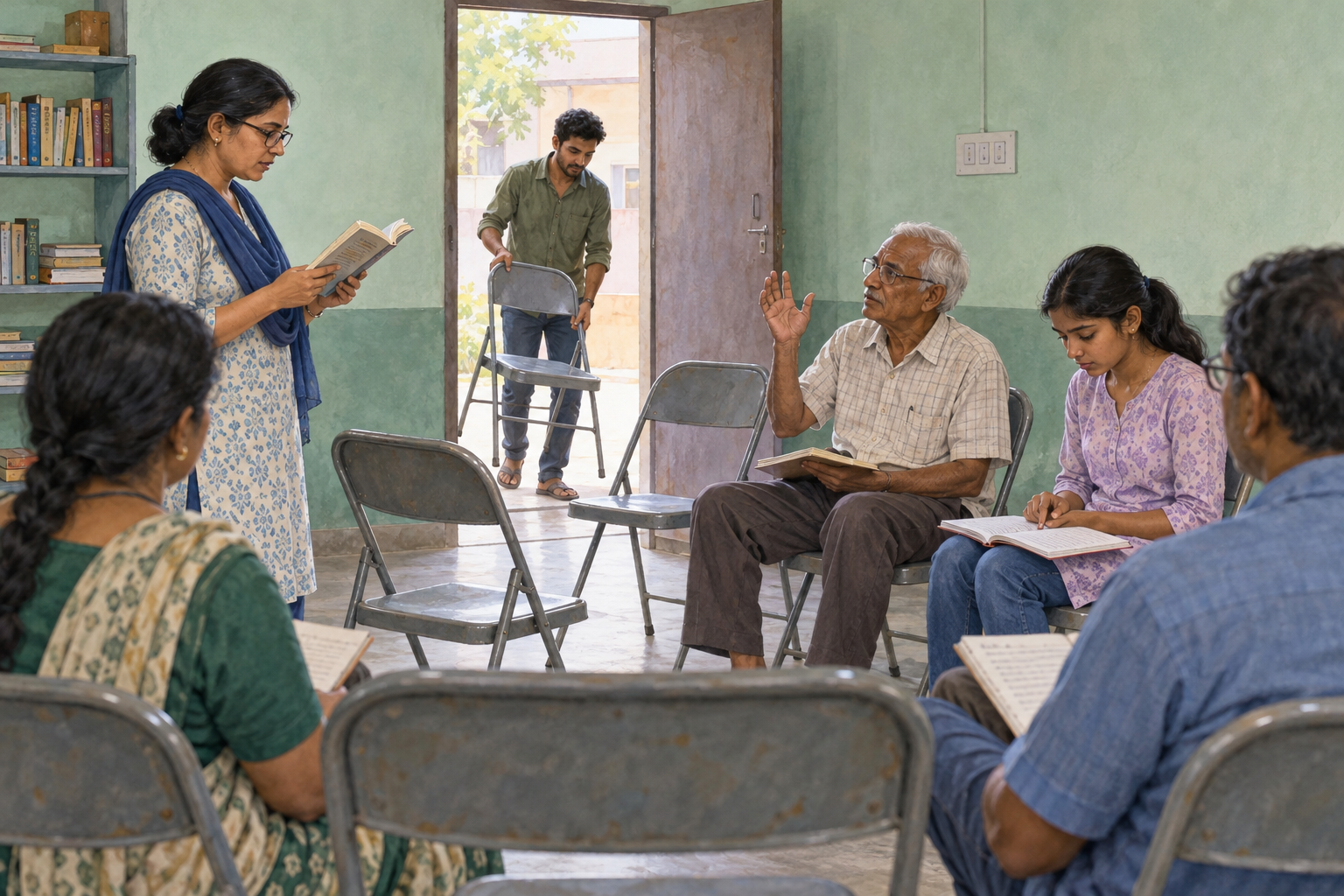
What the Bhagabata Tungi tradition can teach us about building community today.
Who opens the room? Who brings the book? Who makes a newcomer feel comfortable enough to ask a question? And who remembers to arrange the next meeting?
These are modest questions, but anyone who has helped organise a group knows how much depends on their answers. An idea becomes useful when people give it their time. A gathering becomes dependable when they return.
In Rise, Children of Utkal, I argued that we can begin with the knowledge, relationships and resources already within reach. Here I want to consider one possible beginning: a place where neighbours can learn together. Odisha’s Bhagabata Tungi tradition gives us a meaningful starting point for that conversation.
Atibadi Jagannath Das composed the Odia Bhagabata, around whose reading and recitation communities developed the Bhagabata Ghara or Tungi. Historian Kailash Chandra Dash places this development after the composition of the work and describes its role in religious and moral teaching.1
This is a story about a work and the people who sustained its use. Jagannath Das’s contribution and the continuing labour of communities belong together in the account. The evidence does not justify describing him as the personal founder of every Tungi.
The religious purpose matters. A Bhagabata Tungi is connected with a sacred text, devotion and the practices of its participants. Understanding that purpose allows us to appreciate its wider community significance without reducing it to a convenient modern label.
Literary scholarship helps us see that wider setting. In Modernity, Print and Sahitya, Sumanyu Satpathy discusses the Tungi through literary and ethnographic accounts. His examples include collective reading, community deliberation and shared support. He draws on Fakir Mohan Senapati’s fictional description of a village temple as well as other accounts.2
Fiction can show how an institution was imagined and represented. It cannot by itself tell us how every actual village operated. Even so, the association between reading and gathering offers a useful question for the present: what happens when knowledge has a regular place in community life?
One person may read confidently while another prefers to listen. Someone may recognise a word but need help understanding its use. A passage may prompt a memory, a disagreement or a question that continues after the reading ends. These are possibilities a shared learning space can make room for.
The tradition also deserves attention in the present. Deogarh district’s institutional account of its literary life includes Bhagabat Tungees among locally managed cultural organisations. That description gives us a regional connection, although it is not a current directory of active groups or evidence of any particular meeting schedule.3
We should resist turning such references into a claim that every village had an identical institution, or that everyone participated on equal terms. The sources consulted here do not settle how access varied by gender, caste, age or locality. A fuller local history would ask who read, who listened, who maintained the space and whose account has been preserved.
For me, the constructive response is to take that attention into the design of a gathering today.
Begin by listening to the people who might come.
A new learning circle could start with a few conversations. Ask neighbours what they would like to learn and what they could offer. Perhaps parents want a relaxed place for children to read Odia aloud. Perhaps young people want help presenting their work. An older resident may be willing to explain a local song, a craft process or the history of a familiar place.
Choose one purpose for the first month. An invitation that says what people will actually do is more useful than a promise to transform the whole neighbourhood.
If an existing Tungi wishes to host an additional activity, its custodians and participants should shape that decision. A community room, library or another agreed space may be more suitable for a separate secular programme. The connection proposed here is one of learning from a tradition; it does not require changing the purpose of an existing institution or borrowing its name.
Make a small promise and organise around it.
Try four meetings of about an hour, at a time participants can manage. Agree on a modest budget and divide the work: preparing the reading, opening the venue, welcoming people and arranging the next session. Make these commitments visible so the same person does not quietly become responsible for everything.
A first meeting could use one short Odia passage. A willing reader introduces it, the group explores a few unfamiliar words, and participants discuss one idea it raises. Someone who is learning to read should be able to listen or practise without embarrassment.
The next meeting might connect the reading to a practical activity. An elder and a younger participant could prepare a note about a local expression. A practitioner could demonstrate a skill and explain the work behind it. Ask contributors how they wish to be credited and agree beforehand whether their preparation is voluntary or paid.
These are suggested activities, not a reconstruction of a historical Tungi programme.
Let participation shape the group.
An invitation to everyone needs practical choices behind it. Ask whether the timing works for people with jobs or care responsibilities. Provide seating that older participants can use comfortably. Let newcomers participate without buying materials or speaking publicly on their first visit.
Give people who attend a say in what happens next. If the group promises Odia reading but participants also speak another language at home, welcome explanations and comparisons. Odisha’s cultural life contains many voices; learning one language need not make another a source of embarrassment.
Religious participation should remain voluntary. Children’s participation and any recordings should be arranged with appropriate permission. A person who shares a family memory should be able to choose whether it stays within the room or is recorded for others.
The most useful record may be a short note: what we read, who contributed, what we learned and what we will try next. Keep questions beside the answers. “This is how our family remembers it” preserves a different kind of knowledge from a dated document, and both deserve an honest description.
Pay attention to the second meeting—and the fourth.
An opening event can attract interest. A dependable group needs to understand what makes people return. After four meetings, ask participants what helped them, what made attendance difficult and whether the work is manageable for the organisers.
Look for specific results. Can someone now read a passage they previously avoided? Has a local teacher found willing learners? Did participants finish the note or recording they agreed to make? These questions are more useful than assuming that attendance alone demonstrates lasting change.
The group might continue monthly, narrow its purpose or pause. A modest trial can still leave a useful reading list, a clearer understanding of local needs or a relationship that leads to something else.
This is where I see a contemporary parallel with social entrepreneurship: recognising a shared need and organising a dependable response. It is an interpretation, not a historical classification of every Tungi. Nor does every voluntary learning group need to become a business or a formal organisation.
What it does need is care that survives the first burst of enthusiasm.
We can honour Jagannath Das by reading his work and understanding its place in people’s lives. We can also recognise the less visible contribution of those who kept a text, prepared a gathering and made time to listen. Their work invites us to consider what we are willing to sustain.
For a new learning circle, the beginning can be quite ordinary: a suitable room, a few willing people, something worth learning and a date everyone has agreed to keep.
ଆସନ୍ତୁ ଏକାଠି ଶିଖିବା—let us learn together. Then decide, together, when to meet again.
Footnotes & Sources
-
Kailash Chandra Dash, “A Discourse on Odia Cultural Space”, 2020, “Bhagavata Ghara” section. Historical synthesis, inspected as web text. Its regional observations are not used here as current counts or universal claims about access. ↩
-
Sumanyu Satpathy, Modernity, Print and Sahitya: The Making of a New Literary Culture, 1866–1919, Routledge, introduction, printed p.12. The relevant publisher-preview passage was available in indexed text; its page image and underlying cited editions were not inspected. A separate shorter preview supplies a 2024 imprint but ends before this passage. This article uses a brief attributed account, not a claim of firsthand village observation or full-book review. ↩
-
Deogarh district, Government of Odisha, “Literature”, paragraph on locally managed literary and cultural organisations. Indexed institutional text inspected on 23 October 2026; direct retrieval returned 502. Publication date, current group schedules and individual operating status remain unverified. ↩
Continue reading
These three essays move from carrying culture into everyday life, to taking initiative, to creating a place where people can learn together.
Further reading
Suggest an update. GitHub submissions are public; omit private contact details and consent documents.