
Odisha · Language and living heritage
Odia Cultural Identity and Pride
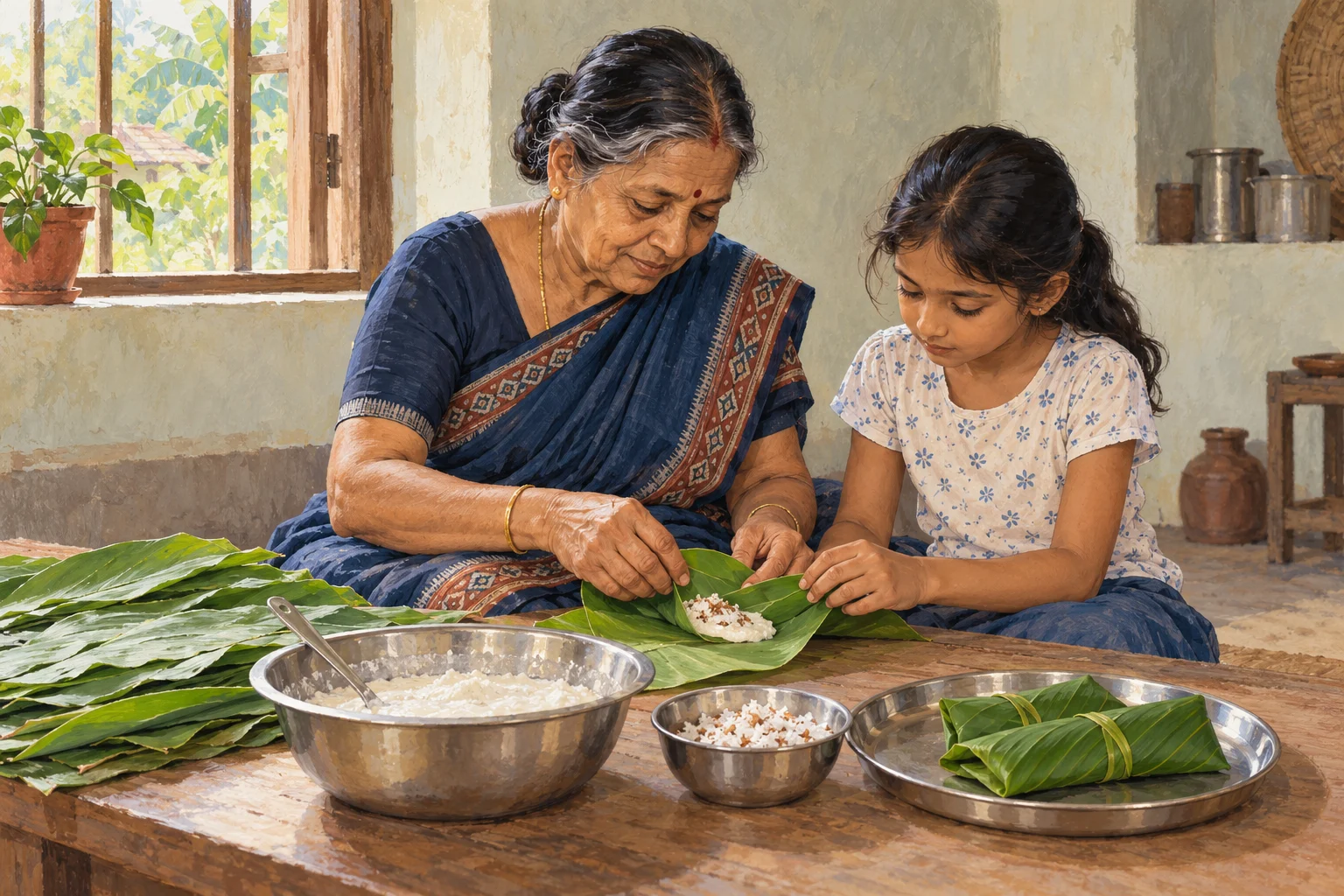
A child learns the name of a pitha while helping to make it. A family writes its festival invitation in Odia. Someone wearing a handloom saree can name the weaving centre and explain how its pattern was made. A neighbourhood gathering gives a local singer enough time to teach a song.
These are small, possible acts. Together, they offer a practical answer to a large question: how do we carry Odia cultural identity into the next generation?
Pride grows through familiarity. We need names we can use, stories we understand, skills we can practise and people whose work we recognise. Odisha offers many starting points. The task is to bring them into everyday life with enough care that someone else can learn them too.
Begin with the words we use
An Odia name gives a conversation a place to begin. On an Odia invitation, ପୂଜା — puja deserves its ordinary, confident place. ଦୁର୍ଗାପୂଜା — Durga Puja and ଦଶହରା — Dasahara carry the local language into the autumn celebration. Sambalpur district’s Odia cultural account uses ଦଶହରା in its Dalkhai section and ଦୁର୍ଗାପୂଜା in its description of Bhaijiuntia.1
The invitation can make room for guests who read another language: put the Odia name first, then add a clear explanation. A parent can do the same at home. Say the name of an object or dish, explain what it means, and use it again tomorrow. A correction becomes useful when it gives someone a word they feel comfortable saying.
There is a substantial resource behind this work. G. C. Praharaj’s Purnnachandra Odia Bhashakosha, published in Cuttack between 1931 and 1940, is available through the Digital South Asia Library. It offers a historical starting point for investigating words; contemporary meaning and regional usage also deserve attention.2
A family word notebook could begin with ten entries: a form of address, a kitchen object, a food, a greeting, a proverb and the names of several local observances. Record who uses each expression and where. Ask an older relative to explain it, and let a younger person write or record the answer with permission. The useful outcome is a word returning to conversation.
UNESCO describes songs, stories, riddles and rhymes as settings in which languages live, linking language with the transmission of oral traditions.3 For a family notebook, keep the expression with a short example of when someone would say it. With permission, add a recording of the speaker, their chosen credit and locality. A child can then learn the expression in a story or conversation, and use it again with the person who shared it.
Let a wedding tell the family’s story
A wedding invitation can preserve useful knowledge: what the family calls an observance, what happens during it and why it matters. That knowledge becomes harder to pass on when every ceremony receives a generic event label. The practical mistakes to avoid are misnaming a rite, presenting an added event as a universal ancestral custom, and letting a ready-made programme replace the family’s own explanations.
Nirbandha deserves an explanation beyond “ring ceremony.” A 2016 MyCityLinks feature identifies Nirbandha as an engagement observance. That description does not make every ring-exchange event identical to Nirbandha. Ask the family how it observes and names the occasion before writing the invitation. The same feature records Cuttack parent Smita Choudhury describing requests for added sangeet, mehendi and bachelor-party functions, which she attributed to peers and media. Her account gives us one family’s experience, rather than a measure of change across Odisha.4
Mangana also needs its own context. In a December 2023 New Indian Express report, trade representative Brij Mohan Agarwal contrasted mangana, the wedding and reception with programmes containing separately staged haldi, mehndi and sangeet events. This does not establish that a commercial “haldi” package and a family’s Mangana are exact synonyms, or that turmeric use is foreign to Odisha. In the same report, Swadesh Patra described modern additions coexisting with Odia rites. Families can make choices while keeping the distinctions intelligible.5
Cinema helps explain why some wedding styles become familiar. In the abstract of her 2009 study, Jyotsna Kapur connects lavish wedding culture with Bollywood, economic liberalisation and the professional wedding industry. It offers a wider interpretive context; it does not demonstrate that media caused the disappearance of particular Odia names.6
A useful programme can therefore begin with the family rather than the template. Write the name in Odia script after checking its spelling with a knowledgeable speaker; add a transliteration and one sentence explaining this household’s practice. If an event is a new addition, describe it plainly as something the couple has chosen. A caption should identify the occasion actually pictured, rather than assign a ritual name from its decoration alone.
Make time for family songs and the people who remember them. Ask which songs belong to the occasion, invite willing relatives or practitioners to explain them, and seek permission before recording. Leave room for regional, community and household differences, including families that do not observe a particular rite. A wedding can welcome new pleasures and still give the next generation names, meanings and memories they can carry home.
Give the festival its full name and meaning
Accuracy makes cultural pride more interesting. Navaratri and Vijaya Dashami refer to different parts of the calendar. Navaratri names nine nights; Vijaya Dashami names the tenth day. Akashvani’s account of Odisha’s autumn celebrations distinguishes Navaratri from the sequence of Maha Saptami, Maha Ashtami and Maha Navami culminating in Vijaya Dashami. Replacing one term with the other would lose that distinction.7
When describing an event, name what is actually being observed: Durga Puja, Dasahara, Vijaya Dashami or a particular local rite. Then explain the day, the place and the practice. This gives a child or visitor something more lasting than a general festival label.
The local map matters too. Cuttack’s district cultural account names Maa Katak Chandi and Gada Chandi in its discussion of Durga worship. Sambalpur’s district account identifies Samaleswari as its presiding deity. These names open different histories of place and devotion; they deserve introductions of their own.89
In western Odisha, Bhaijiuntia provides another specific connection: Sambalpur’s account places it on Mahastami and describes the observance undertaken by girls and women for their brothers. A festival guide that names this practice helps readers recognise the region’s own calendar and family traditions.10
For a community programme, invite someone who knows the local observance to explain one part of it. Keep sacred participation voluntary, respect the community’s arrangements, and make space for people who want to learn through history, music or craft. Knowing a tradition can be a shared pleasure.
Make room to learn Dalkhai
Gujarat offers a useful parallel. Its tourism account places dandiya, with its small wooden sticks, within the state’s Navratri dance celebrations. UNESCO’s recognition of Garba of Gujarat in 2023 draws attention to another named practice and to the people who transmit it through participation, observation and learning. Garba and dandiya should retain their own names and contexts.1112
The constructive question for an Odisha gathering is: which local artists and traditions will people get to know here?
Dalkhai offers one answer. Sambalpur’s district account describes young women from Binjhal, Soura and Mirdha communities performing in lines or semicircles with Dalkhai songs during Dussehra, Bhaijuntia and other festive occasions. This is a situated account, rather than an exhaustive description of every community or performance.10
A neighbourhood association could invite a knowledgeable Dalkhai practitioner to introduce a song, explain its occasion and teach an appropriate passage or movement. Pay for the preparation and teaching. Credit the performers and musicians. Ask before recording or sharing their work.
That programme gives participants a relationship with a living practice. It also gives an artist time, recognition and paid work. A useful measure of success would be how many people return to learn the next song.
Learn the cloth beyond its colours
A saree can begin a conversation about a loom, a town and a maker. Odisha’s handloom department lists a varied geography: tie-dyed cotton textiles in Bargarh; silk Bomkai and tie-dyed textiles around Sonepur and Boudh; Khandua silk at Nuapatna; vegetable-dyed sarees and scarves at Kotpad; and Habaspuri sarees in Kalahandi.13
This is a richer starting point than judging cultural belonging from a red border or a white ground. Colour alone cannot tell us who wove a cloth, where it was made or what a family associates with wearing it. Those questions require provenance and context.
For a celebration, someone might choose a textile from one of these traditions and learn three things about the actual piece: its fibre, its technique and its maker or weaving centre. Ask the seller what evidence supports the description. Keep the maker’s name with the photograph when sharing it.
An apartment gathering or school exhibition could arrange a small cloth table: a few examples, accurate labels and a weaver or knowledgeable curator to explain them. Participants can bring pieces they already own. No expensive purchase is required to begin noticing the knowledge in a garment.
Cultural confidence becomes tangible when a wearer can introduce the cloth and the people behind it.
Let food teach the season
Food gives cultural learning a practical setting. In a November 2019 contribution hosted by Odisha Tourism, Sameet Mamta Pattnaik describes a family preparation of enduri pitha for Prathamastami: stuffed batter wrapped in turmeric leaf and steamed, with a sweet filling of coconut and jaggery or sugar. It is a named household account, and other cooks may prepare their versions differently.14
The name, leaf, filling, method and occasion give a learner several things to remember. Ask the cook why a particular texture matters or how the leaf is folded. Record the quantities actually used. Give the cook credit, including when the knowledge comes from someone in the family whose work is usually taken for granted.
Nuakhai offers a different lesson. Sambalpur’s cultural account connects the festival with offerings of new rice, sharing within the family and greeting one another. Its description of Nuakhai-Bhet Ghat also brings gatherings with family and friends into view.10
The meal becomes an opportunity to ask where the grain comes from and what preparation precedes the celebration. A community food event can introduce a dish through its local name, cook and occasion. A recipe card can preserve variation by saying “this is how our family makes it” and naming the place.
A photographed plate is an introduction. A person learning to prepare it carries the knowledge further.
Give Odisha’s many voices room
Odia deserves confident everyday use. Odisha’s broader cultural life also includes languages and communities with their own names and histories. SCSTRTI’s learning-resource catalogue provides separate booklets for Kui, Kuvi, Santali, Saora and other language labels. Those distinctions should remain visible.15
Likewise, a Sambalpuri song should be introduced with its regional voice and credited performers. A local custom should be connected to the people who practise it. A cultural programme becomes more informative when participants can hear where an example comes from and how another locality differs.
This matters when we say “our culture.” No single household can stand for every part of Odisha. A welcoming account allows readers to contribute a different local word, preparation or memory without being told that their inheritance is an error.
Ask people how they name their language and tradition. Preserve that answer alongside the source’s terminology when they differ. The resulting record will be more useful to the next generation.
Carry culture into everyday life
Culture needs a place in an ordinary week. The following are small ways we can make language, knowledge and participation familiar at home, among friends and in the places where we work and celebrate.
At home, make room for doing things together. Use Odia in everyday conversation, tell a story, or ask a child to help prepare a family dish. Let grandparents and younger relatives teach each other: one may remember a song while another can help record it. Welcome questions and imperfect attempts. Someone who is learning should feel comfortable trying again.
With friends, share something worth returning to. Bring an Odia book, song or film into the conversation and explain what you enjoyed. Introduce a friend to a local performer or maker. When someone uses an unfamiliar word, offer the expression your family uses and its context without turning the conversation into a test of belonging. A shared meal can begin with each person naming a dish and the person who taught them to make it.
At work, give colleagues an invitation to learn. A voluntary lunch or short cultural session can introduce a food, a textile or a story from Odisha. Put its local name beside an explanation colleagues can understand, and credit the cook, maker or contributor. Speak Odia comfortably with those who share it while keeping mixed-language conversations accessible to everyone. Organisers can invite a local artist to teach or perform, with an agreed fee and time for preparation. Participation, dress and religious observance should remain personal choices.
At social events, plan a meaningful place for local culture. Put the Odia name of the occasion on the invitation, with another language where helpful. Give a host time to explain it. Include a local song, a practitioner-led activity or a food with its story, and give it a proper place in the programme. Ask who will help children and newcomers participate. Share the organising, cooking and tidying so the same few people do not carry every gathering.
At weddings, let the family’s own knowledge guide the programme. Before booking a package, ask relatives which rites, names and songs matter to them. Keep those names and explanations in the invitation or programme, allowing for the couple’s choices and the family’s regional traditions. Give willing relatives space to teach a song or explain an observance. New additions can sit alongside that knowledge without making it harder to recognise.
Choose one practice that people would enjoy repeating. A word used again next week, a colleague who remembers a maker’s name, or friends who return for another song can give a single event a continuing life.
A cultural programme people can carry home
These ideas can fit into an ordinary community gathering. Start with one well-prepared evening rather than an ambitious programme that gives every subject a few hurried minutes.
- A name to use: introduce a handful of Odia words connected to the occasion, with their meanings and natural contexts.
- A story to understand: let a local practitioner explain a festival, a textile or an object, with credit and time for questions.
- A skill to try: arrange a suitable song-learning, food or craft demonstration, led by someone who knows the practice.
- A record to keep: make a short, permission-based note with the contributor’s chosen credit, locality and date.
- A next meeting: give learners a way to continue and budget for the people who teach them.
A school can adapt this into a monthly activity. A diaspora group can connect families with a willing practitioner. A neighbourhood association can include children in preparing the labels and asking questions. An online post can offer one accurate name and one clear invitation to learn more.
These are proposals for participation, not evidence that every tradition can be taught in the same setting. Let practitioners decide what is appropriate to demonstrate, record and share.
Pride becomes a habit
UNESCO’s account of living heritage places transmission at the heart of safeguarding: knowledge and skills remain viable when people continue to learn and practise them, while communities also recreate their traditions over time.16
That gives us a useful standard for cultural work. After the article, event or video, what can someone now name, understand or do? Has a child learned a word? Has a cook received credit? Has a performer gained a returning learner? Has a family recorded a story with its teller’s permission?
Begin with one answer. Write the invitation in Odia. Ask about the cloth. Learn the song’s name. Make the pitha with someone who knows how. Give a local artist the stage and the time to teach.
The most useful expression of pride is something we can pass on.
Footnotes & Sources
-
Sambalpur district, Culture & Heritage, Odia, Dalkhai and Bhaijiuntia sections; Deogarh district, Fairs and Festivals, Odia, opening paragraphs. These attest contemporary official usage, not first recorded use or the extent of language change. ↩
-
G. C. Praharaj, Purnnachandra Odia Bhashakosha, Cuttack: Utkal Sahitya Press, 1931–1940. Digital South Asia Library. Bibliographic record and search resource; no claim that every modern usage can be settled by a historical dictionary. ↩
-
UNESCO, “Oral traditions and expressions including language as a vehicle of the intangible cultural heritage”. Indexed institutional text inspected on 23 October 2026; direct retrieval returned a browser-verification challenge. Used only for the connection between language and oral traditions, not as evidence of measured language loss in Odisha. The family-notebook activity is a practical proposal. ↩
-
Dikhya Mohanty, “With So Many New Age Additions, Odia Weddings Are Truly Witnessing A Makeover!”, MyCityLinks, 20 December 2016, Nirbandha reference and Smita Choudhury interview. Local reporting and a named parent’s interpretation; not a representative survey or a complete inventory of Odia wedding rites. ↩
-
Diana Sahu, “Big, fat Odia weddings”, The New Indian Express, page updated 17 December 2023, Brij Mohan Agarwal and Swadesh Patra passages. Reported industry and participant accounts; neither statewide prevalence nor evidence that turmeric is newly introduced or older names have disappeared. ↩
-
Jyotsna Kapur, “An ‘Arranged Love’ Marriage: India’s Neoliberal Turn and the Bollywood Wedding Culture Industry”, Communication, Culture & Critique 2(2), 221–233, June 2009 issue; first published online 21 July 2009. Publisher abstract and metadata inspected, not the full article. Broader cultural interpretation, not an Odisha-specific causal study. ↩
-
Akashvani, “Durga Puja festivities begin across Odisha with Maha Shashthi celebrations”, festival-sequence paragraphs. Used for the distinction between nine nights and the concluding tenth day, not as an annual calendar for every shrine. ↩
-
Cuttack district, Culture & Heritage, “Durgapuja” paragraph. Source names Maa Katak Chandi and Gada Chandi. Its undated counts and historical superlatives are not used. ↩
-
Sambalpur district, Samaleswari Temple, opening description. Used for the deity–place relationship; travel information and ancient trade assertions are outside this article. ↩
-
Sambalpur district, Culture & Heritage, Dalkhai, Bhaijiuntia and Nuakhai sections and opening account of Nuakhai-Bhet Ghat. A regional institutional description, not an exhaustive record of community variation. ↩ ↩2 ↩3
-
Gujarat Tourism, Navratri Festival, dance description. Used for the dandiya/sticks association; the page’s superlatives and event-date wording are not adopted. ↩
-
UNESCO, Decision 18.COM 8.B.32: Garba of Gujarat, 2023. Recognition and transmission description; the inscription is for Garba, not a blanket designation covering all dances called dandiya. ↩
-
Odisha Handlooms, Textiles & Handicrafts Department, Important Handloom Centers, centre/product table. This identifies production associations, not the provenance or availability of an individual garment. ↩
-
Sameet Mamta Pattnaik, “Enduri Pitha on the Occasion of Prathamastami”, 22 November 2019, contribution hosted by Odisha Tourism. Family preparation account; its health and exclusivity claims are not adopted. ↩
-
SCSTRTI, Trilingual Booklets. Catalogue evidence for separate learning resources, not a complete language census or resolution of disputed classifications. ↩
-
UNESCO, Transmission. Safeguarding through continued transmission and practice; the proposed activities in this essay are editorial suggestions. ↩
Continue reading
These three essays move from carrying culture into everyday life, to taking initiative, to creating a place where people can learn together.
Further reading
Suggest an update. GitHub submissions are public; omit private contact details and consent documents.