
Jajpur and Cuttack · Buddhist heritage
Odisha’s Buddhist Triangle: three places, distinct histories
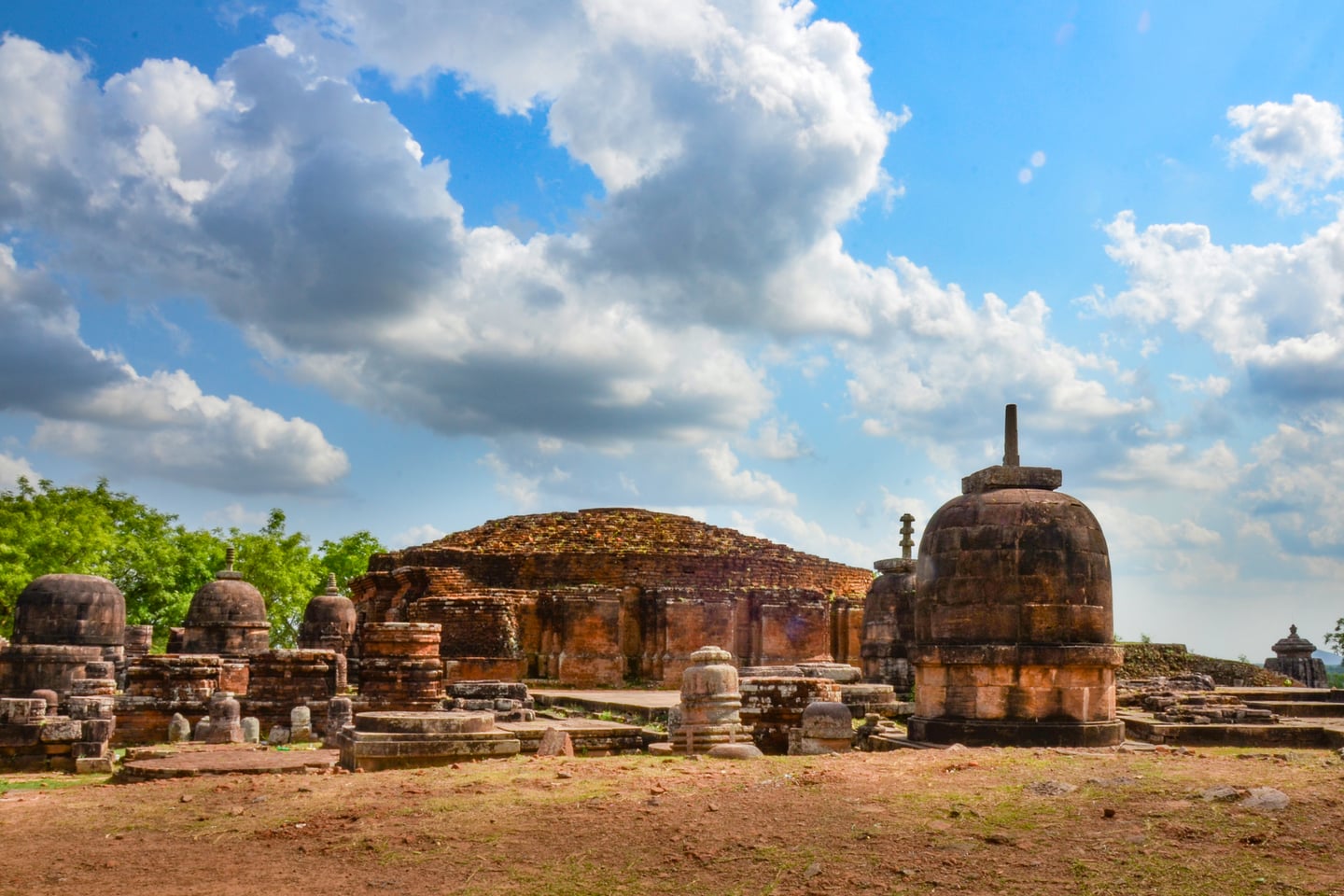
A monastery’s name can survive on a small piece of clay. At Ratnagiri, sealings identify Ratnagiri Mahavihara. At Buddhist Udayagiri, they preserve two names: Madhavapura and Simhaprastha. At Lalitgiri, sealings from one monastery name Chandraditya Vihara. These objects give the three places something more specific than a shared identity as Buddhist ruins.1
Together, Ratnagiri, Buddhist Udayagiri and Lalitgiri form the circuit commonly called Odisha’s Diamond Triangle. Buddhist Udayagiri is near Ratnagiri in Jajpur district, distinct from the Jain Udayagiri–Khandagiri caves near Bhubaneswar.2 Lalitgiri is in Cuttack district. Their proximity makes them rewarding to explore together. Their inscriptions, buildings and deposits make it equally important to keep their histories distinct.
The circuit connects places for a modern reader or visitor. It does not establish that they were campuses of a single ancient university.
Begin with the names
At Ratnagiri, excavated sealings refer to the community of Ratnagiri Mahavihara. The ancient name and the name used today correspond. This is direct material evidence for an institution, rather than a name assigned solely from a later literary account.3
At Buddhist Udayagiri in Jajpur, the archaeological areas called Udayagiri 1 and Udayagiri 2 yielded Madhavapura and Simhaprastha respectively. Those numbered areas are modern excavation labels. The names on the sealings belong to the communities themselves.4
At Lalitgiri, Chandraditya Vihara is associated with the building numbered Monastery 4. That identification should not automatically be extended to every building at the site in every century.5
The distinction between a whole site and a particular monastery is central to reading the triangle. A place could contain several buildings, different phases and more than one institutional identity.
Compare the buildings without flattening the dates
Ratnagiri’s two principal monasteries offer a clear architectural comparison. The larger had an elaborate entrance, a courtyard and a shrine with a large seated Buddha. The smaller had its own arrangement of cells, windows and drainage. Relationships between floors helped the excavators place one building between phases of the other.6
At Udayagiri, the Simhaprastha monastery included a passage around its shrine and evidence of an upper storey. Later excavations widened the picture to include earlier religious structures, a paved approach, residential rooms and a probable kitchen.7
Lalitgiri adds a prominent apsidal worship hall to the comparison. Its rounded end, earlier stupa beneath the floor and successive alterations reveal the continued remaking of a sacred place. Its numbered monasteries belong to different phases, and their numbers do not represent their order of construction.8
None of these settlements was built in one moment. Nor do the oldest objects necessarily date the largest surviving buildings. A script can suggest the age of an inscription; a buried wall can precede the building above it; a stylistic comparison can help date an image. These are different kinds of chronological evidence.
The excavation reports themselves acknowledge difficult, disturbed deposits. The eighth- to early twelfth-century range proposed for Udayagiri’s Simhaprastha monastery, for example, should not be applied to every earlier structure subsequently excavated nearby.9
Relics, texts and the many purposes of a stupa
Lalitgiri’s nested relic caskets are among the circuit’s most important finds. Two stone containers held successively smaller vessels of steatite, silver and gold, with bone fragments in the innermost vessels. A third outer container was empty. The two relic-bearing sets are uninscribed, so the people commemorated cannot be securely identified.10
This evidence must remain separate from discoveries at the other sites. At Ratnagiri, some small stupas contained bone deposits; others held images or written formulae. No relic was found in the excavators’ central pit through the main stupa, a result they did not treat as proof that no deposit had ever existed elsewhere within it.11
Udayagiri’s later excavation report describes sacred texts on clay sealings and stone, including objects displaced from their original settings. Some small monuments had cavities suited to deposits. The relationship between text and monument is part of their religious history.12
A field of small stupas can therefore represent more than repetition of one shape. It may preserve acts of offering, commemoration and the enshrining of sacred words. The particular find context determines which interpretation is supported.
Learning and the work of sustaining a community
The monasteries belonged to a religious world in which teachings, images and ritual practices were transmitted. Inscriptions preserve Buddhist formulae; sculptures give material form to Buddhas, bodhisattvas and other divinities. Such evidence supports an account of learned monastic communities without inventing modern departments, degrees or enrolment figures.
Daily activity belongs in that account too. Udayagiri’s probable kitchen was identified through associated utensils and grinding equipment. Lalitgiri’s courtyards had systems for carrying rainwater out of the buildings. Ratnagiri’s successive repairs show communities adapting existing structures.13
These practical arrangements help explain how religious institutions endured. Their history includes the maintenance of walls and drains as well as the commissioning of images and the preservation of texts.
Xuanzang and the Pushpagiri question
The seventh-century traveller Xuanzang describes the historical country of Uda as a place of Buddhist learning. In Li Rongxi’s English translation, the account refers to more than one hundred monasteries and over ten thousand monks before turning to Pushpagiri monastery.14
Those numbers concern the wider country. They are not a student register for Pushpagiri, Ratnagiri or Udayagiri, and should not be presented as one. The traveller’s accounts of spiritual signs at stupas also belong to the character of his religious narrative.
Earlier scholars proposed identifying Pushpagiri with one or more of the triangle sites. Excavated monastery names changed the discussion. Arguments concerning Langudi offer another proposed identification, but the ASI’s 2007 Udayagiri report records differing interpretations and calls for further examination.15
The useful distinction is between the traveller’s regional testimony and the named institutions recovered through archaeology. They can illuminate the same broader landscape without becoming interchangeable evidence.
Seeing the conserved sites
The remains visible today also reflect excavation and conservation. At Ratnagiri, scattered pieces were assembled to make damaged sculpture and architecture intelligible. At Lalitgiri, portable stupas were rearranged during conservation and sculptures moved to protected storage.16
This is part of the history a visitor encounters. An orderly line of objects is not automatically its original ancient arrangement; a reconstructed façade is not simply an untouched survival. Site plans, object labels and excavation photographs can help distinguish these stages.
India submitted the three sites together to UNESCO’s Tentative List on 22 December 2025. Their status is tentative, not inscription on the World Heritage List.17 The grouping recognises the value of considering the places together while leaving their particular archaeological histories essential to the account.
Begin with whichever detail draws your attention: Ratnagiri’s named community, Udayagiri’s spaces for worship and daily life, or Lalitgiri’s careful enclosure of relics. Following that detail into the evidence is a rewarding way to move between the three places.
Further reading
- ASI, Indian Archaeology 1958–59—A Review, pp.33–36.
- Bimal Bandyopadhyay, Excavations at Udayagiri-2 (1997–2000), ASI, 2007.
- P. K. Trivedi, Further Excavations at Udayagiri-2, Odisha (2001–03), ASI, 2012; Internet Archive scan.
- Jeeban Kumar Patnaik, Excavations at Lalitagiri (1985–1991), ASI, 2016; third-party-hosted scan.
- ASI, Indian Archaeology 1957–58—A Review, pp.39–41.
- Xuanzang, The Great Tang Dynasty Record of the Western Regions, translated by Li Rongxi, 1996, Fascicle X, pp.269–270.
- ASI, Indian Archaeology 1960–61—A Review, pp.28–30,81.
- UNESCO World Heritage Centre, Serial Nomination of Buddhist Triangle Sites of Odisha, India’s submission of 22 December 2025; status checked 26 October 2026.
Footnotes & Sources
-
Indian Archaeology 1958–59—A Review; Excavations at Udayagiri-2 (1997–2000); Further Excavations at Udayagiri-2, Odisha (2001–03); Excavations at Lalitagiri (1985–1991). ↩
-
Excavations at Udayagiri-2 (1997–2000), pp.1,123,141; Further Excavations at Udayagiri-2, Odisha (2001–03), pp.10–11,201. ↩
-
Excavations at Lalitagiri (1985–1991), pp.111,245. ↩
-
Indian Archaeology 1958–59—A Review, pp.33–35. ↩
-
Excavations at Udayagiri-2 (1997–2000), pp.33,38; Further Excavations at Udayagiri-2, Odisha (2001–03), pp.11–16,148–149. ↩
-
Excavations at Lalitagiri (1985–1991), pp.79–90,104. ↩
-
Excavations at Udayagiri-2 (1997–2000), p.41; Further Excavations at Udayagiri-2, Odisha (2001–03), pp.15–24. ↩
-
Excavations at Lalitagiri (1985–1991), pp.44,51. ↩
-
Indian Archaeology 1957–58—A Review, pp.39–41; Indian Archaeology 1958–59—A Review, p.36. ↩
-
Further Excavations at Udayagiri-2, Odisha (2001–03), pp.13,201–214. ↩
-
Further Excavations at Udayagiri-2, Odisha (2001–03), p.149; Excavations at Lalitagiri (1985–1991), pp.95,108,116; Indian Archaeology 1958–59—A Review, pp.34–35. ↩
-
The Great Tang Dynasty Record of the Western Regions, pp.269–270. ↩
-
Excavations at Udayagiri-2 (1997–2000), pp.12–17. ↩
-
Indian Archaeology 1960–61—A Review, pp.30,81; Excavations at Lalitagiri (1985–1991), p.54. ↩
Continue reading
Suggest an update. GitHub submissions are public; omit private contact details and consent documents.