
Jajpur · Buddhist heritage
Ratnagiri: A place built for learning
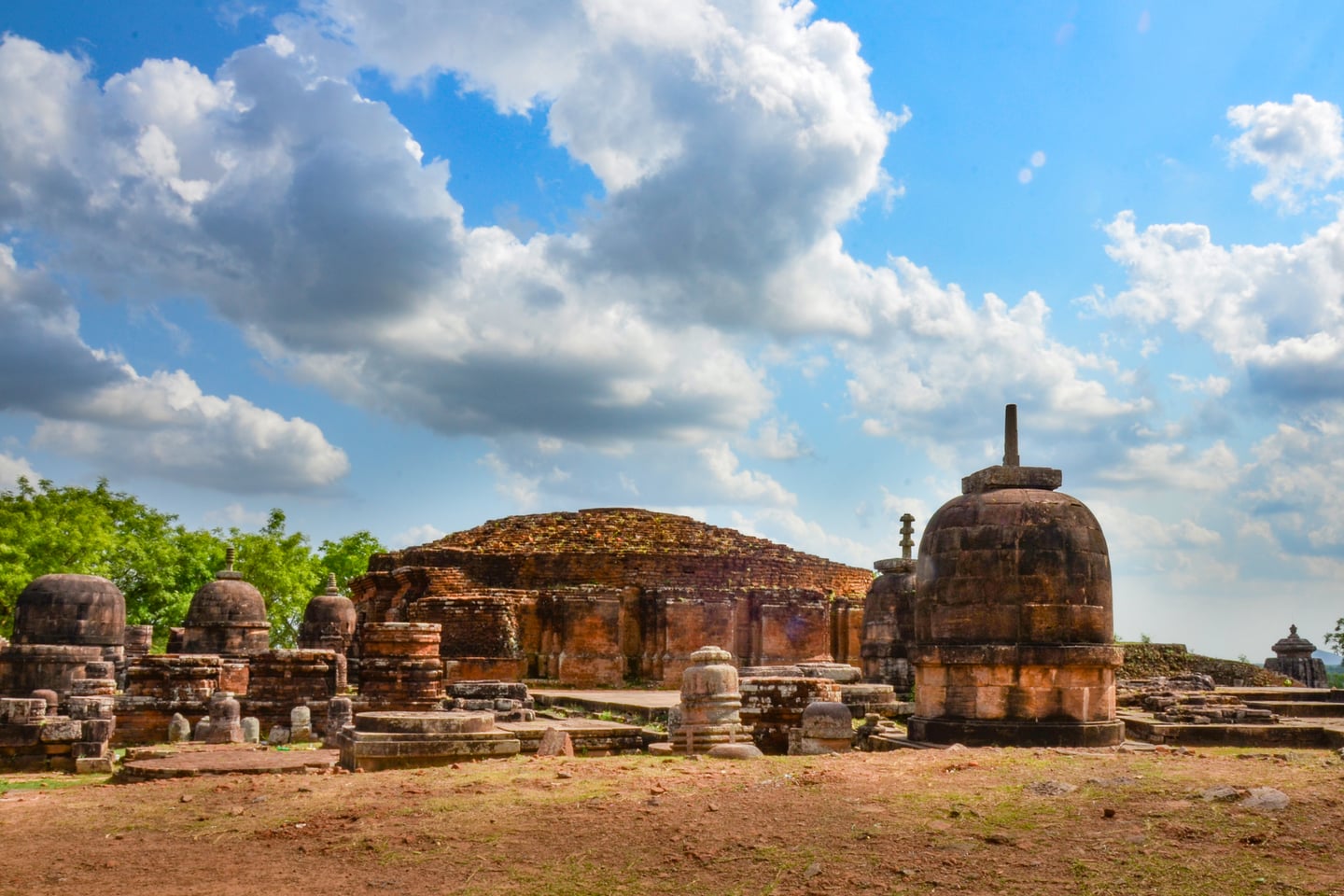
At Ratnagiri in Odisha’s Jajpur district, a doorway opens onto the remains of a Buddhist monastery. Beyond it are a courtyard, residential cells and a shrine. Around the monastic buildings stand stupas of different sizes, some carved from a single stone, others constructed from many pieces. Together they preserve evidence of a community whose religious life involved images, written texts, offerings and repeated acts of building.
The community left its name behind. Excavators recovered sealings bearing the legend sri-Ratnagiri-mahavihariy-arya-bhikshu-samghasya, identifying the monastic community of Ratnagiri Mahavihara. This is a rare kind of connection: the place known as Ratnagiri today carries a name attested in its own archaeological material.1
A history built in layers
Ratnagiri cannot be reduced to a single foundation date. Its earlier Buddhist presence, its principal monasteries and its later sculptures are different pieces of evidence, dated in different ways.
During the 1957–58 excavation season, the Archaeological Survey of India found a stone slab inscribed with the Pratitya-samutpada-sutra, a Buddhist text concerning dependent arising. The report assigned its lettering to the Gupta period. The slab came from debris, rather than a sealed foundation deposit. It supports an earlier Buddhist phase, but does not date every structure now visible on the hill.2
The following season’s report approached the larger monastery more cautiously. Its excavators found affinities between the building’s decorative work and eighth-century temples at Bhubaneswar, while explicitly acknowledging the limits of that comparison. Other sculptures belonged to later artistic traditions. The site developed through construction, damage, repair and reuse.1
Debala Mitra directed the ASI’s Eastern Circle work in the late 1950s and early 1960s. Her eventual two-volume Ratnagiri (1958–61) became the major excavation publication. The contemporary annual reports also preserve something valuable: the sequence in which archaeologists encountered the remains and worked out how the buildings related to one another.123
Two monasteries, different arrangements
The excavators called the larger building Monastery 1. Its roughly square footprint measured about 180 feet across, with a substantial central courtyard and 24 cells in the excavated arrangement. A staircase indicated an upper storey. The shrine stood across the court from the entrance, giving the building a clear spatial focus.1
Its carved entrance combined architectural ornament with religious imagery. A chlorite doorway, figures flanking the approach and a succession of thresholds marked the passage into the monastery. Within the shrine was a large seated Buddha in the earth-touching gesture, accompanied by bodhisattvas. The Buddha was recovered in pieces and reconstructed: its present coherence is partly the achievement of archaeological conservation.1
Monastery 2 was smaller, roughly 95 feet square, with 18 cells. Its architecture included arched anterooms, stone windows and drains. These details make the buildings legible as inhabited environments, with arrangements for movement, shelter and water as well as worship.1
The relationship between them was established through more than appearance. Floors in the passage beside the buildings showed that Monastery 2 belonged between two phases of Monastery 1. The larger monastery had undergone extensive rebuilding, including the raising of room levels. Ratnagiri’s inhabitants adapted existing buildings rather than always beginning anew.1
Calling Ratnagiri a place of learning is appropriate to its monastic setting and its religious texts. The remains do not, however, provide a classroom timetable, a student census or the departments of a modern university. Their strength lies in the particular life they reveal: a Buddhist community maintaining buildings, cultivating religious knowledge and commissioning sacred objects.
What the stupas held
The main stupa was an elaborate brick monument. Its projecting and recessed base would have produced a changing pattern of light and shadow. Smaller stupas accumulated around it at different levels, showing that the surrounding space also changed over time.2
These smaller monuments did not all serve an identical purpose. Some held written texts or images. Others contained bone deposits, giving them a funerary character. The excavators found no relic in their central test pit through the main stupa, but did not treat that limited result as proof that no deposit had ever existed elsewhere within it.12
One especially revealing discovery was a group of five terracotta plaques inscribed with dharanis inside another stupa. Dharanis are sacred Buddhist formulae; their placement made writing part of the monument’s religious function.1 Later epigraphic study by Umakanta Mishra compared Ratnagiri’s texts with inscriptions and textual traditions elsewhere in the Buddhist world. The comparisons help explain how a local deposit could participate in a much wider religious practice.4
The distinction matters when looking across a field of small stupas. Their repetition need not mean sameness. Commemoration, devotion and the preservation of sacred words could take closely related architectural forms.
Sculpture and the wider Buddhist world
Ratnagiri’s sculptural record includes Buddhas, bodhisattvas and deities associated with Mahayana and Vajrayana practice. The ASI’s 1960–61 report describes a shrine containing Vajraraga-Manjusri, Vajradharma-Lokesvara and Vajrasattva. Inscriptions on the first two images were assigned to around the tenth century on the evidence of their lettering. A nearby shrine contained a standing Manjusri more than two metres high.3
Such discoveries allow the site’s religious history to be explored through specific objects rather than a single label. The images differed in form, setting and function; some were built into monuments, while others were separately fashioned and installed.3
Art historians have also examined Ratnagiri’s relationship with Buddhist imagery beyond India. Sindhu M. J.’s study of Buddhas accompanied by bodhisattvas proposes connections with a Vajradhatu-mandala programme and considers parallels in Java.5 These are interpretations of visual relationships. They open questions about shared religious knowledge and artistic traditions without supplying, by themselves, a named traveller or a direct journey between two monasteries.
Ratnagiri is best understood within that wider field of exchange while retaining the precision of its local evidence: an inscription, an image, a deposited text, a doorway.
The archaeological place we visit
Today’s Ratnagiri is also a conserved site. The ASI reports describe resetting stones, rebuilding damaged masonry and assembling recovered architectural fragments. A reconstructed shrine façade, for example, brought scattered carved elements back into an intelligible arrangement.3 Knowing this does not diminish the place. It helps distinguish ancient work, the collapse through which it survived and the care that makes it readable now.
Ratnagiri belongs to the three-site Buddhist circuit commonly called Odisha’s Diamond Triangle, alongside Buddhist Udayagiri and Lalitgiri. Each site has its own buildings and archaeological history. The circuit is a useful way to explore them together; it should not erase their differences.
India submitted the three sites to UNESCO’s Tentative List on 22 December 2025. Their present status is tentative, not inscription on the World Heritage List. The submission also records renewed ASI excavation at Ratnagiri in 2024–25.6 Further research may sharpen the chronology and extend the known plan.
For now, the strongest reason to visit is already visible. Ratnagiri preserves the material traces of a community that returned to its buildings, images and texts over generations. Its story emerges from those accumulated choices, and from the patient work of reading them.
Further reading
Debala Mitra, Ratnagiri (1958–61), Memoirs of the Archaeological Survey of India 80, two volumes, 1981 and 1983. This article’s page-specific excavation references are to the directly consulted annual reports; the complete monograph was not available for this review.
Footnotes & Sources
-
Archaeological Survey of India, Indian Archaeology 1958–59—A Review, pp. 33–36; conservation, p. 88. The annual report uses the historical district designation Cuttack; Ratnagiri is now in Jajpur district. ↩ ↩2 ↩3 ↩4 ↩5 ↩6 ↩7 ↩8 ↩9
-
Archaeological Survey of India, Indian Archaeology 1957–58—A Review, pp. 39–41. ↩ ↩2 ↩3 ↩4
-
Archaeological Survey of India, Indian Archaeology 1960–61—A Review, pp. 28–30 and 81. ↩ ↩2 ↩3 ↩4
-
Umakanta Mishra, “Dhāraṇīs from the Buddhist Sites of Orissa”, Pratnatattva 22 (2016), pp. 73–84, especially pp. 76–79 and 81–82. ↩
-
Sindhu M. J., “Dhyani-Buddhas with Four Attending Bodhisattvas from Ratnagiri, Odisha and Its Importance in Buddhism”, Heritage 7 (2019), pp. 289–300. ↩
-
UNESCO World Heritage Centre, “Serial Nomination of Buddhist Triangle Sites of Odisha”, Tentative List submission by India, 22 December 2025; status checked 26 October 2026. The descriptive nomination text is the responsibility of the submitting State Party. ↩
Continue reading
Suggest an update. GitHub submissions are public; omit private contact details and consent documents.