
Cuttack · Buddhist heritage
Lalitgiri: relics, monasteries and a long Buddhist history
Lalitgiri’s most celebrated discoveries were vessels placed one inside another. Within stone containers shaped like miniature stupas, excavators found further vessels of steatite, silver and gold. Two of the innermost containers held fragments of bone. The care given to these deposits makes their religious importance unmistakable, even though the people they commemorated cannot be securely named.1
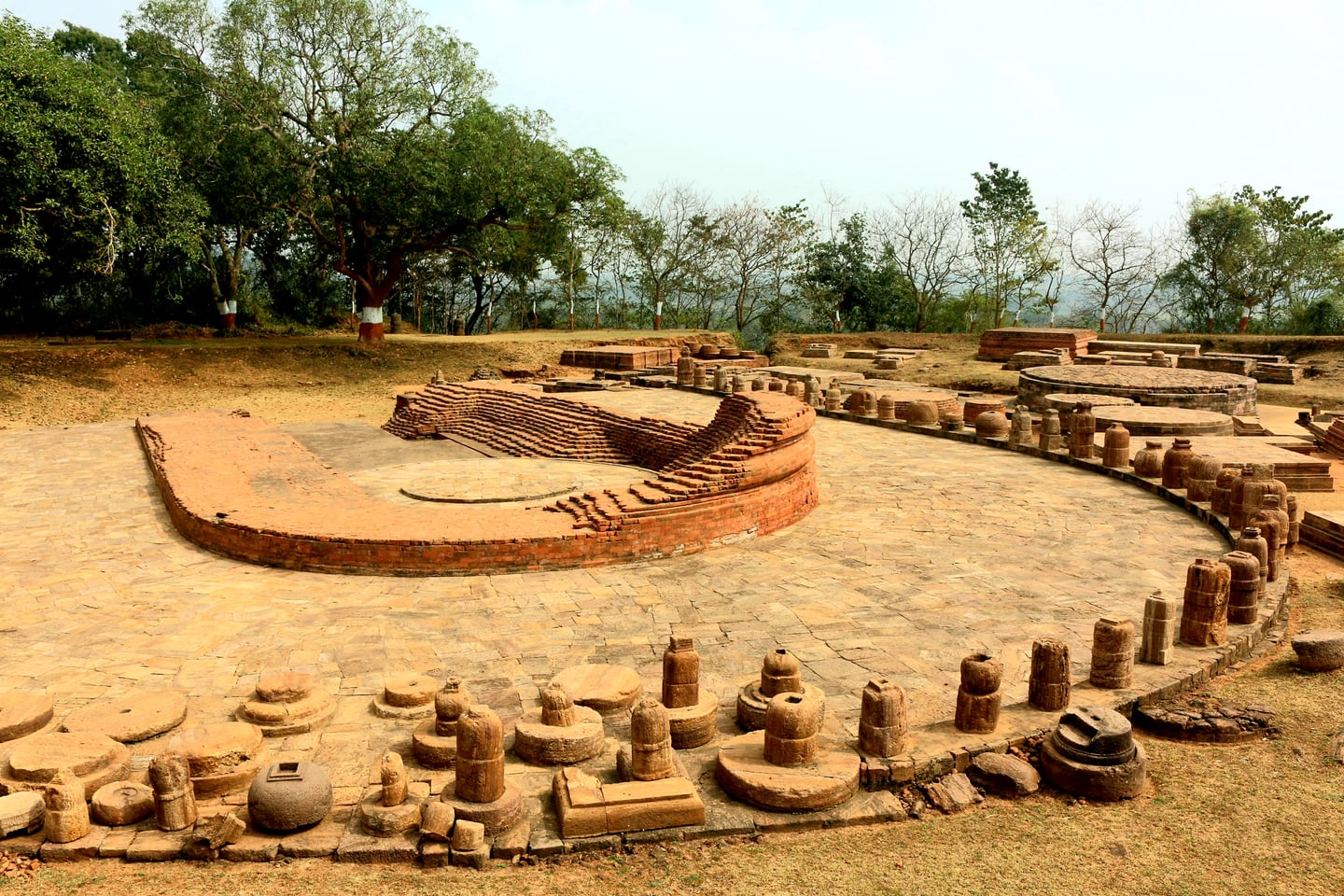
Around that discovery lies a much larger archaeological story. Lalitgiri, in Odisha’s Cuttack district, preserves a hilltop stupa, an apsidal worship hall, smaller stupas and several monastic buildings. Its remains developed over a long period, and its objects range from monumental sculpture to inscribed pottery and small clay sealings.
It forms one part of the Buddhist circuit commonly called the Diamond Triangle, with Ratnagiri and Buddhist Udayagiri in neighbouring Jajpur district. Lalitgiri’s particular contribution is the conjunction of early evidence, changing religious architecture and unusually elaborate relic deposits.2
Excavating a long-lived settlement
The remains were known to local people before they became the subject of archaeological reports. Nineteenth-century accounts drew scholarly attention to the hills and their sculptures. K. S. Behera undertook limited excavation in 1977, and the Archaeological Survey of India’s larger programme began in 1985 under G. C. Chauley.3
Jeeban Kumar Patnaik, who participated in the work, later prepared the substantial ASI report Excavations at Lalitagiri (1985–1991), published in 2016. It brings together buildings, pottery, inscriptions, sculpture and the circumstances in which they were found.
Patnaik proposed a broad occupation sequence extending from the second century BCE into the medieval period. His synthesis divided it into four phases: an early period ending around the third century CE, a fourth- to sixth-century phase, a seventh- to tenth-century phase and a final medieval phase.4
That sequence is an archaeological interpretation assembled from several kinds of evidence. The report acknowledges that the deposits were disturbed. Structures were altered, material was reused and later activity affected earlier remains. The dates therefore describe a developing settlement; they should not be read as a foundation date for every monument on the hill.
What the relic caskets contained
The caskets were found in the hilltop stupa between December 1985 and January 1986. Three outer containers of khondalite stone lay towards its southern, eastern and northern sides. Two contained nested sets: steatite enclosing silver, and silver enclosing gold.5
The northern set held a small bone fragment wrapped in gold foil. The eastern set held a charred fragment without that wrapping. The southern outer container was empty and differed in its internal form; the report considered the possibility that it had been left incomplete.6
The excavation director suggested that the difference in treatment might reflect the relative importance of the people commemorated, possibly the Buddha and a disciple. The report presents this as speculation. Neither of the two relic-bearing sets has an inscription identifying a person. The excavated bones should therefore be described as Buddhist relics whose individual identity remains unverified.6
Their importance does not depend on resolving that identity. The nested vessels show how carefully the relics were enclosed, protected and honoured. Stone, steatite, silver and gold formed successive boundaries around a very small deposit. They make the act of preservation itself visible.
The date of the surrounding settlement also cannot simply be transferred to the hilltop stupa. In discussing that monument, Patnaik notes the difficulty of establishing a precise chronology from its associated finds.5
A worship hall built over earlier remains
Elsewhere on the site stands the outline of an apsidal chaityagriha: a worship hall with a rounded end. Excavation revealed earlier stupa construction beneath its floor, later enlargement and successive working surfaces. The visible plan belongs to a history of rebuilding rather than one uninterrupted act of construction.7
The hall’s approximately twenty-two-metre length gave it a strong architectural presence. Inside, a stupa occupied the rounded western part, with space arranged for movement around the sacred focus. Outside were paved areas and smaller monuments. A stone approach beneath later pavement belonged to an earlier arrangement of the complex.8
Inscriptions add another dimension. A pedestal near the entrance carries a Prakrit record assigned by its script to about the second century CE. Other inscriptions use different scripts and belong to later phases. These are clues to repeated religious activity in the area, rather than proof that all the surrounding masonry belongs to the date of the earliest text.9
The report’s detailed discussion proposes several construction phases and contains differing estimates for their dates. What remains clear is the relationship between an earlier stupa, later building around it and continuing modifications. Lalitgiri’s sacred spaces were maintained and remade over generations.
Four monastic buildings, different histories
The monastery numbers are archaeological labels. Monastery 1 was the first of these buildings excavated, not necessarily the first built.10
It was the largest of the excavated monasteries, measuring approximately thirty-six metres on each side. An eastern entrance led towards a courtyard and surrounding verandah, with seventeen cells and a shrine on the western side. Stone was used selectively in thresholds, steps and other features within predominantly brick construction.11
Stairs and blocked lower openings helped the excavators reconstruct changes in the levels of occupation. The surviving remains do not preserve a complete upper floor, but they show that the building’s use changed. Its rainwater system also mattered: a covered drain carried water away from the courtyard and through the outer wall.12
Monastery 3, despite its later number, was interpreted as the earliest of the excavated monasteries. It had a south-eastern entrance, thirteen cells in the recovered arrangement, a courtyard and a shrine. Patnaik linked its orientation to the slope and the available ground. Drainage protected the building from water descending from higher parts of the site.13
Monastery 2 was smaller and less completely preserved. Its reused bricks and incomplete remains make it harder to reconstruct in full. It belongs to the site’s later building history, but the report’s date estimates differ between chapters; a precise final date would be misleading.14
Monastery 4 faced west and contained a large seated Buddha, now without its head. The figure was assembled from separate stone blocks joined with metal fittings. Earlier masonry beneath the monastery showed that this location, too, had a history before the surviving building.15
The name Chandraditya Vihara
Monastery 4 yielded an especially important kind of evidence: sealings naming Sri Chandraditya Vihara and its monastic community. This associates a recovered institutional name with one part of the settlement. It does not require every building at Lalitgiri, in every period, to have shared that name.16
The sealings also belong to a larger body of written material. The report’s epigraphic chapter describes religious formulae on stone, terracotta and images, including the Buddhist teaching concerning phenomena and their causes. A fragmentary Sanskrit slab preserves part of the Pratitya-samutpada-sutra, also called the Nidana-sutra, and is assigned by its script to the early fifth century.9
Written texts were part of religious practice, not merely labels attached to sculpture. They could be inscribed on an image or placed within a monument. Together with the named sealings, they reveal a community that expressed its identity and teachings through durable objects.
These names also matter to the Pushpagiri question. One aim of the excavation was to investigate whether Lalitgiri could be identified with the monastery known from Xuanzang’s account. The ASI report treats Chandraditya’s recovered name as evidence against that straightforward identification. Lalitgiri should not be presented as a proven campus of a single three-site Pushpagiri University.17
Small stupas and the conserved landscape
Around the chaitya, numerous smaller stupas preserve different forms of devotion. Some were carved from one stone; others were assembled from separate pieces. A few carry inscriptions, and some bases have recesses suitable for deposits.18
Their present arrangement also reflects conservation. The excavation report says that many portable stupas were rearranged around the monument during this work. Sculptures were moved into protected storage. The orderly rows a visitor sees should therefore not automatically be understood as an untouched ancient layout.18
Recognising that history helps connect the open site with the museum. The archaeological remains show spaces and relationships; protected objects allow closer attention to details that might otherwise be difficult to preserve outdoors.
The museum and the wider circuit
Lalitgiri’s archaeological museum was inaugurated on 24 December 2018. The Ministry of Culture’s description of the museum outlined six galleries for Buddhist sculptures, architectural fragments and excavated antiquities, with the relic caskets among its central discoveries.19 Those historical announcements establish the museum’s opening and purpose; current hours and visitor arrangements should be checked separately.
Lalitgiri, Ratnagiri and Udayagiri were submitted together by India to UNESCO’s Tentative List on 22 December 2025. This is a tentative-list entry, not World Heritage inscription.20
The three places reward comparison, but Lalitgiri deserves time on its own terms. Its importance lies both in the smallness of a carefully enclosed relic and in the scale of a settlement repeatedly rebuilt around sacred places. The caskets, halls, monasteries and inscriptions preserve different parts of that history. Read together, they show how devotion could take the form of a precious container, an enduring text or a building maintained for another generation.
Further reading
- Jeeban Kumar Patnaik, Excavations at Lalitagiri (1985–1991), Memoirs of the Archaeological Survey of India 112, 2016. Full report consulted at the pages cited. The linked PDF is a third-party-hosted scan of the ASI publication. Excavation director: G. C. Chauley; report author: Jeeban Kumar Patnaik; sealings and inscriptions chapter: Snigdha Tripathy.
- Press Information Bureau, Ministry of Culture, museum announcement, 20 December 2018.
- Press Information Bureau, Prime Minister’s Office, report confirming the inauguration, 24 December 2018.
- UNESCO World Heritage Centre, Serial Nomination of Buddhist Triangle Sites of Odisha, India’s submission of 22 December 2025; status checked 26 October 2026.
Footnotes & Sources
-
Excavations at Lalitagiri (1985–1991), pp.44,51. ↩
-
Excavations at Lalitagiri (1985–1991), pp.1,15. ↩
-
Excavations at Lalitagiri (1985–1991), pp.11–12. ↩
-
Excavations at Lalitagiri (1985–1991), pp.37–40. ↩
-
Excavations at Lalitagiri (1985–1991), pp.79–80,86–87. ↩
-
Excavations at Lalitagiri (1985–1991), pp.80,86. ↩
-
Excavations at Lalitagiri (1985–1991), p.261. ↩ ↩2
-
Excavations at Lalitagiri (1985–1991), pp.90,95. ↩
-
Excavations at Lalitagiri (1985–1991), pp.90,95,100. ↩
-
Excavations at Lalitagiri (1985–1991), pp.104,108,111. ↩
-
Excavations at Lalitagiri (1985–1991), pp.100,104. ↩
-
Excavations at Lalitagiri (1985–1991), pp.111,116. ↩
-
Excavations at Lalitagiri (1985–1991), pp.111,245. ↩
-
Excavations at Lalitagiri (1985–1991), foreword, pp.12,15. ↩
-
museum announcement, 20 December 2018; report confirming the inauguration, 24 December 2018. ↩
Continue reading
Suggest an update. GitHub submissions are public; omit private contact details and consent documents.