
Jajpur · Buddhist heritage
Buddhist Udayagiri in Jajpur: monasteries and daily life
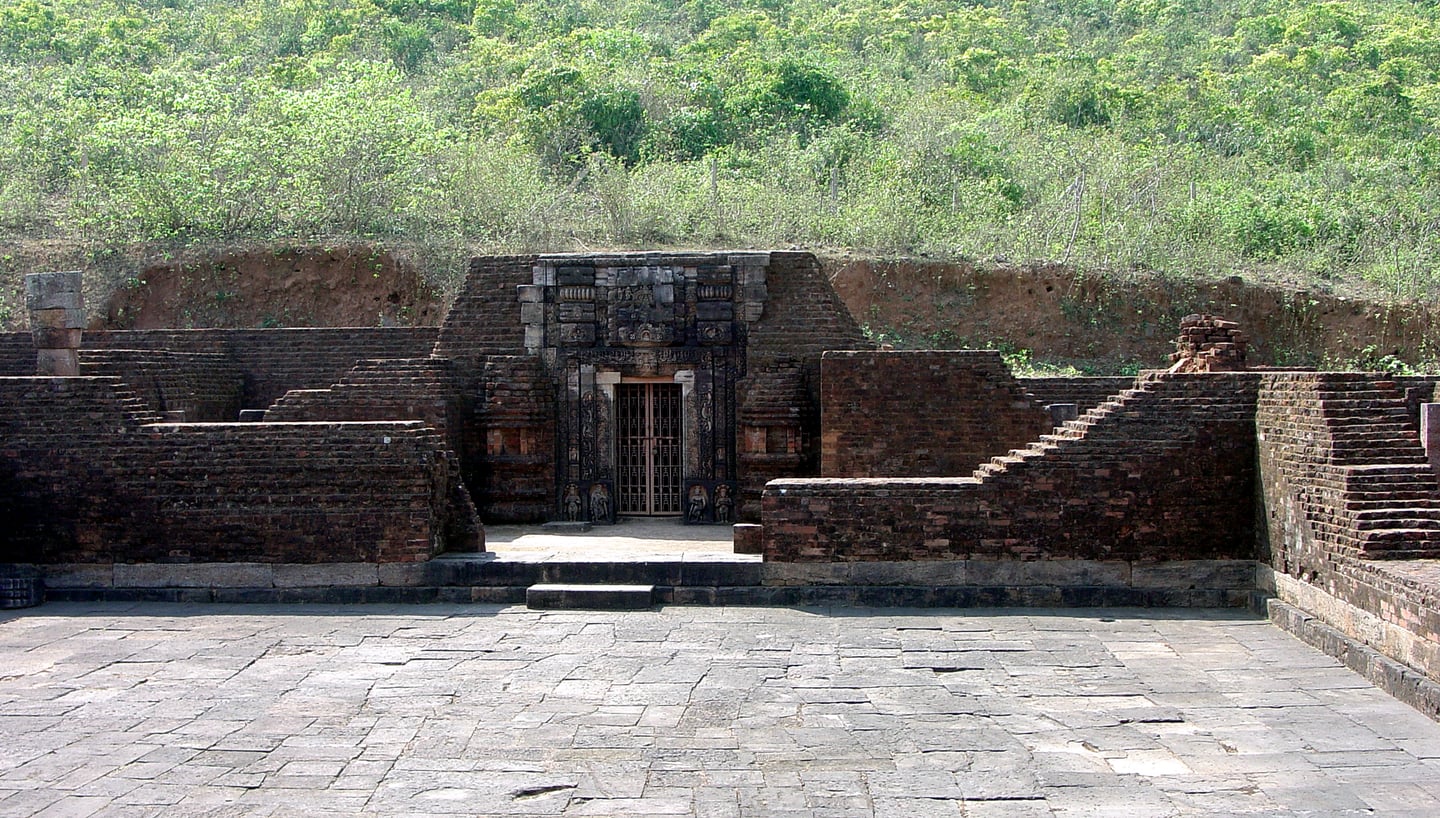
A Buddhist monastery needed more than a shrine. People needed rooms, water, food and paths between the places where they lived and worshipped. At Udayagiri in Odisha’s Jajpur district, excavations have recovered evidence of all these things: monumental images and small clay impressions, residential buildings and drains, a paved approach and objects used for preparing food.
This is Buddhist Udayagiri in the Assia hills of Jajpur, near Ratnagiri and part of the circuit with Lalitgiri. It is distinct from the Jain Udayagiri–Khandagiri caves near Bhubaneswar. The shared name can confuse a journey before it begins; the archaeological histories are different.1
Udayagiri also contains more than one named Buddhist establishment. Sealings identify Madhavapura Mahavihara and Simhaprastha Mahavihara. Those names, recovered from objects made and used at the site, provide a firmer starting point than the modern tendency to merge the region’s monasteries into a single institution.2
Two names recovered from the earth
The excavated areas are usually called Udayagiri 1 and Udayagiri 2. These are modern archaeological labels, useful for understanding the site plan.
Work in the north-western part of the settlement during 1985–89 exposed a substantial monastery and a stupa with images in its cardinal niches. Seal impressions carried the name Madhavapura Mahavihara. The monastery was approximately 35 metres square, with a shrine and an ornamented entrance.3
Excavation resumed in another part of the valley in 1997. Bimal Bandyopadhyay’s work through 2000 revealed the monastery identified as Simhaprastha. Further campaigns directed by P. K. Trivedi in 2001–03 extended investigation beyond that building into the surrounding religious and residential areas.4
The discoveries changed the scale of the story. A monastery with an imposing shrine could now be considered alongside the spaces and activities that sustained it. The two names establish distinct monastic identities, although they do not by themselves explain every relationship between the neighbouring communities.
A building shaped for movement
The Simhaprastha monastery had an excavated arrangement of thirteen ground-floor cells around a courtyard. Stairways and surviving structural evidence supported the reconstruction of a building with an upper storey. Its central shrine housed a large seated Buddha in the earth-touching gesture.5
An important feature was the passage around the shrine, allowing worshippers to move around its sacred centre. Vaulted openings brought light and air into passages. Above, at the rear of the central shrine, archaeologists found the remains of another shrine chamber. Its pedestal survived, but the image once placed there was missing.6
These details make the monastery easier to understand than a plan of walls alone. A building could direct a person towards an image, provide a route around it, and connect a courtyard with rooms and upper spaces. Religious practice was accommodated in the arrangement of doors, passages and levels.
The rooms also preserve traces of change. Some windows and cells were blocked during later use, and floors were altered. The 2007 excavation report proposed an approximately eighth- to early twelfth-century span for this monastery. It was careful about the difficulty of separating layers within a mass of collapsed building material.7
The same report considered possible explanations for decline, including changes in patronage. Those explanations remain different from the directly observed evidence of blocked openings and repairs. Udayagiri’s buildings document adjustment over time more securely than they identify a single cause of abandonment.
An older history beyond the monastery
The dates of the Simhaprastha building do not define the beginning of Buddhist activity across Udayagiri. Trivedi’s later excavations investigated a larger area with earlier structures beneath or beside subsequent construction.
The 2012 report describes an early stone platform and an apsidal, or rounded-ended, worship structure. Later brick building and additional floors transformed the area. Stupas were enlarged, sometimes retaining an older core inside a new exterior. Enclosure walls were repaired with reused materials.8
Trivedi proposed a sequence beginning in the centuries around the start of the Common Era and extending into the medieval period. The dating drew on inscriptions, coins, pottery, architectural comparisons and the relationships between structures. It was also constrained by disturbed deposits: rebuilding and erosion had prevented the survival of a simple, uninterrupted stack of layers.9
The distinction between the two reports is useful. The earlier publication concentrated on a particular monastery; the later one widened the excavated picture. A visitor looking at the whole site is looking across different phases, not at a settlement built all at once.
Water, shelter and preparing food
A monastery built against a slope had practical demands. At Simhaprastha, archaeologists found a reservoir beside the building and drains carrying water away from the monastic and shrine areas. The later excavation traced more of the drainage system.10
A stone-paved path, exposed for about seventy metres, provides another way of imagining movement through the settlement. Its long use and its relationship with surrounding structures mattered to the excavators’ reconstruction. It was an approach through a changing built landscape, not merely a decorative feature.11
Beyond the religious enclosure, a residential building contained several compartments and a hall. Pots had been set into some floors for storage. Stone thresholds, door pivots and steps preserved details of how the building was entered and used.12
Nearby, the finds included querns, pestles, pounders, storage vessels and utensils. Their association led the excavators to identify a neighbouring building as a probable kitchen. Small stupas stood in the vicinity as well.13
The interpretation does not recover a menu or identify the people who cooked. It does, however, give daily labour a place in the site’s history. The communities represented by large Buddha images also depended on grinding, storing, carrying and preparing. The archaeological record holds both kinds of activity.
Clay impressions and sacred words
Some of Udayagiri’s most informative objects are small enough to hold in a hand. The 2001–03 excavations produced more than five hundred terracotta sealings and related inscribed pieces. Only a smaller part of that assemblage carried the monastery’s name.14
Others contained sacred formulae, sometimes accompanied by representations of stupas. Several preserve leaf impressions on their reverse sides, evidence of the surfaces on which the clay dried. The object can therefore tell two stories at once: the religious text impressed on its face and something of its manufacture on the back.15
Stone inscriptions provide another record of religious language. Many contain the Buddhist creed concerning the arising of phenomena from causes; others carry dharanis, sacred formulae used in Buddhist practice. The inscriptions occur on images, slabs and architectural fragments.16
The later report cautions that the stone inscriptions were displaced from their original locations. Their texts are valuable evidence, but a loose slab should not automatically be assigned to whichever wall or stupa now stands nearest it. Archaeological context governs the story an object can responsibly tell.
Images in the making
Udayagiri’s stone sculpture belongs to the religious world of Buddhas, bodhisattvas and other Buddhist divinities. It also belongs to a material landscape. Khondalite was available in local quarries, and unfinished carving survives among the site’s evidence.17
One striking find was an unfinished stone image more than five metres long, interpreted as an intended Avalokitesvara. The report describes the emerging form of the figure and suggests that damage during work may have caused its abandonment.12
A finished image draws attention to its sacred subject. An unfinished one brings the labour of making into view: the selection of a block, the decisions of the carver and the possibility that the work would not reach completion. Although the excavators did not locate a workshop building, the quarry and unfinished material help connect sculpture with local production.
The Pushpagiri question
The name Pushpagiri often enters accounts of Odisha’s Buddhist heritage through the seventh-century traveller Xuanzang. Earlier scholars proposed identifying his monastery with Udayagiri, Ratnagiri, Lalitgiri or a larger establishment embracing them.
The excavated names complicate that picture. Madhavapura and Simhaprastha are directly attested at Udayagiri. The 2007 ASI report reviews the separate arguments concerning Langudi and Pushpagiri, including disagreement about the interpretation of inscriptions and remains. The 2012 report likewise rejects treating the three familiar sites as securely identified Pushpagiri.18
The sound starting point is therefore Udayagiri’s own evidence. It preserves named monasteries and a long, developing settlement. It does not need an unverified university identity to be historically important, and Xuanzang’s regional numbers cannot serve as its student register.
Reading Udayagiri today
Udayagiri rewards attention to scale. A shrine image, a courtyard, a drain, a storage pot and a clay impression each reveal something different. Together they bring religious and ordinary activity into the same field of view.
Alongside Ratnagiri and Lalitgiri, it forms the Buddhist Triangle group submitted by India to UNESCO’s Tentative List on 22 December 2025. That is a tentative-list status, not World Heritage inscription.19
The three sites are best explored together while allowing each its own history. At Udayagiri, the enduring interest lies in the relationship between monumental worship and the work of sustaining a community: water moving through drains, paths connecting buildings, clay taking an impression and stone becoming an image.
Further reading
- Bimal Bandyopadhyay, Excavations at Udayagiri-2 (1997–2000), Memoirs of the Archaeological Survey of India 100, 2007. Relevant printed pages: 1; 12–17; 33; 38; 41; 46; 123; 141. Inscription readings in the report are credited to Snigdha Tripathy.
- P. K. Trivedi, Further Excavations at Udayagiri-2, Odisha (2001–03), MASI 104, 2012. Relevant printed pages: foreword; 10–16; 23–25; 148–149; 201; 205; 214. The linked copy is an Internet Archive scan of the ASI publication. Its epigraphy chapter is by Snigdha Tripathy and S. Khamari. Dates and functional identifications in this article retain the reports’ archaeological scope rather than treating every inference as a direct observation.
- UNESCO World Heritage Centre, Serial Nomination of Buddhist Triangle Sites of Odisha, submitted by India, 22 December 2025. Status checked 26 October 2026.
Footnotes & Sources
-
Excavations at Udayagiri-2 (1997–2000); Further Excavations at Udayagiri-2, Odisha (2001–03). ↩
-
Further Excavations at Udayagiri-2, Odisha (2001–03), p.10. ↩
-
Excavations at Udayagiri-2 (1997–2000), p.1; Further Excavations at Udayagiri-2, Odisha (2001–03), pp.10–11. ↩
-
Excavations at Udayagiri-2 (1997–2000), pp.33,38. ↩
-
Excavations at Udayagiri-2 (1997–2000), pp.41,46. ↩
-
Further Excavations at Udayagiri-2, Odisha (2001–03), pp.11–16,23–25. ↩
-
Further Excavations at Udayagiri-2, Odisha (2001–03), pp.13–16,23–24. ↩
-
Excavations at Udayagiri-2 (1997–2000), p.46; Further Excavations at Udayagiri-2, Odisha (2001–03), p.13. ↩
-
Further Excavations at Udayagiri-2, Odisha (2001–03), pp.14,16. ↩
-
Further Excavations at Udayagiri-2, Odisha (2001–03), p.148. ↩ ↩2
-
Further Excavations at Udayagiri-2, Odisha (2001–03), p.149. ↩
-
Further Excavations at Udayagiri-2, Odisha (2001–03), p.201. ↩
-
Further Excavations at Udayagiri-2, Odisha (2001–03), p.205. ↩
-
Excavations at Udayagiri-2 (1997–2000), p.123; Further Excavations at Udayagiri-2, Odisha (2001–03), p.214. ↩
-
Further Excavations at Udayagiri-2, Odisha (2001–03), p.13. ↩
-
Excavations at Udayagiri-2 (1997–2000), pp.12–17; Further Excavations at Udayagiri-2, Odisha (2001–03), foreword. ↩
Continue reading
Suggest an update. GitHub submissions are public; omit private contact details and consent documents.