
Kuvi and the Jatapu script
By Ahimanikya Satapathy
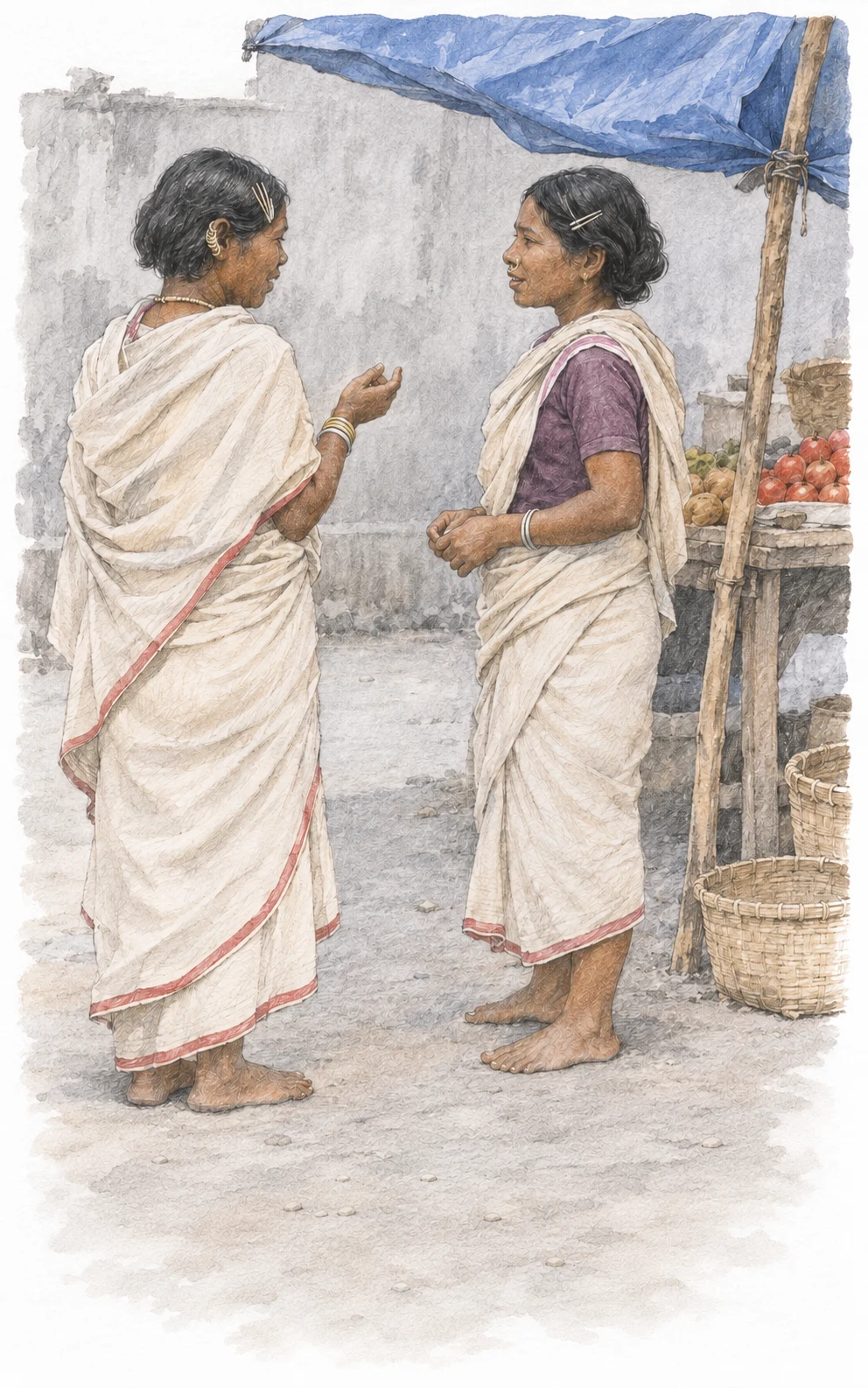
Two women talking beside a market stall - an interpretive illustration. The figures and conversation are imagined; no speech or script is transcribed.
A lesson becomes useful when a learner can make sense of it. In Learning and belonging, Jayanti Sabar’s pupils helped classmates by explaining lessons in Kuvi.1
Three distinct resources matter here: the Kuwi Primer, written with Odia-based letters; the Jatapu (Kuvi) Primer, which uses Telugu-based writing; and a separate Jatapu script devised by Prasanna Sree. Her alphabet is not the one used in the Jatapu primer.234
Kuvi and Kui
The Central Institute of Indian Languages identifies Kuvi as a Dravidian language spoken in Odisha and Andhra Pradesh and records its use of the Odia script. CIIL maintains a separate entry for Kui, describing it as closely related to Kuvi. The names are not interchangeable.5
A familiar script can help a reader recognise letters without making the language itself familiar.
A name heard in Niyamgiri
In Children of the Earth Goddess, Roland Hardenberg records Kuang Kata as the Dongria name for their language. He also names two people who taught him: Brundabati Kondapani and Sandyarani Kadraka, workers in a local development organisation. His acknowledgement makes visible the people whose teaching helped an ethnographer listen and understand.6
The spelling follows his account; Hardenberg explains that he recorded words as he heard them, rather than using a linguist’s transcription. Glottolog separately catalogues Dongria Kuvi as a dialect. Neither a catalogue label nor a printed spelling replaces the way a speaker names and pronounces their own language.67
A teacher making resources
A regional example comes from Putsil in Koraput. A November 2020 account by government and programme staff describes anganwadi worker Phulamani Jani noticing that children engaged more readily when she spoke Kuvi. Yet she wondered whether Odia would better prepare them for primary school; some community members shared that concern. After training in 2017, she combined purchased learning materials with ones she made locally and composed Kuvi songs.8
Her account brings a teacher’s choice into view: how to build on children’s understanding while preparing them for school. It does not identify the writing system of her materials or describe the community as Dongria.
The Odia-based Kuwi primer
The Kuwi Primer was prepared in an NCERT workshop with the Central University of Odisha, Koraput, according to its credits. Its alphabet chart and illustrated lessons use Odia-based writing.2
The Ministry of Education records its launch alongside the Desia primer in Bhubaneswar on 17 August 2023. The intended audience was children speaking these languages in undivided Koraput.9
A 2025 CIET newsletter later records revised Desia and Kuwi primers submitted for printing, without confirming printing or identifying recipient schools.10
The Telugu-based Jatapu primer
The CIIL–NCERT Jatapu (Kuvi) Primer has a first-edition date of 9 March 2024. It is intended for early learners at Balvatika and Anganwadi levels and for adult literacy programmes. Its alphabet chart and opening illustrated lesson use Telugu-based writing. Its resource-person credits include headmaster Tadangi Timmarusu and teacher Puvvala Ramaswamy, both working in Parvathipuram Manyam district, Andhra Pradesh.3
Jatapu (Kuvi) is the publication’s title, not a name for every Kuvi-speaking community.
Prasanna Sree’s Jatapu script
Prasanna Sree’s university-hosted academic profile lists Jhatapu among the languages for which she devised scripts.4 The Atlas of Endangered Alphabets explains the design through a palm-leaf parasol, with a curved upper portion and a supporting vertical shaft.11
Omniglot publishes a chart and credits Prasanna Sree as its information provider. It displays 13 vowel-labelled and 19 consonant-labelled entries, with additional panels called “Independent vowels” and “Long consonants.”12 The labels describe the chart, not a verified inventory of Kuvi sounds; “Long consonants” remains unexplained in the materials examined.
These sources document Prasanna Sree’s design. They do not establish that Dongria villages use it, or that it is an ancestral writing system.
Listening beyond the alphabet
Linguistic descriptions record speech sounds as well as written forms. PHOIBLE’s Kuvi sound inventory, drawing on Israel’s 1979 grammar, includes short and long vowels, such as /i/ and /iː/, and nasalised vowels such as /ĩ/.13 These symbols describe pronunciation, not letters in the devised Jatapu script.
Behind a grammar are people who help a researcher hear and understand. In the reproduced preface to his grammar, Israel credits Binondo K. Manding of Narengpodra and contributors including Prokas Meleka and Anondo Meleka of Putisil. He dates his fieldwork to 1971–74, with further examination through 1977, mainly in Saptamaha near Putisil and Narengpodra on Deomali.14
PHOIBLE presents particular documented sound inventories, not every speaker’s pronunciation.13 This regional description cannot by itself map the devised Jatapu signs to spoken Kuvi in Niyamgiri; that needs examples and explanations from speakers.
Words across regions, voices in an archive
The Kuvi Dictionary app offers another route into the language. Its publisher describes a collaborative multilingual-education project initiated by the Education Department through ITDAs, with Telugu, English and Hindi indexes. It covers Kuvi spoken in Andhra Pradesh and is described as a community-approved draft. It can help a reader compare words, but entries need checking with Dongria speakers before becoming a Niyamgiri glossary.15
Elsewhere in Odisha’s language-documentation network, O Foundation’s OpenSpeaks lists Opino Gomango’s work with Sora, Juray, Juang and Gorum. Its community documenters record speakers on audio and video; its tools support subtitles, descriptive information and consent agreements. This is a useful example of how voices can accompany written accounts, not evidence of an OpenSpeaks Dongria Kuvi collection.16
A small collection shaped by Dongria speakers could begin with words they choose: a place name, a seed, an everyday greeting. The recording, explanation and translation would belong together, with each speaker deciding what may be shared.
From letters to lessons
Publication and classroom use are separate milestones. Neither primer’s publication record identifies the edition used in a particular Dongria school.
Sabar’s pupils explained lessons to classmates; Phulamani made resources for children she taught. Their accounts return attention to who can understand and use the words. The song accounts that follow introduce other people who explain, remember and pass them on.
Further reading
Dongria life · Learning and belonging · Songs and singers · Kapadaganda colours and motifs
Footnotes & Sources
Adapted illustration: Project Odisha. CC BY-SA 4.0. Clothing reference: photograph by Pillai Sree Vidya, CC BY-SA 4.0. Imagined composition; portrait adaptation for this edition.

-
Manipadma Jena, India Coaxes Tribal Girls Into Schools, IPS, 18 September 2012, Jayanti Sabar’s classroom account. Historical testimony, also used in the learning article; not a current school assessment. ↩
-
NCERT, Kuwi Primer, linked from the CIIL primer catalogue, accessed 3 November 2026. PDF pp. 4–5: title and preparation credits; p. 9: Kuwi alphabet chart; pp. 11, 14 and 16: illustrated lessons in Odia-based writing. Selected pages visually inspected. No edition date or classroom distribution is inferred from this inspection. ↩ ↩2
-
CIIL–NCERT, Jatapu (Kuvi) Primer, first edition 9 March 2024. Visually inspected: PDF p. 5 (printed ii), edition and intended learners; p. 10 (vii), development credits; p. 14 (1), alphabet; p. 16 (3), opening lesson. These pages establish the Telugu-based writing used in the primer, not a survey of classroom adoption. The publication also appears in the Ministry of Tribal Affairs’ 4 December 2025 list, item 32. ↩ ↩2
-
Academic profile of Prof. S. Prasanna Sree, Adikavi Nannaya University, PDF page 18, printed p. 17, section 27, “Script Devised.” Creator’s institutional profile; source spelling Jhatapu retained in the text. It establishes attribution, not community adoption. ↩ ↩2
-
CIIL, Bhasha Sanchika entries for Kuvi and Kui, accessed 3 November 2026. Language classification and stated Odia-script use; not a survey of every community’s writing practices. ↩
-
Roland Hardenberg, Children of the Earth Goddess (De Gruyter, 2018), publisher preview, pp. IX–X (teachers), XXV (spelling method), and 3 (Kuang Kata). His attributed field account; not a standardised orthography. ↩ ↩2
-
Glottolog 5.3, Dongria Kuvi, dialect entry
dong1300, accessed 8 November 2026. ↩ -
Anu Garg, Aravind Agarwal, R.R. Nayak and Priyadarsini Mohanty, Scaling-up mother tongue-based multilingual preschool education in Odisha, Early Childhood Matters, 5 November 2020, opening and concluding Putsil passages. Full article and author roles inspected. The authors were government or programme-management staff; this is their account of practice, not an independent evaluation or evidence of adoption of the later primers. ↩
-
Ministry of Education, Kuwi and Desia books launched at Bhubaneswar, PIB, 17 August 2023. Confirms the launch and intended regional audience; not classroom distribution, adoption or learning outcomes. ↩
-
CIET–NCERT, Newsletter, Volume IX, Issue 4, 1 October–31 December 2025, Table 10, printed pp. 9–10 (PDF pp. 13–14), “Primers – Research, Development & Dissemination.” Relevant pages read in extracted text; complete printed p. 10 visually inspected. The table confirms submission of revised primers for printing. Its adjacent general entries for showcasing and orientation do not identify a Kuwi school, edition or participant group. ↩
-
Atlas of Endangered Alphabets, Jatapu, accessed 3 November 2026. The design explanation is attributed to this account; its unrelated geographical and social generalisations are not used. ↩
-
Omniglot, Jatapu, page last modified 23 April 2021, accessed 3 November 2026. Chart visually inspected from the user-supplied image; the page links a GIF at https://www.omniglot.com/images/writing/jatapu.gif, which the web tool could not render. Counts describe displayed entries, not independently verified sounds. ↩
-
Steven Moran and Daniel McCloy, editors, PHOIBLE 2.0, Kuvi inventory PH 920, vowel entries and source attribution to Israel 1979; editorial FAQ, “How are PHOIBLE inventories created?” and “Why do some languages have multiple entries in PHOIBLE?” Accessed 3 November 2026. The database and its methodology were inspected; the full grammar was not retrieved; its reproduced preface is considered separately in note 10. IPA examples reproduce listed segments, not a verified mapping to the devised script or a contemporary Dongria speech sample. ↩ ↩2
-
M. Israel, A Grammar of the Kuvi Language with Texts and Vocabulary (1979), preface reproduced on Exotic India’s book page, accessed 3 November 2026. The reproduced preface was read, not the complete book or a scan of its original pages. Names and place spellings follow that transcription; the passage is the author’s account of his research. ↩
-
Kuvi Dictionary, publisher’s Google Play description, accessed 8 November 2026. Andhra Pradesh variety; project history and draft status are the publisher’s account. Individual entries have not been validated here. ↩
-
O Foundation, OpenSpeaks, programme overview, fellows and tools, accessed 8 November 2026. Organisation’s own account; the listed languages do not establish a Dongria Kuvi collection. ↩
