
Learning and belonging in Niyamgiri
By Ahimanikya Satapathy
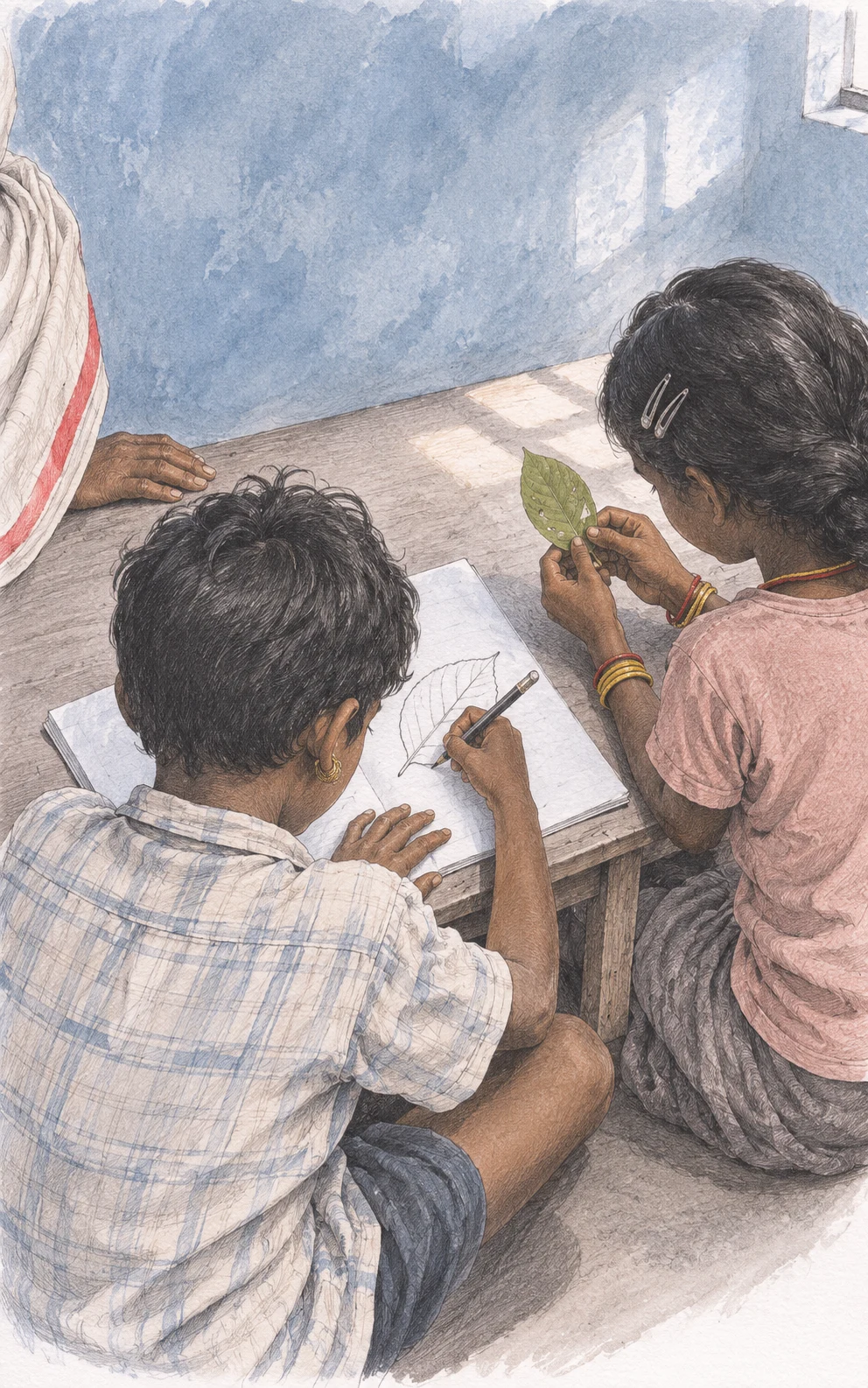
Children drawing and observing a leaf indoors - an interpretive illustration. The figures and learning activity are imagined.
Mukteswar Wadaka taught children in Khambesi without charging for tuition during the pandemic lockdown. In Abhijit Mohanty’s January 2021 report, the Dongria Kondh student also spoke of wanting to enter the civil service and challenge assumptions about the work Adivasi people could do.1
Mukteswar brought teaching close to home. For students who left Niyamgiri to study, education also raised questions about language, family and belonging.
Ambition and example
Mohanty’s report followed students associated with the Kalinga Institute of Social Sciences in Bhubaneswar. Phulaki Wadaka, who had earned a master’s degree in psychology, described wanting to encourage friends to continue their studies. Ravindra Wadaka recalled taking up weightlifting after encouragement from coach Shubakanta Malya. At his first competition he felt nervous among so many people, despite months of training.1
Understanding the lesson
In September 2012, journalist Manipadma Jena reported from Sikhsya Niketan, a residential school for Dongria Kondh girls in the Chatikona area. Teacher Jayanti Sabar described students helping translate lessons into Kuvi for classmates who struggled with the language of instruction. Understanding a lesson depended partly on classmates who could explain it in familiar words.2
The same report introduced Rina Wadaka of Khambesi, then a schoolgirl who wanted to teach. Jena traced her inspiration to Kasturi Melaka, who had completed school.2 Another student’s example helped Rina imagine teaching others; the report does not tell us what career she later pursued.
Readers, primers and workbooks
One resource for Kuvi readers is Pilanka Katha (Kuvi), Part I, published by Odisha’s Academy of Tribal Languages and Culture. Its preparation credits name a Kuvi Resource Group: Trinath Wadaka, Tripati Hikaka and Surya Narayan Padhy, with Paramananda Patel as coordinator and Priyaranjan Baral as illustrator. One story page places Kuvi text above an illustration and an Odia passage below it, using Odia-based writing.3
The reader’s edition date remains unconfirmed. A separate resource, NCERT’s Kuwi Primer, was launched in August 2023; a 2025 CIET newsletter records revised Kuwi and Desia primers submitted for printing.4
By March 2026, the Ministry of Education also reported the development of Shishu Vatika workbooks in Odia script for languages including Kuvi.5 Readers, primers and workbooks offer different resources. These publication records do not tell us which edition reached a particular Dongria classroom or how a teacher used it.
Staying connected to home
A July 2016 Kalpavriksh study recorded parents’ interest in literacy and education alongside concerns about sending children away. Participants wanted schools within Niyamgiri, teaching that related to local life, and teachers who understood the community. Their concerns included children’s separation from parents and from the knowledge associated with livelihoods in the hills.6
The study drew on short visits and translated discussions, with limited participation by women and young people.6 The parents’ concerns and students’ aspirations raise connected questions: where to study, which language to learn through and how to remain close to family.
Returning to education
SPREAD’s 2024–25 annual report describes Dasami Wadaka, an embroiderer from Khajur and member of its Rang Kerang collective, returning to senior-secondary study through the National Institute of Open Schooling. According to the account, she stayed at SPREAD’s Koraput office while attending her examinations. Her friend Jyoti Huika, whom the report identifies as Dongria Kondh, accompanied her and also decided to resume her education.7
The account leaves the examination dates and results unstated. It describes a return to studying, not a completed qualification.
Teaching close to home
Mukteswar’s village tuition, Sabar’s pupils explaining lessons and the two women returning to study show different forms of help between learners. Qualifications and careers matter in these accounts, but so do familiar words, someone willing to explain, and company when a person begins again.
Further reading
Dongria life in Niyamgiri · Learning Kapadaganda · Niyamgiri and village decisions
Kuvi and the Jatapu script follows the distinction between a language, a writing system and evidence of its use.
Footnotes & Sources
Adapted illustration: Project Odisha. CC BY-SA 4.0. Clothing reference: photograph by Pillai Sree Vidya, CC BY-SA 4.0. Imagined composition; portrait adaptation for this edition.

-
Abhijit Mohanty, Residential school empowers tribal children through education, Village Square, 20 January 2021, “Identifying skills” and “Academic achievement.” Named accounts; not an independent evaluation of the institution. Uncorroborated claims of community-wide “firsts” are omitted. ↩ ↩2
-
Manipadma Jena, India Coaxes Tribal Girls Into Schools, Inter Press Service, 18 September 2012. Historical reporting; the named student’s later career and present school arrangements have not been established. ↩ ↩2
-
Academy of Tribal Languages and Culture, Pilanka Katha (Kuvi), Part I, hosted by SCSTRTI. PDF pp. 1–2: title and credits; p. 5 (printed 2): illustrated Kuvi and Odia passages. Selected pages visually inspected on 3 November 2026; edition date and school-level distribution not established. SCSTRTI’s MLE resources page lists Parts I and II. English name spellings follow the credits; no identity match with other people in this series is inferred. ↩
-
Ministry of Education, Kuwi and Desia books launched at Bhubaneswar, 17 August 2023; CIET–NCERT, Newsletter, 1 October–31 December 2025, Table 10, printed pp. 9–10 (PDF pp. 13–14). Reuses the sources inspected for the language companion: the launch release and the newsletter’s revised-primer printing-submission entry. Submission does not establish completed printing, distribution or classroom use. Neither source identifies the revised edition’s changes. ↩
-
Ministry of Education, Lok Sabha Unstarred Question 2711: Accelerated Implementation of NEP 2020 in Aspirational Districts of Odisha, answered 9 March 2026, part (c), PDF p. 2. Official reply inspected in full extracted text. It attributes the workbook information to the State Government of Odisha; it does not provide a workbook edition, recipient-school list or a Kuvi-specific learning evaluation. The workbook is not equated with Pilanka Katha, the NCERT primer or Nua Arunima. ↩
-
Meenal Tatpati, Ashish Kothari and Rashi Mishra, The Niyamgiri Story: Challenging the Idea of Growth Without Limits?, Kalpavriksh, July 2016, printed pp. 19–20; methodological limitations pp. 4–5. Participant preferences remain dated and attributed. ↩ ↩2
-
SPREAD, Annual Report 2024–2025, printed p. 16 (PDF p. 18), case study “The Empowerment Journey of Dasami Wadaka and Jyoti Huika Through Embroidery.” Complete page visually inspected on 4 November 2026. Implementer testimony; event dates, examination results and subsequent educational progress are unspecified. The report explicitly identifies Jyoti as Dongria; no identity is inferred for Dasami from her surname. The account is not independent evidence of a causal effect of the programme. ↩