
Kapadaganda — the embroidered cloth of Niyamgiri
By Ahimanikya Satapathy
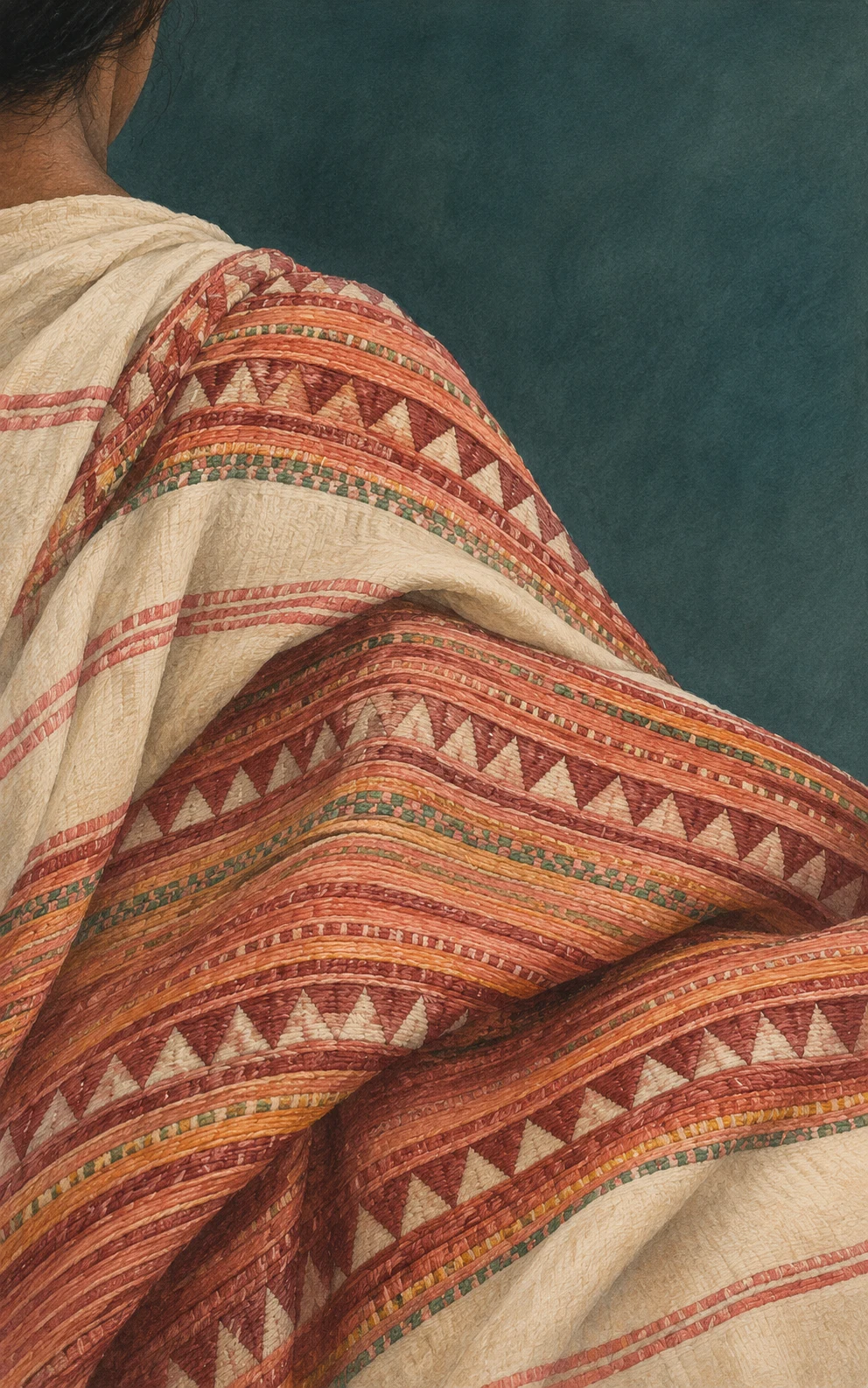
An embroidered wrap across a shoulder and back - an interpretive illustration with imagined cloth folds.
Kumri Sikoka began learning embroidery at about nine or ten, taught by her father’s sister. Speaking to Kanak Rajadhyaksha in November 2017, she placed the skill within a family relationship. Other women also credited their atta, a paternal aunt.1
A Kapadaganda connects several kinds of work: weaving the cotton, embroidering its surface, and choosing how to wear or give it. “It is our identity,” Sindhe Wadakka of Khajuri told Annapurna Devi Pandey in an account published in April 2026. She related the joining of coloured threads to Kondh people coming together.2
Learning, making and giving
Rajadhyaksha’s interviews follow embroidery alongside farming and household work. Binjo Jakesika and Sukri Kadraka fitted stitching into the time available; long training sessions could cause discomfort. Site Jakesika valued the independence that selling her work could bring.1
The companion account describes wraps made for oneself, relatives or lovers, and worn at weddings and festivals. People could wrap and drape them in several ways. Not every woman embroidered: the account records choices about whether to do this work as well as how it was done.3
Binjo described wearing her own embroidery for celebrations until the cloth tore, then making another. Site sometimes preferred buying gifts because embroidery took so much work.1
Making a cloth for someone and making one for sale could involve the same skill, but different relationships. In the 2017 interviews, Kumri reported selling two shawls for ₹2,000 each. At the DKDA training centre, women received ₹100 a day, lunch and materials; Binjo and Site did not know the eventual selling price of that work. These were different historical payment arrangements, not current rates or measures of profit.1
The cloth beneath the stitches
The embroiderer’s work begins with someone else’s weaving. In July 2019, The New Indian Express followed Ram Hial in Jhigidi, where he had learned to weave from his father, Kamala Hial. The report described him as the village’s remaining maker of Kapadaganda base cloth. When officials brought replacement cloth from Mayurbhanj, embroiderers said it did not match his fabric.4
Textile researcher Pankaja Sethi describes unbleached cotton, loosely woven with paired warp and weft yarns in a construction resembling basket weave. She traces its traditional production to neighbouring Dom weavers. The open structure lets women count fabric threads as they position their embroidery.5
Preparing those yarns also takes work. Twinkle Rastogi’s fieldwork paper, published in January 2023, describes cotton warp dipped in maida flour and water, squeezed and stretched to dry. This sizing strengthens the yarn and helps prevent tangling and breakage. Her account names Hiyal Rama of Jigidi; it does not establish whether he is the Ram Hial named in the earlier report.6
In the 2017 interviews, Sukri recalled exchanging fruit for base cloth, followed by buying it with money at markets.1 Kala Bhoomi’s raw-cloth catalogue records harvested crops exchanged for cloth supplied by Domb weavers. The entry gives neither a transaction date nor quantities, leaving the continuation of that arrangement uncertain.5
Working a pattern, explaining its meaning
Rajadhyaksha describes embroidery proceeding row by row in satin stitch. Women straighten the worked cloth and trim loose ends with a katri, a blade-shaped hair ornament. They buy coloured thread at weekly markets; Ritu Sethi’s 2022 UNESCO survey also describes a shift towards purchased thread.37
In Rajadhyaksha’s interviews, linga, a triangular motif, represented the mountains and Niyam Raja. Kairi, diagonal lines, referred to cultivated fields; akka, larger triangles, to leaves; and kanaka, a circular motif, to eyes. The women’s designs varied in size and arrangement.3
Sumita Wadaka of Khambeshi used the terms Kudi Linga for triangle designs and Keri for lines in Deepanwita Gita Niyogi’s January 2026 reporting, connecting them with Niyamgiri’s history.8 Keeping the speaker beside the explanation allows those differences to remain visible.
Colours in cloth and language
Red, yellow and green recur alongside threads described as brown or maroon. The explanations connect embroidery with cultivation, worship and community life.359
| Colour | Attributed meanings |
|---|---|
| Red and maroon | Pankaja Sethi associates them with blood sacrifice.5 |
| Green | Sethi relates it to the forest; the GI description also names soil fertility and mountain biodiversity.59 |
| Yellow | Sethi associates it with turmeric; the GI description adds reciprocal help, harmony and community well-being.59 |
| Dark brown | Rajadhyaksha’s interview account connects it to cultivated soil in the mountain motif.3 |
Colour words vary between accounts. The GI description gives Kambita, Hinga and Sanja for red, yellow and green. Rajadhyaksha records netru, hinga and kadi alongside red, yellow and dark brown. Sanghamitra Sethi and Paramananda Naik’s study of 40 women and girls in Kurli gram panchayat records Kambiti, Aka, Hinga and Mirga for red, green, yellow and brown.3910 The sources do not resolve the differences in wording.
The 2018 Odia–Kuvi Sabdakosh adds another connection: its blood entry includes ନେତରୁ, while turmeric is ହିଙ୍ଗା and yellow is ହିଙ୍ଗାରାଙ୍ଗୁ.11 These entries help explain relationships between words and substances; they do not establish a dye recipe. Sethi treats earlier natural dyes as probable, while the GI description asserts forest-derived colours without a dated recipe or material test in the inspected passages. A yellow thread’s association with turmeric does not show what dyed it.59
Recognition and what reaches the maker
In August 2026, embroiderer and former Kurli sarpanch Dinja Jakesika described greater demand and recognition, while questioning how much retail benefit reached the women. She also described training to apply Kapadaganda motifs to garments, bags, notebooks and other products.12
Formal recognition and public support took several forms. Kapadaganda’s GI certificate is dated 2 January 2024; its application names the Niyamgiri Dongoria Kandho Weavers Association and SCSTRTI.13 A parliamentary reply records toolkits distributed to 20 artisans, while AdiShilpi records describe designer recruitment and plans for training, materials and honoraria. These documents establish particular kinds of support, not subsequent earnings.141516
Reliable cloth remained a concern. Diana Sahu’s August 2026 reporting said Jhigidi’s weavers had stopped producing the fabric. Officials proposed a local weaving cluster, with Koraput cloth as a fallback. The report named Lahari Kundika, Murudi Wadaka and Bangari Wadaka of Khambesi as selected trainers. That selection recognised expertise within the community; completed training, cluster production and deliveries were not established.17
New markets raise Dinja’s question again. RISA promoted Dongria embroidery and Kotpad cotton as distinct traditions.18 Boito’s “Dongria Overlay” description does not name its embroiderer or payment. A related profile’s prompt-payment testimony comes from Kotpad weaver Jagabandhu Panika, not a Dongria embroiderer.19 Folkweave’s Kapadaganda work appears among several regional textile traditions, and SPREAD’s reported exhibition sales combine several crafts; that total cannot identify an individual embroiderer’s return.2021
Kumri’s learning, Ram Hial’s cloth and Dinja’s question about payment belong to different moments in this history. Together they keep attention on the relationships that make the finished wrap possible: someone teaches, someone weaves, someone stitches, and someone wears or buys the work.
Further reading
Dongria life in Niyamgiri · Learning and belonging · Niyamgiri and village decisions
Kotpad and Kapadaganda through their makers compares weaving, dyeing and embroidery across distinct regional traditions.
Footnotes & Sources
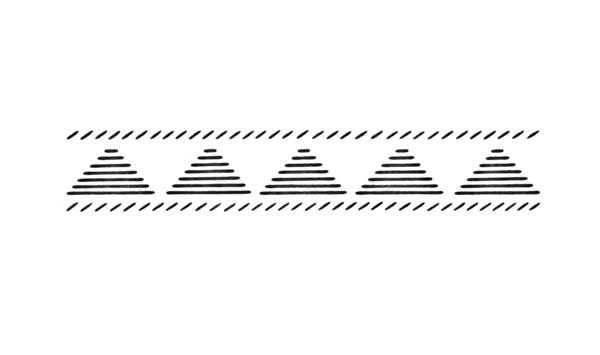
Interpretive stitch-band drawing: Project Odisha. Technique reference: Kanak Rajadhyaksha, Kapdagondas: Motifs and Technique, Sahapedia.
Adapted illustration: Project Odisha. CC BY-SA 4.0. Clothing reference: photograph by Debanutosh, CC BY-SA 4.0. Imagined composition; portrait adaptation for this edition.

-
Kanak Rajadhyaksha, Kapdagondas: Embroidery and Work for Dongariya Kondh Women, Sahapedia. Interviews conducted 8–14 November 2017 with women and development-agency staff. These are historical interview accounts, not current earnings data. ↩ ↩2 ↩3 ↩4 ↩5
-
Annapurna Devi Pandey, Kapdganda as the Marker of Dangaria Identity and Women’s Spirituality, Unruly Dialogues, 9 April 2026, page also displays 11 April; opening interview account. Field-visit date unspecified. Name and village follow this source; no identification with similarly named people in other reports is assumed. ↩
-
Kanak Rajadhyaksha, Kapdagondas: Motifs and Technique, Sahapedia. Interviews conducted 8–14 November 2017; sections on motifs and process. The two Sahapedia articles draw on the same interview period and are not independent corroboration of one another. ↩ ↩2 ↩3 ↩4 ↩5 ↩6
-
Kapdaganda: No coarse cloth for Dongria designs, The New Indian Express, 7 July 2019. The account of Jhigidi’s weavers and material shortages refers to that reporting period. ↩
-
Brinda Gill, The Kapdaganda Shawl, Selvedge, 22 May 2023; interview with Pankaja Sethi on construction, embroidery and symbolism. Also American Institute of Indian Studies, Kala Bhoomi collection, page 3, “Raw Cloth for Dongria Scarf,” consulted 5 November 2026. The entry describes crop barter for base cloth; transaction date and quantities are unspecified. Repeated gallery descriptions are one source, and collection documentation in 2019–20 does not date the exchange. ↩ ↩2 ↩3 ↩4 ↩5 ↩6 ↩7
-
Twinkle Rastogi, Design Intervention on the Motif Patterns of “Kapda Gonda” Craft of Dongria Kondh Tribe of Orissa, ShodhKosh 4(1), 48–65, published 21 January 2023, pp. 54–56. Relevant HTML and PDF text inspected; PDF visual retrieval unsuccessful. Fieldwork dates are unspecified. The weaver’s name and village spelling follow this paper; identity with similarly named people in other reports is not assumed. The sizing account concerns cotton foundation yarn, not embroidery dye. ↩
-
Ritu Sethi, Handmade for the 21st Century: Safeguarding Traditional Indian Textiles, UNESCO New Delhi, 2022, “Dongaria Kondh textiles,” printed p. 95 / PDF p. 102. Relevant page visually inspected; author credits on PDF p. 3 checked. A craft survey describing purchased threads, not chemical identification or a dated census of dye use. ↩
-
Deepanwita Gita Niyogi, From Sacred Hills to Global Shelves: Can Dongria Shawl Survive Demand for Uniformity?, The Indian Tribal, 9 January 2026, “Sacred Language of Embroidery.” Sumita Wadaka’s reported terminology; not a speaker-verified glossary. Interview date unspecified. ↩
-
Intellectual Property India, Geographical Indications Journal 178, 31 August 2023, application 773, printed pp. 104 and 106 (PDF pp. 2 and 4 of the application’s journal extract). Download available under “773 - GI - Journal Copy - 31-08-2023” in the official application record. Visually inspected. The published application description is a source for attributed terminology and meanings, not an independent ethnographic survey or dye analysis. Journal advertisement precedes the January 2024 certificate. ↩ ↩2 ↩3 ↩4 ↩5
-
Sanghamitra Sethi and Paramananda Naik, Gender Role in Handicraft Promotion: A Case Study among Dongria Kandha Women in Rayagada District, Odisha, Anthropology and Ethnology Open Access Journal 3(1), published 4 June 2020, p. 2 (methods) and p. 3 (“Cultural Importance of Colour”). The authors describe observation, interviews and focus groups with 40 participants in Kurli gram panchayat; fieldwork dates and speaker-level colour transcriptions are not supplied. Terms follow the paper’s English headings. Full PDF text inspected; visual retrieval unsuccessful. Sanghamitra Sethi is not identified here with textile researcher Pankaja Sethi. An earlier IJCRT version, 8(2), February 2020, pp. 84–91, gives the same authors, title, sample and overlapping colour passages; these are one evidence family. Its colour headings (p. 87) and labelled textile (p. 89) were visually inspected. ↩
-
Tripati Hikaka, Surya Narayan Padhy, Ramesh Nala, Laxman Hikaka and Trinath Wadaka, compilers, Odia–Kuvi Sabdakosh, Special Development Council, Rayagada, first edition September 2018. PDF p. 3: credits; printed p. 36 (PDF 41): blood; printed p. 43 (PDF 48): turmeric and yellow; printed p. 67 (PDF 72): later word list giving short and longer forms for yellow. Complete relevant pages visually inspected; Odia-script forms transcribed from the printed entries, not from the legacy-font text extraction. This is a dictionary comparison, not speaker validation of embroidery terminology. ↩
-
Diana Sahu, Fame without fortune: Kapdaganda’s GI fame grows, but Odisha’s Dongria women struggle for fair pay, The Times of India, 29 August 2026. Jakesika’s statements are attributed testimony, not audited market or earnings measurements. ↩
-
Intellectual Property India, GI application 773, application details and certificate entry, consulted 3 November 2026. Filing and certificate dates are distinct. ↩
-
Ministry of Textiles, Rajya Sabha Unstarred Question 1117, Financial Support to Kapdaganda Weavers in Odisha, answered 28 July 2023, answer (a). Official report of toolkit distribution; the event date and recipients are not specified. The same reply describes the GI application as pending at that time. ↩
-
TDCCOL, Notification on commencement of AdiShilpi Scheme and operational guidelines for implementation in Rayagada district, letter 568, 25 March 2025. PDF p. 1: notification; pp. 5–6 (printed pp. 3–4): duration, honoraria, support and budget. Full extractable guidelines read; notification, payment provisions and budget visually inspected. The six-month budget combines 15 days of venue training per month with 15 days of monitored assignments. Honoraria are specified as ₹300 per day at the venue and ₹100 per day for monitored training, the latter conditional on completing the 15-day session. Food, travel allowance, materials, toolkits and a crèche are also provided for. Thirty is the budgeted participant count, not verified enrolment. These provisions are not matched to the private or NGO training described in note 6. The document’s GI-date statement is not adopted; note 4 retains the official certificate date. ↩
-
TDCCOL, Designer recruitment notice and terms of reference, advertisement 1538, 31 August 2024, PDF p. 1 and pp. 2–5; Odisha ST & SC Development, Minorities & Backward Classes Welfare Department, Annual Activity Report 2024–25, printed p. 60 / PDF p. 65, item 8. Recruitment cover and annual-report passage visually inspected. The notice’s tentative September 2024 commencement is not treated as an actual start date; empanelment is not completion evidence. ↩
-
Diana Sahu, To sustain Kapdaganda, Odisha plans local cloth supply, artisan training, The Times of India, 29 August 2026. Reported departmental plans; completion and operational supply have not been established. This and note 6 are same-day reports by the same journalist, not independent confirmation of programme results. ↩
-
Ministry of Tribal Affairs, RISA brand launch, PIB release 2241924, 18 March 2026; Ministry of Tribal Affairs and TRIFED, RISA store inauguration, PIB release 2271214, 10 June 2026. Full release texts inspected. These are implementing bodies’ accounts of launch, inclusion and objectives, not independent evaluations of earnings. The brand launch and store inauguration are distinct events; no current stock or individual product provenance was checked. ↩
-
Boito, Dongria Overlay, product description accessed 4 November 2026; Rekha Balakrishnan, This woman entrepreneur wants to preserve Odisha’s rich textile legacy by empowering remote weaving communities, YourStory, 14 June 2024, “Classic and unique masterpieces.” The listing is the seller’s attribution, not independently verified object provenance. The profile supplies Kotpad payment testimony, not a Dongria payment record. No retail price, sales volume, profit margin or current stock claim is adopted. ↩
-
Kiran Yadav, Slow fashion: A lesson from Koraput, Village Square, 28 February 2026, “Picking up the threads” and “The impact.” Full article body inspected on 4 November 2026. Founder-centred profile covering multiple communities; its unspecified margin measure is not a maker wage or audited profit share. Workforce totals, environmental-performance claims and universal dye statements are not adopted. ↩
-
SPREAD, Annual Report 2024–2025, printed pp. 13–15 (PDF pp. 15–17), section E, “Creative Manufacturing & Livelihoods.” Cover and complete relevant pages visually inspected on 4 November 2026. Implementing organisation’s account; exhibition sales are reported for the programme, not disaggregated by product or community. The “Targeted Artisan Involvement” table is a target, not confirmed attendance. No maker-payment reconciliation or batch-level base-cloth supplier is provided in this section. ↩