
Odia cinemaMemory and Discovery
Surya Deo: keeping a cinema’s memory alive
In this article
Before an old film can find a new audience, someone must keep its traces within reach.
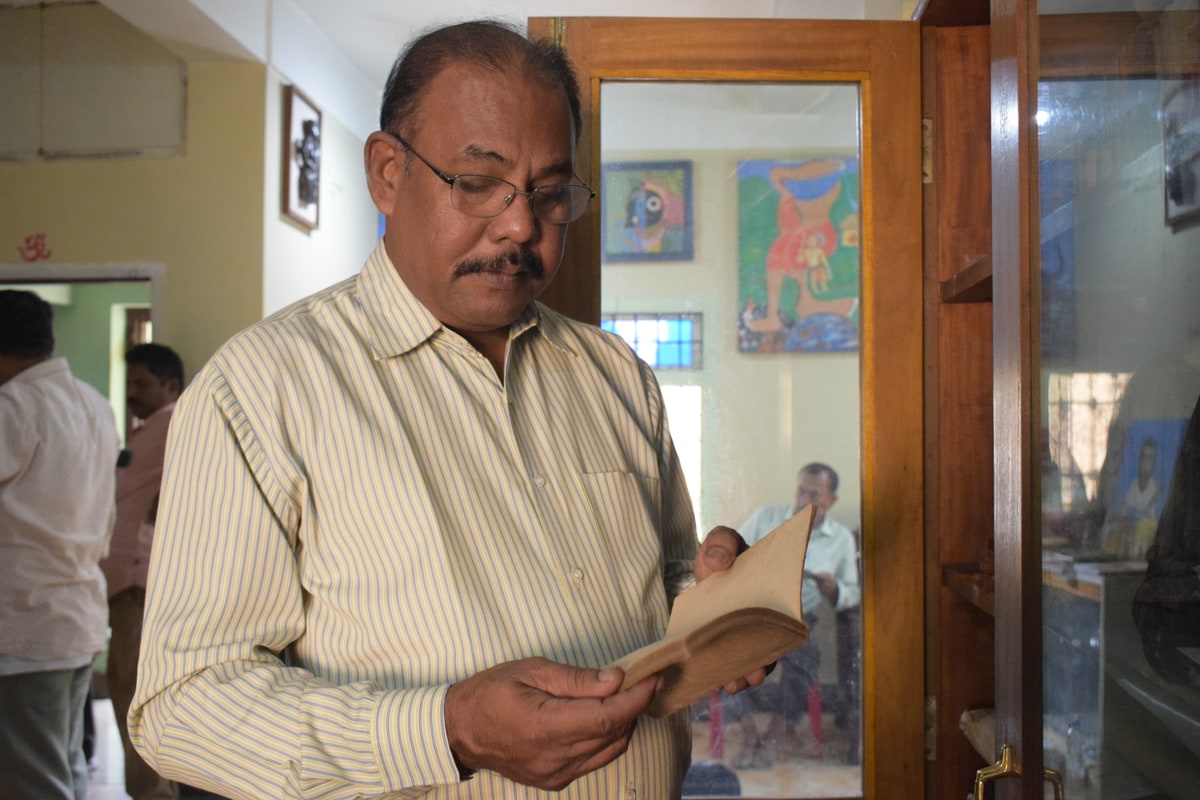
A collection of magazines, songbooks and photographs once needed a mini-truck to make its journey from Puri to Bhubaneswar. Recalling it in a 2022 interview, Surya Deo credited Srikant Mohanty, publisher of Manoranjan, with entrusting the material to him.1 There is something quietly moving about that scale: cinema’s memory travelling as things someone had kept.
The gesture belongs to a larger story. Deo’s writing, collecting, exhibitions and screenings have helped make Odia cinema available for another kind of encounter—one that continues after the lights come up.
A question sent him to the newspapers
Deo traced the beginning to a cinema-history column for Dharitri’s Sunday supplement, Chhutidina, developed with fellow journalists Gopal Mohapatra and Bibhuti Mishra. Dependable information was difficult to find. He remembered Akshaya Mohanty encouraging him to consult old newspapers, and acknowledged the help of journalists, Film Journalists’ Forum members and film workers. He also described setting aside part of his earnings for the work.1
A column needs an answer by its deadline. Research can leave the writer with more questions. A notice may establish that a film was advertised; a songbook may preserve a lyricist’s name. Neither, by itself, explains everything that happened. Their value grows when they can be read together.
When a singer finds a photograph she does not own
At Geeti Chhaya, an exhibition opened at the Odisha State Museum in 2017, singer Trupti Das expressed surprise at seeing photographs she did not herself possess. Reporting on the exhibition described more than a hundred photographs of film-music work from 1950 to 1986, alongside gramophone records. The Culture Department and Film Journalists’ Forum collaborated on it; Deo credited material gathered from producers, directors, composers, lyricists, researchers and actors.2
Writing that travels beyond a screening
Some of the writing collected in Kali Paine Kalira Cinema grew from booklets prepared around Film Journalists’ Forum screenings. The book brings together accounts of 21 films, giving an evening’s encounter a life on the page.3 Its recognition was a Special Mention in Best Writing on Cinema at the 68th National Film Awards, for the 2020 award cycle, announced in 2022.4
Deo’s wider work includes Odia Cinema Rupa Rupantara, Jhura Mana Jhara Giti and compilations of Odia film lyrics. A narrative history, writing about music and a collection of song texts serve different readers and different questions.5 Our guide to books on Odia cinema places these alongside work by other authors.
The National Film Archive of India also lists his History of Odia Film among its completed research-fellowship projects.6
Finding a copy is also work
A 2024 account of efforts to screen ଉଲ୍କା (Ulka) describes a damaged film print that could not be projected. A U-matic video cassette was subsequently traced and cleaned for use.7 It was a way to bring the film back before viewers; the report does not establish a restoration from the original film negative.
A surviving video copy allowed an audience to meet the film again. Its recovery mattered, even while the future of the film elements remained a separate question.
Memory can become another film
Filmmaker Lipika Singh Darai’s project Rediscovering Sita Bibaha provides a particularly suggestive connection. India Foundation for the Arts names Deo as her collaborator and describes gramophone recordings, contracts, poster copies and press material in his collection informing her search. The project concerns the missing first Odia film and the world around its making.8
Here, the archive is part of a new creative process. A filmmaker asks what surviving traces can tell us—and how to tell a story when the film itself is absent. Our companion article follows that search.
Deo’s public record gives us a picture of sustained attention, supported by many people who kept something, shared something or helped an audience see it again. For a cinema seeking its next possibilities, that work offers more than reassurance about the past. It leaves material with which someone else can begin.
Something kept, ready to be passed on.
Footnotes & Sources
-
Bijay Mandal, interview with Surya Deo, OrissaPOST, 28 July 2022, p. 2. ↩ ↩2
-
Minati Singha, Geeti Chhaya exhibition report, The Times of India, 5 October 2017. ↩
-
Deo on his book and the screening booklets, Odisha Bytes, 22 July 2022. ↩
-
Press Information Bureau, 68th National Film Awards, Best Writing on Cinema, Special Mention. ↩
-
Shyamhari Chakra, profile of Surya Deo, 27 October 2020. ↩
-
NFAI, Research Fellowship, completed-project list, “History of Odia Film”. ↩
-
“Ulka shines bright after 43 years”, OrissaPOST, 20 July 2024. ↩
-
India Foundation for the Arts, Lipika Singh Darai project record, 2024–25. Project in development; no recovered print. ↩
Credit: Sangram Keshari Senapati. Source · CC BY-SA 4.0 ↩

Further reading
Suggest an update: share a publication record, credit or precise correction.