
Odia cinemaMemory and Discovery
Reading Odia Cinema: the books behind the screen
In this article
The screen gives us one encounter. A book can help us return with different questions.
A song can remain with a family long after the film around it has become difficult to find. A photograph may outlive the studio where it was taken. Somewhere, a reader opens a book and encounters the name of the person who wrote the song.
The writing around Odia cinema belongs to this continuing exchange. It includes histories and criticism, but also collected lyrics, working lives and memories kept by families. Read together, these works can bring more people into the picture.
This growing guide draws on selected original pages and public previews, as well as catalogue and publication leads. It is not an exhaustive bibliography or a review of every book. The entries distinguish what is available and keep unsettled edition details visible.
Begin with the question you want to follow. For chronology, look towards Ghosh and Rath; for cinema’s social questions, Sanjoy Patnaik. For songs, try Surya Deo’s collections and Devdas Chhotray’s lyrics. For a working life remembered from within, turn to the memoirs below.
Where a longer account begins
Kartik Kumar Ghosh — Oriya Chalachitrara Itihas. A Fakir Mohan University accession list records a first edition dated 1984. The explanatory notes in the Encyclopedia of Indian Cinema also identify Ghosh’s work as a source. This is an important earlier point of reference when tracing who has documented the field; later bibliographies give another date, so editions still need to be compared.1
Bhim Singh — Odia Chalachitrara Agyanta Adhyay. The filmmaker’s book is documented in biographical reporting and later scholarship. Roy’s bibliography gives 2008; the edition history still needs to be established. Its place here also reminds us that practitioners have written about the industry from within.2
Surya Deo — Odia Cinema Rupa Rupantara. A history of changing forms of Odia cinema. Reports place its beginnings in 2010; a bookseller lists a 2016 second edition. His Kali Paine Kalira Cinema, published by Pakshighar Prakashanee, brings together accounts of 21 films. It received a Special Mention for Best Writing on Cinema in the 68th National Film Awards, announced in 2022 for the 2020 cycle.34
Ranjan Kumar Rath — Evolution of Odia Cinema: A Historical Study (1936–2010). Published by B K Publications in 2024, this English-language study is listed at 324 pages. In the preview passages we examined, the cinema’s beginnings connect to theatre-trained actors, musicians, makeup workers and stage builders. That is a useful starting point for following skills across media. Explore the available Google Books preview.5
Sanjoy Patnaik — Of Reels, Romance and Retakes: Social Narratives of Cinema in Odisha. Released in 2023, with Routledge’s catalogue carrying a 2024 copyright date, this study places cinema in a social and cultural frame. Its contents and publisher description point towards literature, audiences, class, gender and the industry’s future. We have read selected preview passages, not the full arguments of those chapters. Explore the Google Books preview.6
The books ask different questions: what followed what, who participated, and how audiences encountered the films.
Songs, literature and the people around a film
Surya Deo — Jhura Mana Jhara Giti. A study of Odia film music, documented in his published profiles. Alongside it are his two film-song compilations: Odia Cinema Gita 1936–1969 and a second volume described in a festival biography as covering 1970–1978. The first appears in a government book-selection list and a scholarly bibliography; the second volume’s exact title-page date range still needs inspection.37
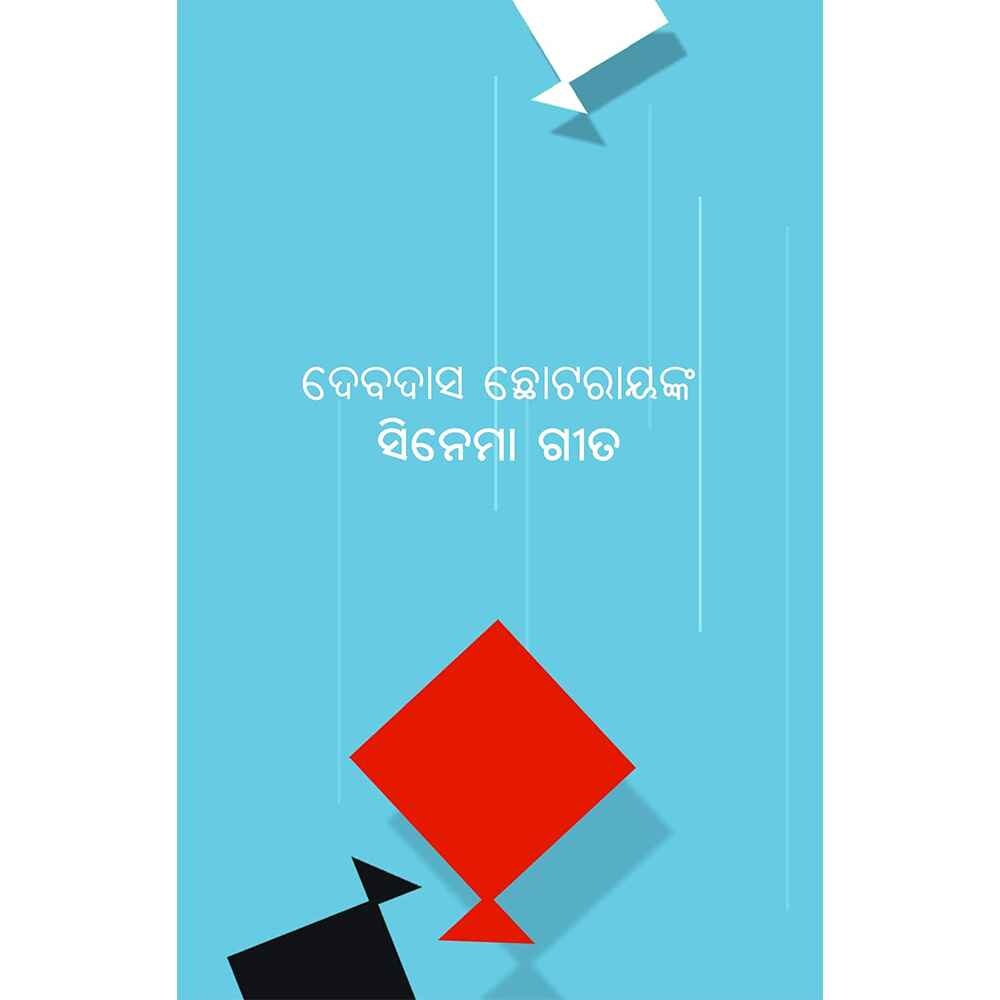
Devdas Chhotray — Cinema Geeta (ସିନେମା ଗୀତ). Published by Ketaki Foundation Trust in January 2020, this collection gathers Chhotray’s film lyrics. A lyricist’s words on the page offer a different object of attention from the finished recording.8
Dillip Kumar Pani — Odia Chalachitra Ra Sahitika O Sanskrutika Mulyayana. Its launch was reported alongside a 2019 Film Journalists’ Forum screening of ରକ୍ତ ଗୋଲାପ (Rakta Golapa). The title concerns cinema’s literary and cultural evaluation. We still need the title page to settle its exact transliteration and publication details.9
Iti Samanta, editor/compiler — Odia Cinema: Expansion & Analysis (1936–2019). Her author website lists this work with material spanning creative and technical roles. The English wording is how the website presents the title; it does not establish an English-language edition.10
Sanjoy Patnaik, editor — Odia Cinema@90: Rhythms, Renditions and Reflections. The Bhubaneswar Film Circle’s 2024 collection brings multiple contributors into the discussion. A contemporary review identifies writing on literature, folk music, film songs, production facilities and representation. The festival’s subsequent report describes the book as bilingual. The organisers later reported that nearly 200 copies sold within an hour of its launch.11
Pragati Mohapatra’s chapter on literary classics and cinema is also recorded in her institution’s publication list. The collection’s review names Mahasweta Baxipatra on film songs and Debasis Mohapatra on folk music. These are promising routes for further reading, rather than arguments we can claim to have examined in full.11
Sandip Kumar Nayak — Ollywood and Its Superstars: Its All About Odia Cinema. Catalogues list this short English-language book from Notion Press in 2021. Its contents have not been assessed here.12
A lyric collection may help us find a writer’s contribution. An interview collection may reveal an editor, a technician or a producer whose decisions shaped a film. For the question that brought us here—how creative work reaches people and supports those who make it—both deserve attention.
Lives that sit beside the histories
A memoir remembers from one position. A family account preserves access to another. Those qualities make such books valuable, while leaving room to compare recollections with other records.
- Sarat Chandra Pujari — Nijaswa Chitranatya: Smrutipatha. Collected autobiographical writings, edited by Pritish Acharya (Sikshasandhan, 2015). In the title essay, Pujari recalls being asked how a film actor could also be a college principal. The question opens a way to read him beyond his screen roles.13
- Ratri Ghose Barman — Gour & Parbati. Launched in 2021, this family-authored account concerns Gour Prasad Ghose and Parbati Ghose. The family archive provides a route into their photographs and continuing remembrance.14
- Akshaya Mohanty — Aryyadasara Atmalipi and Aryyadasara Sheshalipi. The catalogue records these as separate works, dated 2002 and 2003. They belong to his autobiographical literary writing; individual episodes should not be treated as independently established biography merely because they appear in that form.15
- Iti Samanta, compiler — Amara Akshaya. Her bibliography lists this work on Akshaya Mohanty and his literary creations. Its wider literary scope makes it a companion to cinema reading rather than a general film history.10
Read beyond the cinema shelf
Four broader works offer useful connections without being books exclusively about Odia cinema:
-
Piyush Roy’s Appreciating Melodrama: Theory and Practice in Indian Cinema and Television includes a chapter on rasa, the Natyashastra and the birth of Odia cinema. The publisher’s contents identify the chapter; our earlier research used selected passages of Roy’s related doctoral thesis.16
-
Ashish Rajadhyaksha and Paul Willemen’s Encyclopedia of Indian Cinema offers a wider reference setting. Its bibliographic trail also makes earlier documentation visible.1
-
Sharmila Chhotaray’s Cultural Politics of Popular Performances: The Structure and Representation of the Odia Jatra concerns theatre rather than cinema. It belongs beside our exploration of storytelling, audiences and performance economies.17
-
Madhusudan Pati — Kalindi Charan Panigrahi. Published by Sahitya Akademi in 2001, this literary biography leads from Matira Manisha into the writer’s working life. In selected sample pages, Pati describes a handwritten magazine carrying Odia, Bengali and English writing under Kalindi’s editorship. He also follows memoir instalments for Kalana into an enlarged autobiography. Magazine-making and recollection offer two ways to approach the person behind the film’s story credit.18
Periodicals and the people behind the pages
A magazine can give stories, songs and the people making a film a place to meet. In his retrospective account of Chitrapuri, Surya Deo describes film-special issues carrying stories, songs, crew names and contributors’ own experiences. Fiction and radio plays also appeared alongside cinema writing.19 His account invites us towards the original issues, where those different voices shared space on the page.
The opening pages of the Encyclopedia of Indian Cinema make another kind of collaboration visible. Its acknowledgements name Chandidas Mishra and Samarendra Das among the Odia contributors. Its source notes identify Ghosh’s 1984 history and credit Das with compiling information after 1986.1 Behind a reference entry are people finding, assembling and passing on information. Their names deserve to accompany the films we look up.
A smaller object offers a further reading trail. Indiana University’s South Asian Cinema Ephemera Collection lists a booklet titled Shesha drushti = The last vision: an Oriya film, catalogued as 1997. That is the item’s catalogue date, not an established release date for the film.20 The booklet’s pages remain to be examined.
A shelf that can keep growing
The present reading list identifies 14 cinema-focused entries and five related entries in life writing or tribute, with the four broader works above kept separate. Editions and formats are not interchangeable: the two reported song compilations are listed separately, while a paperback and an ebook of the same text are not different works.
Older editions and overlooked writing may still change this shelf. A title page supplied by a reader can settle an uncertainty; a full reading can change what we thought a book offered.
For Project Odisha, the next step is to let that reading sharpen our questions. What can an earlier production teach a new team? How did a song acquire a life beyond its film? Which experiences have still not reached a page?
A bibliography becomes useful when somebody follows it—and returns with something we had not yet seen.
Reading opens another question.
Footnotes & Sources
-
Fakir Mohan University, accession list, entry 1478; Encyclopedia of Indian Cinema preview, printed pp. 7 and 12, acknowledgements and source notes. ↩ ↩2 ↩3
-
Bhim Singh profile, The New Indian Express, 2010; Piyush Roy, doctoral thesis, bibliography, PDF p. 300. ↩
-
Shyamhari Chakra, Surya Deo profile; 2016 edition catalogue. Earlier date reported in JDCA talk coverage. ↩ ↩2
-
Google Play publisher catalogue, ISBN 9789391968861. Selected preview: printed pp. 59–63; portions of pp. 19–20 and 251–252. ↩
-
Routledge catalogue; 2023 author interview. Selected preview: contents, partial acknowledgments and ebook locations PT43–45. ↩
-
Odisha Culture Department, 2015–16 book selection, entry 138; 2022 festival biography, second volume. ↩
-
Cinema Geeta, title and imprint photographs; Ketaki Foundation Trust bibliography, ISBN 978-81-944562-3-0. ↩
-
Book launch at a Rakta Golapa screening, My City Links, 1 May 2019. ↩
-
Iti Samanta’s author bibliography. Original title pages and edition details not inspected. ↩ ↩2
-
Bhubaneswar Film Festival, 2024 programme and 2025 retrospective; contemporary review; Pragati Mohapatra’s institutional bibliography, chapter pp. 82–92. ↩ ↩2
-
Bookscape catalogue, ISBN 9781685547165. Title-page inspection pending. ↩
-
Sarat Chandra Pujari, Nijaswa Chitranatya: Smrutipatha, title/imprint, editor’s preface and pp. 10–11 (PDF pp. 2–3, 6, 20–21). ↩
-
Open Library: Akshaya Mohanty, separate work and edition records. ↩
-
Bloomsbury, Appreciating Melodrama, 2022, contents. ↩
-
Primus Books, Sharmila Chhotaray’s study of Odia Jatra, 2022. ↩
-
Madhusudan Pati, Kalindi Charan Panigrahi: Sahitya Akademi catalogue, 2001; public samples, printed pp. 7, 25, 65. ↩
-
Surya Deo, Chitrapuri retrospective, Chhayalipi part 14, Odisha Sambad, 22 August 2021. ↩
-
Indiana University, South Asian Cinema Ephemera Collection, SSEA001, Booklets series, Shesha drushti entry. ↩
Further reading
Suggest an update: help identify a missing book or edition with its title page, author, publisher and publication year.