
Odia cinemaMemory and Discovery
Searching for Sita Bibaha: the film beyond the missing print
In this article
A missing film can leave enough traces for another story to begin.
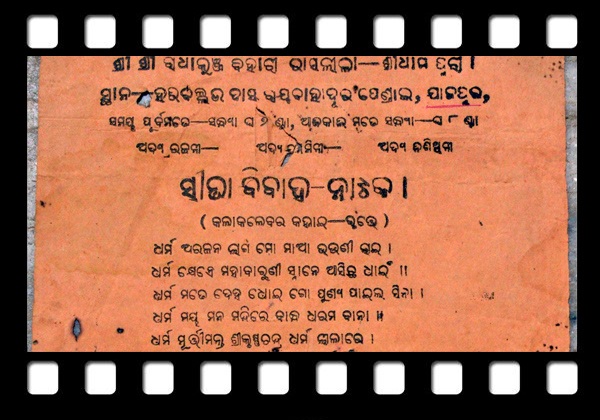
A song, a contract, a poster: small things can hold a large absence.
The first Odia film, ସୀତା ବିବାହ (Sita Bibaha), has a place in our histories that few readers have been able to encounter on a screen. In 2011, Mohan Sunder Deb Goswami’s grandson, Kabiraj Deb Goswami, told a reporter that no print was available.1 That was a statement about what could be found then, not a reason to stop asking.
Years later, filmmaker Lipika Singh Darai made the search the subject of a new project, with Surya Deo as collaborator. Their point of departure includes recordings and paper records he has collected.2 A history that seems to end with an unavailable film opens into the possibility of another.
Returning to 1936
An earlier Calcutta screening preceded the film’s 28 April 1936 Puri opening.3
Our cinema overview places this beginning within a longer story. Here, the question is what survives around it—and what those traces might allow us to understand.
The people before the screen
The 2011 report identifies a play by Kamapal Mishra as the source and names Makhanlal Banerjee, Aditya Ballav Mohanty as Lakshman, and Prabhabati Devi as Sita among the performers.1 A beginning commonly remembered through one filmmaker’s name was also an adaptation and a collaboration.
Piyush Roy’s research connects Goswami to touring rasalila and records Surya Deo’s interpretation of the film as primarily gitinatya, or musical drama. Roy also distinguishes Goswami’s credited role from accounts of Kali Films and technical collaborators in Calcutta.4 These are questions for closer historical reading, rather than grounds for silently rewriting the credits.
An existing dramatic text and Goswami’s performance experience met a new recording medium. That connection is specific to this production; it does not make every Odia performance tradition its direct ancestor.
What a surviving object can tell us
India Foundation for the Arts describes the material informing Darai’s project: gramophone recordings of musically narrated versions, artists’ contracts, copies of posters and newspaper coverage.2
Each kind of record invites a different question. What does a contract say someone was expected to do? What did a poster promise an audience? How was a story presented in a recording? A record may answer one question and leave another open.
These musical narrations have not been established as the film’s original soundtrack. Heard alongside a poster or contract, they can still help us explore the world around its making.
A filmmaker who listens for memory
Darai’s own account gives this project a human setting. She trained in sound recording and design at FTII. She describes Ho as her mother tongue and Odia as the language of her schooling and filmmaking. Her biography also recalls how tracing her late childhood music teacher became the subject of her first film.5
Language here is a place of meeting, with different personal histories entering it. That belongs in the story of Odia cinema as much as a release date does.
Her filmography includes Backstage, concerning puppeteers in Odisha, and works shaped as imagined conversations with her late grandaunt.6 These descriptions suggest an interest in the relationship between memory and the form a film can take. They do not tell us in advance what Rediscovering Sita Bibaha will become.
IFA’s 2024–25 annual report records the project as a proposed docufiction, combining documentation and fictional interpretation.7 The distinction is useful for a viewer: a new enactment can be part of a filmmaker’s response to the past while remaining recognisable as something made in the present.
A completed film, release date or recovered print has not been confirmed.
What the search leaves open
This story returns us to the work of keeping cinema’s memory available. A collection acquires another life when a filmmaker brings new questions to it. Research can support an artwork; that artwork can lead a viewer back to the records.
There are still things to seek: a traceable copy, original credits, fuller accounts of the performers, and the relationship between the surviving music and the film. A responsible telling can acknowledge these gaps without making absence the whole story.
For Darai, the process of looking has itself become a subject. The newspaper, the song and the conversation are material for a new work, even while the older film remains unavailable.
Sita Bibaha remains a beginning. The search around it offers another.
Following what remains.
Footnotes & Sources
-
Minati Singha, “Sita Bibaha prints lost”, The Times of India, 29 April 2011. Family testimony, adaptation and reported cast. ↩ ↩2
-
India Foundation for the Arts, Lipika Singh Darai project record, 2024–25. Describes a search and planned work. ↩ ↩2
-
Kapilas Bhuyan, cinema retrospective, PIB, 2010. ↩
-
Piyush Roy, doctoral thesis, printed pp. 137–139 and 143–144; includes his 2014 interview with Deo. ↩
-
Lipika Singh Darai’s biography, the filmmaker’s account. ↩
-
Darai’s filmography, project descriptions. ↩
-
IFA, Annual Report 2024–25, printed p. 12. ↩
Credit: Sita Bibaha printed material, via OrissaPOST. Source ↩
Further reading
Suggest an update: share a traceable archive record, original credit or documented project update.