
Niyamgiri: cultivation and village decisions
By Ahimanikya Satapathy
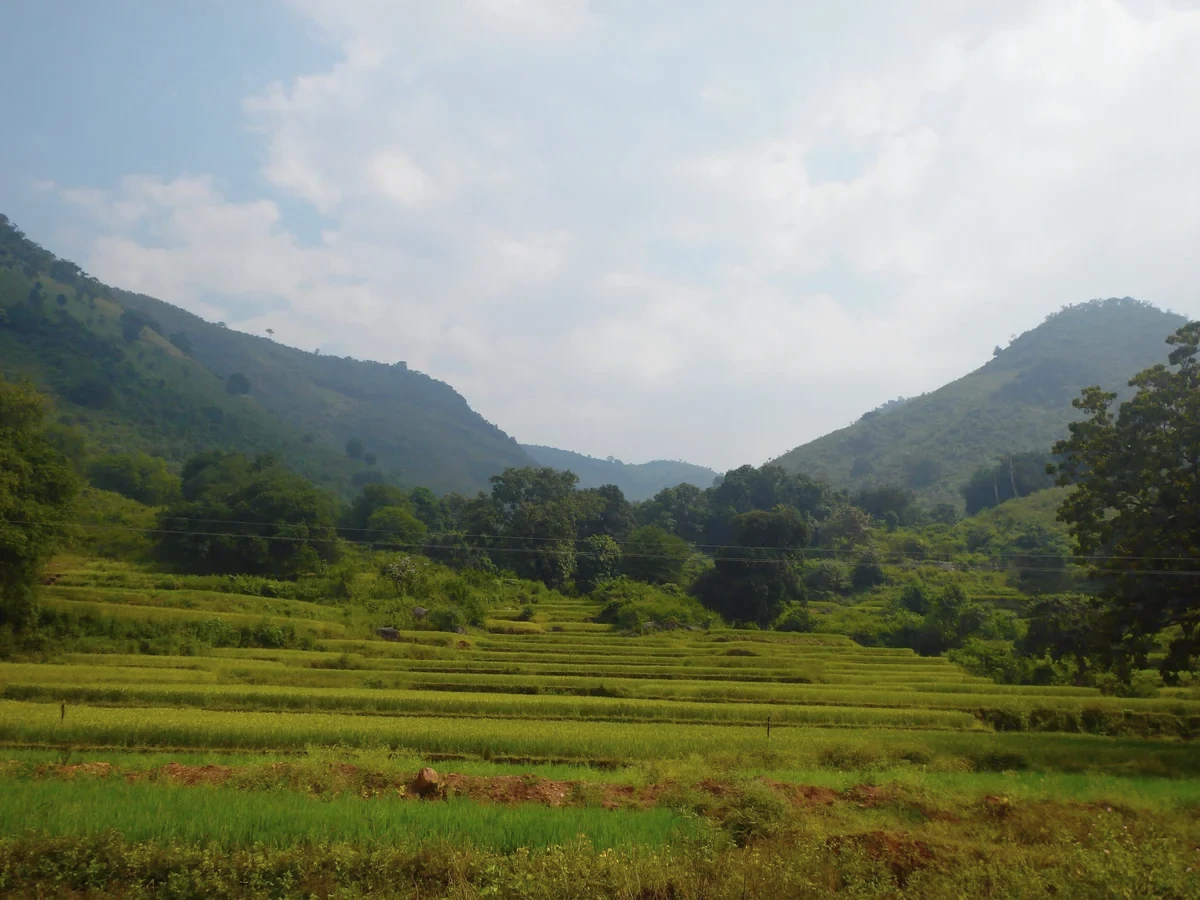
Cultivated land in the Niyamgiri landscape, photographed in 2018.
Suresh Wadaka explained a slope through the roots of its crops. In an undated study commissioned by Odisha’s Scheduled Castes and Scheduled Tribes Research and Training Institute, he described how shallow and deeper root systems worked differently against soil loss. Their spread and depth mattered when deciding what to plant together.1
The Foundation for Ecological Security’s researchers used interviews and walks in selected villages around Chatikona. Wadaka’s explanation offers one way of understanding cultivated land from the work done upon it; the study records village differences, language barriers and gaps in its seasonal observations.1
A landscape that feeds households
In 2017–18 fieldwork centred on Kurli, Sujatarani Dandapat described food crops and commercial horticulture sharing the farming landscape, sometimes the same plot. Finger millet, pulses and tubers appeared alongside pineapple, banana and turmeric.2
Singari Jakesika and Palari’s later accounts bring household choices into that picture: how much land to give to millets, how to earn income and who has authority to decide.3 Those accounts describe different people and years from the village meetings of 2013. They help us see why land has everyday importance, without supplying the participants’ reasons for their votes.
Asking the villages
On 18 April 2013, the Supreme Court directed village assemblies, or Gram Sabhas, to examine individual, community, cultural and religious claims in the Niyamgiri case. They were to consider whether the proposed mining would affect those rights, including worship associated with Niyam-Raja and the deity’s abode.4
A judicial officer of district-judge rank was to observe and certify the proceedings. The assemblies’ decisions would inform the Ministry’s final decision on Stage II forest clearance. These were distinct responsibilities; the judgment separately addressed alleged violations at the Lanjigarh refinery.4
What people asked to have recorded
At Serkapadi on 18 July 2013, Dongria Kondh participants rejected mining. Sandip Das’s report the following day connected the resolution with worship of Niyam Raja and identified district judge Sarat Chandra Mishra as observer. Contemporary newspapers give different attendance figures, retained in the source note.5
Kesarpadi’s assembly followed on 22 July and also rejected mining. The New Indian Express reported that 33 of the village’s 36 voters attended, attributing that figure to district collector Sashi Bhusan Padhi.6
In Down To Earth’s account, Dondu Kutruka asked officials to record the villagers’ statements accurately and read them back. Residents insisted that their claims to the wider Niyamgiri landscape appear in the resolution before they signed. The report also identifies Suku Kutruka as the village forest rights committee president; he connected his opposition to mining with millet-growing slopes and forests shared with wildlife.7
What the record recognised—and how far that recognition extended—mattered alongside the vote itself. These are the reporter’s accounts of their interventions, not a new transcription of the meeting.
Twelve village decisions
The Xaxa Committee’s 2014 report records twelve assemblies held between 18 July and 19 August 2013 in hamlets selected by the state as likely to be affected. All twelve rejected the proposed mining. The committee drew on English translations of resolutions supplied by the state.8
A parliamentary answer in May 2015 records the same outcome, with seven villages in Rayagada and five in Kalahandi.9 These are decisions by particular village assemblies, not a count of every settlement or individual in Niyamgiri. The historical record does not establish current permissions or a permanent ban.
Wadaka’s explanation of roots and the assemblies’ insistence on recording their claims concern different ways of knowing and speaking for land. People cultivate within this landscape, worship within it and argue about its future. The story now turns to their homes, and the work of keeping a household sheltered.
Further reading
Niyamgiri rights and mining: the legal overview
Dongria life in Niyamgiri · Kapadaganda and its makers · Forest foods and home gardens
Footnotes & Sources
Image: Pillai Sree Vidya. CC BY-SA 4.0; source. Colour and tone adjusted for print; composition unchanged.

-
Foundation for Ecological Security, SCSTRTI-commissioned land and water management study, acknowledgement; printed pp. 49–50, 113. The report describes convenience sampling; publication date unverified. ↩ ↩2
-
Sujatarani Dandapat, “Traditional Ecological Knowledge and Continuation of Swidden Cultivation: A Case Study of the Dongria Kondh of Niyamgiri Hills, Odisha”, Man In India 101(3–4), 2021, pp. 159–173; study scope and methods pp. 160–161, crops pp. 166–167, labour p. 168. Fieldwork centred on Kurli in 2017–18; this is not a current survey of all Niyamgiri villages. ↩
-
Deepanwita Gita Niyogi, “Superfood Millets Need Revival at Home”, The Citizen, 19 November 2022, reproduced by the International Women’s Media Foundation. The article draws here on the named accounts of Singari Jakesika and Palari; their experiences are not treated as representative of every household. ↩
-
Supreme Court of India, Orissa Mining Corporation v. Ministry of Environment & Forest & Others, 18 April 2013, paragraphs 55–62, printed pp. 946–948. Court directions are distinct from the parties’ submissions and later outcomes. ↩ ↩2
-
Sandip Das, First gram sabha nixes mining in Niyamgiri, The Indian Express, 19 July 2013, opening paragraphs, Serkapadi dateline. Compare Serkapadi palli sabha says no to mining in any part of Niyamgiri hills, Down To Earth, contemporary account, paragraph beginning “After all”: it reports 38 members rejecting mining, whereas Das reports 36 participants. The discrepancy is unresolved; it is not assumed to distinguish eligible voters from attendees. Attendance and observer attribution have not been checked against signed Serkapadi minutes. Village spelling follows this source. Its forward-looking meeting schedule is not adopted. ↩
-
Second gram sabha too says no to mining at Niyamgiri, The New Indian Express, 23 July 2013, opening two paragraphs. Attendance is attributed to the district collector; the article does not reproduce the signed resolution or provide a speaker-by-speaker account. The report’s wider population estimates and summary of legal powers are not adopted. ↩
-
Down To Earth, Second palli sabha in Niyamgiri deals double blow to Odisha government, 22 July 2013, link labelled “Kesarpadi Palli Sabha resolution/ minutes of the meeting”; six-page scan, recovered 4 November 2026. All six pages visually inspected. Handwritten Odia-script text, signatures and thumb impressions; no complete transcription, translation, signature authentication, independent attendance count or judicial-certification verification claimed. The hosting article supplies the document attribution; this is not a certified archival copy. The same article links a separate two-page verification report, both pages visually inspected on 4 November 2026. The settlement-dispute account is attributed to the reporting; land-table figures and a full translation are not adopted. ↩
-
Ministry of Tribal Affairs, Xaxa Committee report, 2014, printed p. 353, footnote 356. The committee’s account is inspected here; the complete set of signed village resolutions and their translations has not been independently retrieved. A press-hosted Kesarpadi scan is described in note 9. ↩
-
Rajya Sabha, Unstarred Question 1978, “Bauxite mining”, answer by Minister of State Vishnu Deo Sai, 13 May 2015, printed pp. 236–237. This is the minister’s report of village decisions. ↩