
Forest foods and home gardens in Rayagada
By Ahimanikya Satapathy
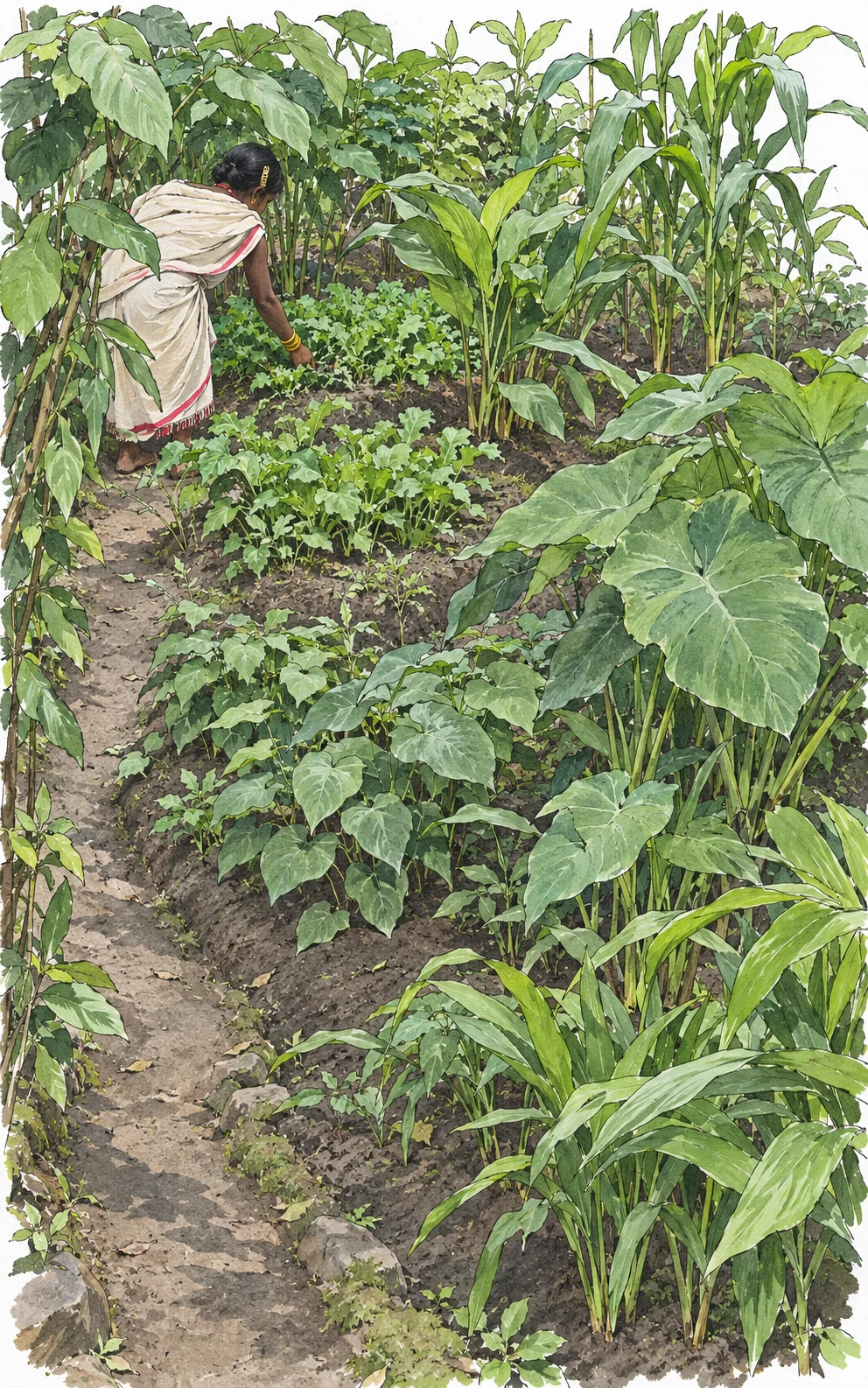
A woman tending plants, seen from above along a garden path - an interpretive illustration. The garden is imagined, not a botanical identification guide.
For Padmavati Paleka of Leling Padar, the rainy season brought mushrooms, tender bamboo shoots, fruits and leaves. Her account in Basudev Mahapatra’s 2017 reporting follows Rayagada’s food through the changing year: what becomes available and what reaches the household.1
These regional accounts concern several communities, not exclusively Dongria Kondh. They follow food gathered in forests, grown in gardens and bought for meals, along with the work and choices connecting those sources.
The changing seasonal plate
In Abhijit Mohanty’s November 2025 reporting, Sana Kumruka of Balipadara recalled varied rainy-season meals, followed by simpler food in summer and winter. She described eating pokhalo, fermented rice, with mashed potatoes or a small selection of boiled vegetables. After establishing a garden, she said, the accompanying foods became more varied, including greens, lentils and tubers. She also described her children enjoying the more colourful meals.2
Kumruka and Paleka spoke from different villages and reporting periods. Their accounts show why a list of local ingredients is incomplete without seasons, quantities and the work needed to bring food home.
What comes home from the forest
Ecologist Debal Deb’s 2017 report for Living Farms examined four forest areas in Rayagada and Balangir. Field assistants visited households and weighed collected foods, including fruits, mushrooms, tubers, flowers and leafy vegetables. Weighing food brought home captured a harvest that might never pass through a market.3
The report related forest condition to the diversity and quantity of foods collected. Its comparisons suggested advantages at the sites under informal community management, while acknowledging that the small sample and limited forest types could not establish a universal result.3
Food gathered for a household’s own meals may never appear in a sales record. The study’s household measurements make some of that contribution visible, while the women’s accounts explain how it changes their meals.
Learning beside someone who knows
In Abhijit Mohanty’s August 2026 reporting, Madhabi Jani of Siriguda in Rayagada described continuing to accompany her mother when gathering mushrooms. Her mother noticed signs in the forest that she did not yet recognise. She said she continued following her mother because she worried about making a mistake. Repeated trips had not made her feel equally skilled.4
The report also follows Sabani Majhi, a Paroja woman in Rayagada, on a seasonal gathering trip.4 Neither account establishes a practice shared by all Dongria households.
Researchers also depended on people who could name and explain what they gathered. A SCSTRTI-commissioned study including Dongria communities describes local workers helping translate plant names into Odia, and summer and monsoon foods known through participants’ accounts because fieldwork took place in winter. Those names and recollections provide context; they do not by themselves establish a plant’s identity.5
Growing food close to home
Mohanty’s November 2025 report describes women growing vegetables, pulses and tubers in gardens supported by Living Farms. Rua Kutruka of Balipadara said spending less on vegetables had allowed her family to buy eggs, fish and chicken more often. Her account shows how home cultivation can change purchases as well as what is harvested.2
Paleka’s seasonal foods, Jani’s learning trips and Kutruka’s household purchases bring different parts of the food story together. Feeding a family involves deciding what to gather, grow, keep and buy—and adapting those choices as the season changes.
What a household keeps for meals and what it sells lead to different decisions. The market accounts that follow turn to the work between harvest and payment.
Further reading
Dongria life in Niyamgiri · Niyamgiri and cultivation · Kapadaganda and its makers
Footnotes & Sources
Adapted illustration: Project Odisha. CC BY-SA 4.0. Clothing reference: photograph by Pillai Sree Vidya, CC BY-SA 4.0. Imagined composition; portrait adaptation for this edition.

-
Basudev Mahapatra, Forest food ensures nutritional security of Odisha’s tribes, Village Square, 2017; interview with Padmavati Paleka under “Perennial food source.” The page displays the date as 11/12/2017. This article uses her seasonal account, not the source’s broader assurances about freedom from hunger. ↩
-
Abhijit Mohanty, How seed banks and nutrition gardens are empowering Adivasi women in Odisha, Good Food Movement, 4 November 2025, “Enabling food diversity.” Household testimony, not an independent programme evaluation; the communities covered are not exclusively Dongria Kondh. ↩ ↩2
-
Debal Deb, Food and Nutrition from Forest: Relationships with Forest Ecological Status and Management System, Living Farms, December 2017. See study design and harvest measurement, sections 3.1 and 3.4; relationships, section 6; limitations, section 10. Acknowledgements identify research during 2016–17. This is a local comparative study, not a survey of all Odisha households. ↩ ↩2
-
Abhijit Mohanty, The last keepers of Odisha’s wild mushrooms, Good Food Movement, 15 August 2026, opening account and “Life-saving, enriching knowledge.” Full text inspected. Madhabi Jani’s community is not specified; Sabani Majhi is identified as Paroja. These accounts support a discussion of learning, not species identification, edibility, medical use or population-wide knowledge loss. Photographs and recipes are not reproduced. ↩ ↩2
-
SCSTRTI, Indigenous Knowledge on Selection, Sustainable Utilization of Local Flora and Fauna for Food by Tribes (PTG) of Odisha, section 1.8, printed p. 18 (PDF p. 32), limitations 2 and 7; section 1.7.2, printed p. 16, gives the overall study period as December 2014–November 2015. Methods and limitations read through extracted PDF text; complete-page visual inspection remains unavailable. The report includes several communities. Its botanical identifications, nutritional estimates and preparation instructions are not adopted here. ↩