
Homes and the work of repair in Niyamgiri
By Ahimanikya Satapathy
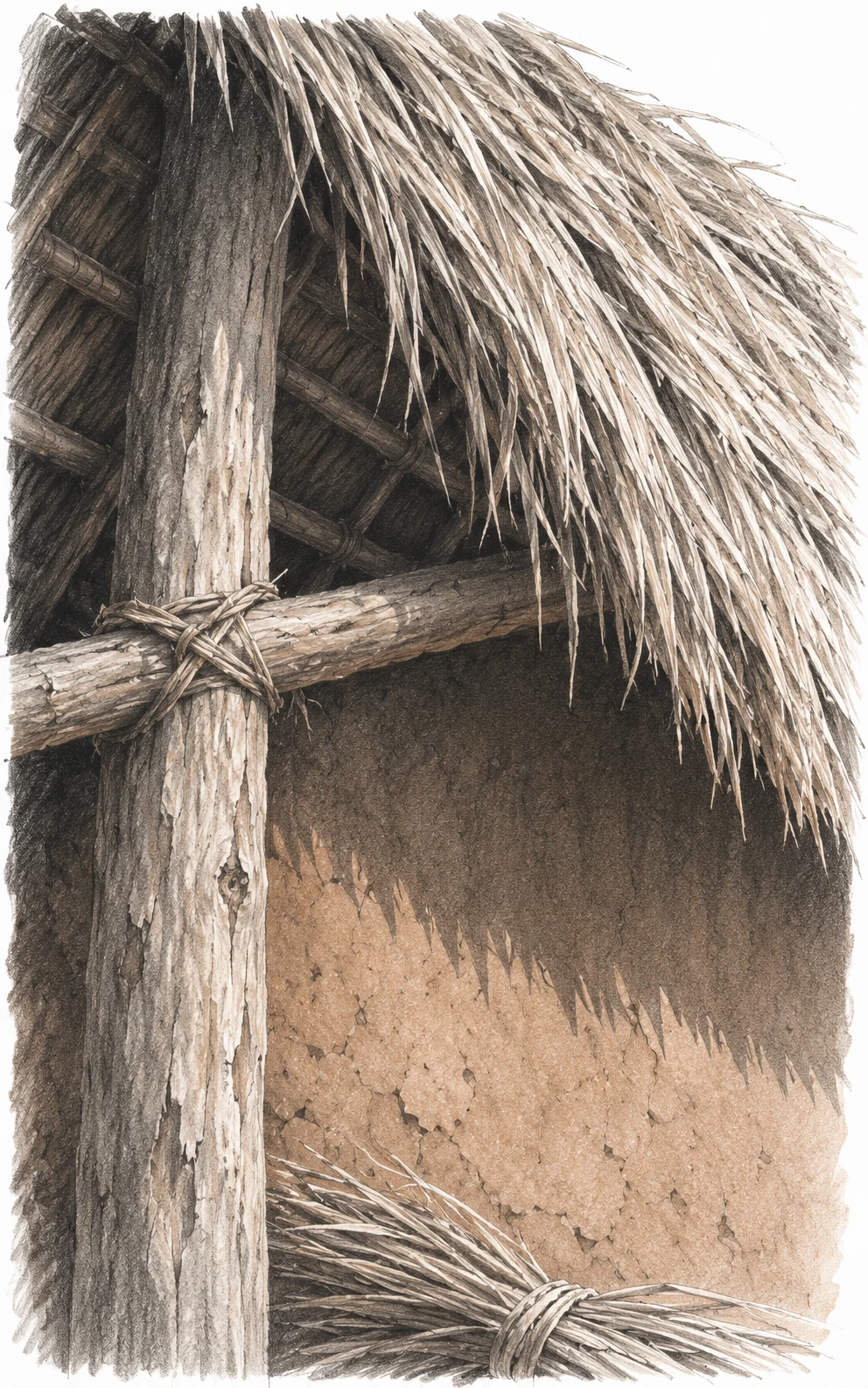
Timber, earth and grass thatch beneath low eaves - an interpretive architectural detail informed by a 2016 description. It is not a documented building or a universal present-day form.
Mana Manjhi feared losing her roof in wind and heavy rain. In a UNDP account displayed with an August 2022 date, the Dongria Kondh farmer said support to build a pucca house had brought relief: she felt more confident that she and her grandson would have shelter during a storm.1
The value she described was practical: shelter for two people when the weather changed. Keeping a home habitable also involves repairs, money and access to help.
Building for the weather
In their July 2016 study of Niyamgiri, Meenal Tatpati, Ashish Kothari and Rashi Mishra described earthen houses arranged in parallel rows, with wooden posts and steeply sloping thatched roofs. They related the low-reaching roofs to protection from wind and rain.2
The researchers describe a particular building form; Mana speaks about her own home. Neither account settles how every thatched house performs.
The young men interviewed also wanted lighting at home and in village streets as kerosene became more expensive. They favoured solar power, explaining their concerns about wires in dense forest and the roads needed to bring in electricity poles.2 Their preference joined an interest in useful services with concerns about how those services would reach them.
Repair before the rains
Income from forest produce could help cover repairs before the rains. Abhijit Mohanty’s June 2020 report described households using these sales to pay for pre-monsoon repairs, livestock and farm inputs. Shyam Wadaka of Khajuri described being unable to reach Chatikana market or find buyers during lockdown.3
The report connects seasonal sales with maintenance costs, but does not say whether repairs to Wadaka’s own home were delayed.
When a roof needs replacing
An October 2022 OdishaBytes report raised a different concern: the deterioration of roofs on houses built through earlier government assistance. It described households seeking help with repair or replacement and reported obstacles to obtaining further support. Minister Jagannath Saraka said the relevant department had been informed and that the problems would be addressed.4
No affected household was named, and the report recorded an assurance rather than completed repairs.
Houses counted and homes maintained
The scale of a housing programme is easier to count than the condition of a particular home. A January 2026 parliamentary reply reported 7,702 houses sanctioned and 6,004 completed under PM JANMAN in Rayagada, combining Dongria Kondh with other PVTGs. It does not identify Dongria-only recipients or connect the totals to the households discussed in 2022.5
Cloth designs on house walls
House walls also became part of a public effort to promote Dongria art. In September 2023, OdishaBytes reported a Special Development Council initiative to decorate homes with Kapdaganda designs in villages including Khambesi, Khajuri and Kurli. The report connected these designs with forms used on shrine walls and embroidered cloth.6
Sindhe Wadeka, identified as president of the Niyamgiri Dongria Kondh Weavers Association, welcomed the promotion of the community’s art and associated it with belonging in The Times of India’s account later that month. Rayagada collector Swadha Dev Singh described recognition and tourism as aims. The district initiative also included Lanjia Soura idital paintings, a separate tradition.7
The accounts describe a programme to promote art, without identifying who painted each wall or chose its design. They do not measure an increase in household income.
A home judged by its residents
Mana’s relief and the October 2022 requests for repairs concern different households. Both draw attention to life after construction: whether a roof holds, repairs are affordable and help arrives when needed. A count of completed houses leaves those everyday questions open.
A household needs food as well as shelter. The next part of the story follows the seeds, gardens and harvests that help sustain it.
Further reading
Dongria life in Niyamgiri · Learning and belonging · Niyamgiri and its landscape · Harvests and markets
Kapadaganda explores the embroidered cloth and its attributed colour and motif meanings.
Footnotes & Sources
Illustration: Project Odisha. Housing reference: Meenal Tatpati, Ashish Kothari and Rashi Mishra, The Niyamgiri Story, Kalpavriksh, July 2016, p. 6. Imagined composition; portrait adaptation for this edition.
-
UNDP India, Odisha’s affordable and disaster resilient houses, 4 August 2022, Mana Manjhi account. UNDP supported the housing programme; this is a participant account published by an implementing partner, not an independent engineering assessment. Her village, interview date and construction date are not specified. UNDP’s 2021 housing progress report, p. 4, mentions a published story with the same title. This leaves first publication and version history unresolved; August 2022 is the displayed webpage date. Report text inspected; PDF download and screenshot failed. ↩
-
Meenal Tatpati, Ashish Kothari and Rashi Mishra, The Niyamgiri Story: Challenging the Idea of Growth Without Limits?, Kalpavriksh, July 2016, printed pp. 6 and 20; limitations pp. 4–5. The study combined secondary material with short visits and translated discussions, with limited in-depth participation by women and young people. Its housing description is not a current architectural survey. ↩ ↩2
-
Abhijit Mohanty, Dongria Kondhs struggle to sell forest produce during lockdown, Village Square, 15 June 2020, “Forest-based livelihood” and “Livelihood loss.” The repair expenditure is the reporter’s general description; the named resident’s account concerns selling difficulties. ↩
-
OB Bureau, Pucca Houses Remain Elusive for Dongria Kondhs in Odisha’s Rayagada, OdishaBytes, 29 October 2022. Named official response but unnamed household sources. The reported eligibility explanation is not adopted here as a statement of scheme rules. ↩
-
Ministry of Tribal Affairs, Lok Sabha Unstarred Question 159, 29 January 2026, answer (b) and Annexure II. District totals include other PVTGs; no separate underlying reporting cut-off is given in the annex. ↩
-
OB Bureau, House Walls Shine With Kapdaganda Design Of Dongria Groups In Odisha’s Rayagada, 10 September 2023. Reported initiative, not a completion audit or a history establishing the origin of wall decoration. The stated total and village breakdown do not reconcile, so no house count is adopted here. ↩
-
Rayagada admn showcases tribal shawl designs, paintings on village walls, The Times of India, 22 September 2023. Named official and association-president statements; intended tourism benefits are not measured outcomes. Sindhe Wadeka’s spelling follows this report and is not automatically merged with similarly named contributors elsewhere in the series. ↩