
Dongria ornaments in use
By Ahimanikya Satapathy
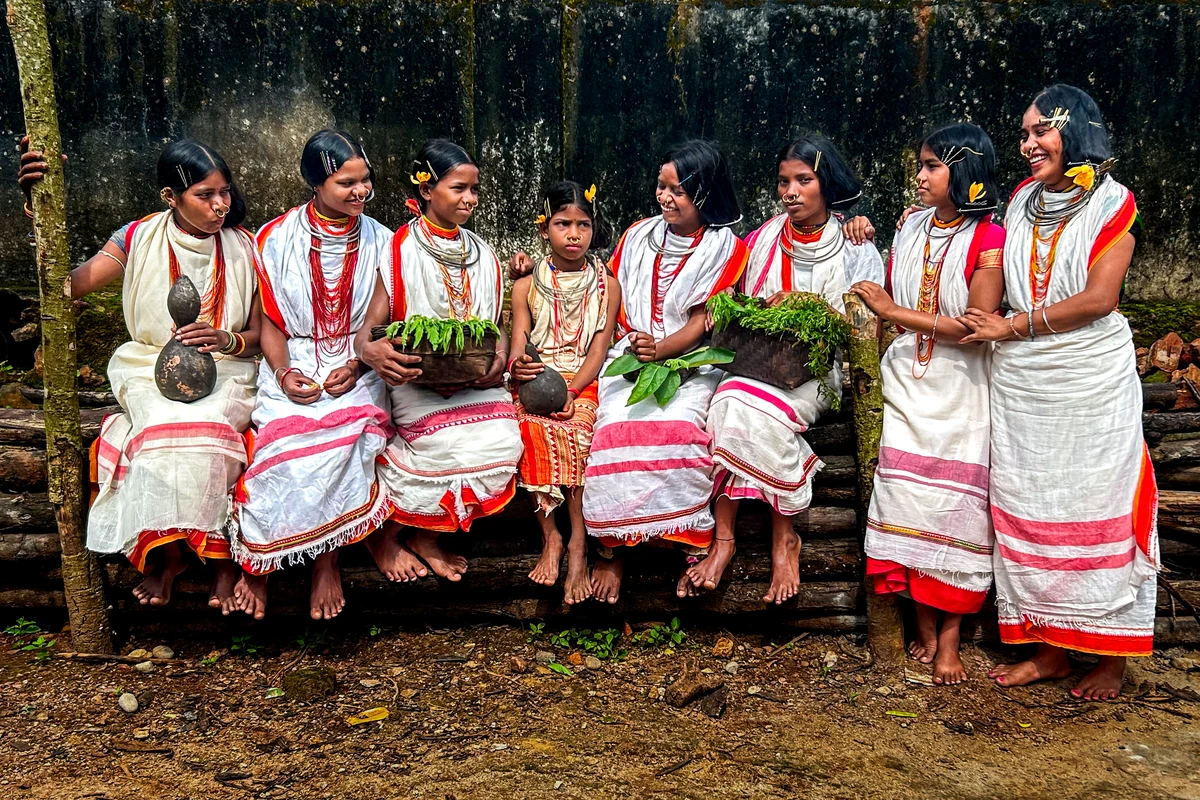
A requested group portrait of children preparing for a wedding, according to the photographer.
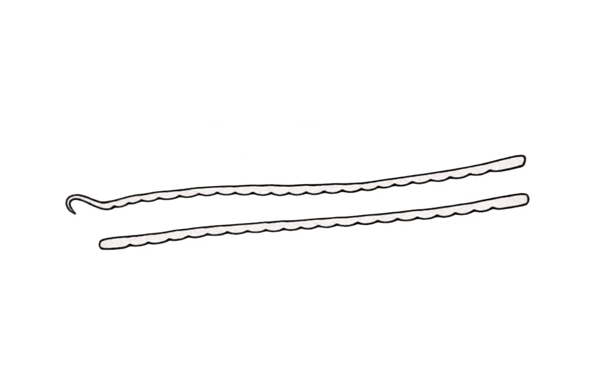
As women stitched Kapadaganda, a hair ornament served as a cutting tool. Kanak Rajadhyaksha’s account, based on November 2017 interviews, describes them using a blade-shaped katri to cut thread into manageable lengths and trim loose ends.1
In the embroiderer’s hands, the katri has work to do. Its appearance alone might not explain that use.
From households to markets
Sanghamitra Sethi and Paramananda Naik’s Jhigidi study follows Ghasi households making ornaments and other metal objects. Older relatives watched over moulds drying outside, while women gathered soil and prepared wax and moulds. Children helped their parents and learned through that participation. Both husbands and wives sold work at weekly markets, including Chatikana. Sales could involve cash or exchanges for produce.2
The authors also describe Ghasi manufacture of brass handles for the katri worn in Dongria women’s hair. The tool used while embroidering therefore connects another household’s metalwork with the making of cloth.2
The study’s historical account also describes travelling sellers receiving food and a place to stay in Dongria settlements. Metalwork moved through relationships of hospitality as well as purchase and exchange. These descriptions are not verified current arrangements.2
Makers and wearers
The Odisha State Tribal Museum’s 2019 catalogue describes andu, brass anklets associated with Dongria Kandha women, as elliptical objects with raised edges and embossed decoration. It attributes their manufacture to non-tribal artisans. The same catalogue lists coin necklaces under the name Takamecodica.3
Mohanty and Sahoo describe Dongria contributions to designs and manufacture by neighbouring artisans, particularly Ghasi craftspeople. Their account connects wearers and makers across communities, without naming the people behind a particular commission.4
A knife in the museum
Kala Bhoomi Odisha Crafts Museum holds an object catalogued as Mila Katri. The Virtual Museum of Images and Sounds describes it as a small, portable knife for cutting thread. Its acquisition record traces it through the General Manager of the Regional Industries Centre, Rayagada, to Nakul Pidikaka.5
The collection was documented in 2019–20, but the knife is undated and its maker unnamed. Nakul Pidikaka’s place in the acquisition record does not establish that he made it; nor does the Ghasi household study identify the maker of this particular object.52
Hairpins and their names
G. N. Mohanty and T. Sahoo’s 2006 account distinguishes several hair ornaments. A museum-derived table lists Aska as a hairpin or small knife and Sipna as a separate hairpin. The accompanying prose calls a small knife worn in the hair mila katra.4
The table distinguishes the names. Whether a wearer uses them in the same way needs a wearer’s explanation.
What a wearer can tell us
The knife that trims an embroidery thread, the patterned anklet and the coin necklace invite different questions. Who made this piece? How was it acquired? When is it worn, and what does its owner value about it?
Appearance alone cannot answer these questions or reliably establish someone’s age, marital status or beliefs. A catalogue can record an object’s name and acquisition; its wearer can explain how it fits into a life.
The relationships between wearers and neighbouring craftspeople continue in the next comparison, which follows the distinct work of Jhigidi and Kotpad textile makers.
Further reading
Kapadaganda and its makers · Dongria life in Niyamgiri · From harvests to market
Footnotes & Sources
Hairpin drawing: interpretive adaptation by Project Odisha from a photograph by Pillai Sree Vidya, CC BY-SA 4.0; adaptation under the same licence. Drawings simplify details.

Image: Shubhamkindia. CC BY-SA 4.0; source. Resized; composition unchanged.

-
Kanak Rajadhyaksha, Kapdagondas: Motifs and Technique, Sahapedia, materials and “Process” sections. Interviews conducted 8–14 November 2017. The term katri and its described use are retained without equating it with other published hairpin names. ↩
-
Sanghamitra Sethi and Paramananda Naik, Dhokra Craft: A Case Study of Jhigidi Village in Rayagada District, Odisha, Adivasi 56(2), issue labelled December 2016, pp. 76–82 (PDF pp. 88–94). Full article read; methods p. 78, family production and markets p. 80, exchange and brass-handled katri p. 81. Cover, contents, article opening and p. 81 visually inspected. Cover and contents say 2016; editorial text also says December 2017, so actual release date remains unresolved. Fieldwork dates and respondent sample are unspecified. This original replaces the earlier citation to the authors’ 2020 summary; the two papers are not independent corroboration of the same trade account. ↩ ↩2 ↩3 ↩4
-
SCSTRTI, Odisha State Tribal Museum, 2019, printed pp. 11–12. Institutional mirror hosted by KISS; the publication date comes from the title and imprint pages, not the filename. Museum descriptions establish the catalogue’s attribution, not a current survey of wearers or makers. ↩
-
G. N. Mohanty and T. Sahoo, Ornaments of Dongria Kondh, Orissa Review, September–October 2006, pp. 29–36: methods p. 29; museum-derived table pp. 31–32; hair ornaments p. 32; makers p. 35. The authors combine museum observation, observation in Kurlia and Parsali areas, and secondary sources; fieldwork dates and participant-level attribution are not supplied. The table on p. 31 was visually checked. These are historical descriptions, not verified equivalents for the Kala Bhoomi object or a current terminology survey. ↩ ↩2
-
American Institute of Indian Studies, Virtual Museum of Images and Sounds, Kala Bhoomi Odisha Crafts Museum collection, “Mila Katri” entries, accessed 3 November 2026. The page dates collection documentation to 2019–20; the object’s date field is blank. Two displayed entries repeat the description and acquisition chain and are not independent corroboration. No photograph reproduced, maker identity inferred or equivalence with Sipna asserted. ↩ ↩2