
Kotpad and Kapadaganda through their makers
By Ahimanikya Satapathy
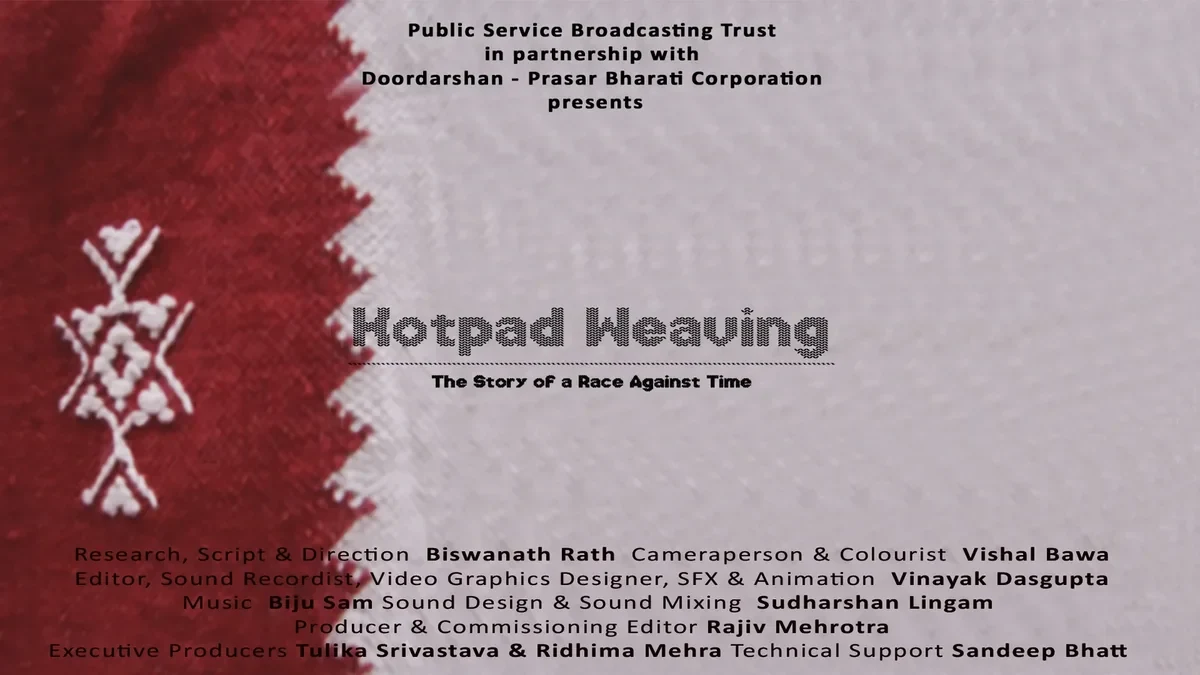
Release poster for Kotpad Weaving (2018), directed by Biswanath Rath; not a workshop photograph.
Ram Hial learned weaving from his father in Jhigidi. Kapilo Mahanta’s profile places her work in Kotpad’s Mirgan Street. Following these two practitioners helps distinguish cloth woven as a ground for Dongria embroidery from yarn dyed and patterned at the Kotpad loom.12
The cloth from Jhigidi
In July 2019, The New Indian Express traced Kapadaganda’s coarse base cloth to Domb weaving families in Jhigidi, in Rayagada’s Bissamcuttack block. Its report named Ram Hial’s father and teacher, Kamala Hial. Ram Hial described demanding work and low returns as reasons younger people were reluctant to continue.1
The report also recorded an attempt to obtain replacement cloth from Mayurbhanj. Dongria women said it did not match Hial’s fabric. Their response suggests that the base cloth mattered to how the embroidery was made and valued.1
Kanak Rajadhyaksha’s Sahapedia account, based on November 2017 interviews, follows the next stage: women purchasing cloth and coloured thread at weekly markets, cutting thread into manageable lengths and embroidering successive rows in satin stitch. Women worked when they had time; the account explicitly notes that not every woman embroidered.3
The work of colour in Kotpad
NIFT’s September 2026 profile credits Kapilo Mahanta with more than 35 years of textile experience, placing her in Kotpad’s Mirgan Street. Alongside her profile, its general craft description follows cotton yarn through washing and dyeing before it reaches the pit loom. Aal roots feature among the dyeing materials; the resulting palette includes reddish-maroon, brown and black alongside undyed tones.2
Patterns are also made at the loom, including supplementary-weft motifs. NIFT identifies the Mirgan community with this tradition and names Dhurua, Poroja, Gadaba, Madhia, Bhatara and Muria among communities for whom Kotpad textiles were traditionally made.2
Comparing the making processes
The Jhigidi report identifies a base-cloth weaver and the embroiderers who valued his fabric. NIFT’s Kotpad account follows dyeing and weaving within a different craft tradition. Neither account makes the two production histories interchangeable.
Colour needs the same care. Sahapedia’s interview account describes purchased embroidery thread; NIFT documents Kotpad yarn dyeing. A red area on each textile does not, by itself, establish the same colouring material or technique.32
Dongria embroidery and Kotpad cotton also shared a promotional platform: RISA’s 2026 launch and New Delhi store presented them as separate traditions.4 That connection documents joint promotion. The cloth supplied for Dongria embroidery in the account here came from Jhigidi; these sources do not establish a supply relationship with Kotpad weavers.
Ram Hial learned weaving from his father; embroiderers describe learning from their aunts. Alongside the work of supplying cloth, preparing colour and forming patterns runs the work of passing on knowledge. The next articles turn to students, teachers and the languages through which they learn.
Further reading
Kapadaganda · Homes and the work of repair · Kotpad textiles
Footnotes & Sources
Image: Seven5carrom (Commons contributor). CC BY-SA 4.0; source. Resized; composition unchanged.

-
Kapdaganda: No coarse cloth for Dongria designs, The New Indian Express, 7 July 2019. Dated reporting on Jhigidi and attempted substitute supply; not evidence of present capacity or a Kotpad connection. The interpretation of the women’s response is the author’s. ↩ ↩2 ↩3
-
NIFT, Kapilo Mahanta, CHHAAP 2026 artisan profile, page last updated 16 September 2026. Institutional maker profile and general craft description, not observation of a particular textile batch. The page uses both bark and root descriptions; no precise recipe, species identification, health benefit or product certification is asserted here. Community names follow the source. ↩ ↩2 ↩3 ↩4
-
Kanak Rajadhyaksha, Kapdagondas: Motifs and Technique, based on interviews with Dongria women and development-agency employees, 8–14 November 2017. Used for purchased materials and embroidery practice. Its tentative historical dye account does not verify a shared recipe with Kotpad. ↩ ↩2
-
Ministry of Tribal Affairs, RISA brand launch, 18 March 2026; Ministry of Tribal Affairs and TRIFED, RISA store inauguration, 10 June 2026. Previously inspected official releases reused from the Kapadaganda evidence record. Separate craft entries establish shared promotion, not direct cloth supply, current stock, maker payments or a common origin. Brand launch and store opening are distinct events. ↩