
Keeping seeds in circulation in Niyamgiri
By Ahimanikya Satapathy
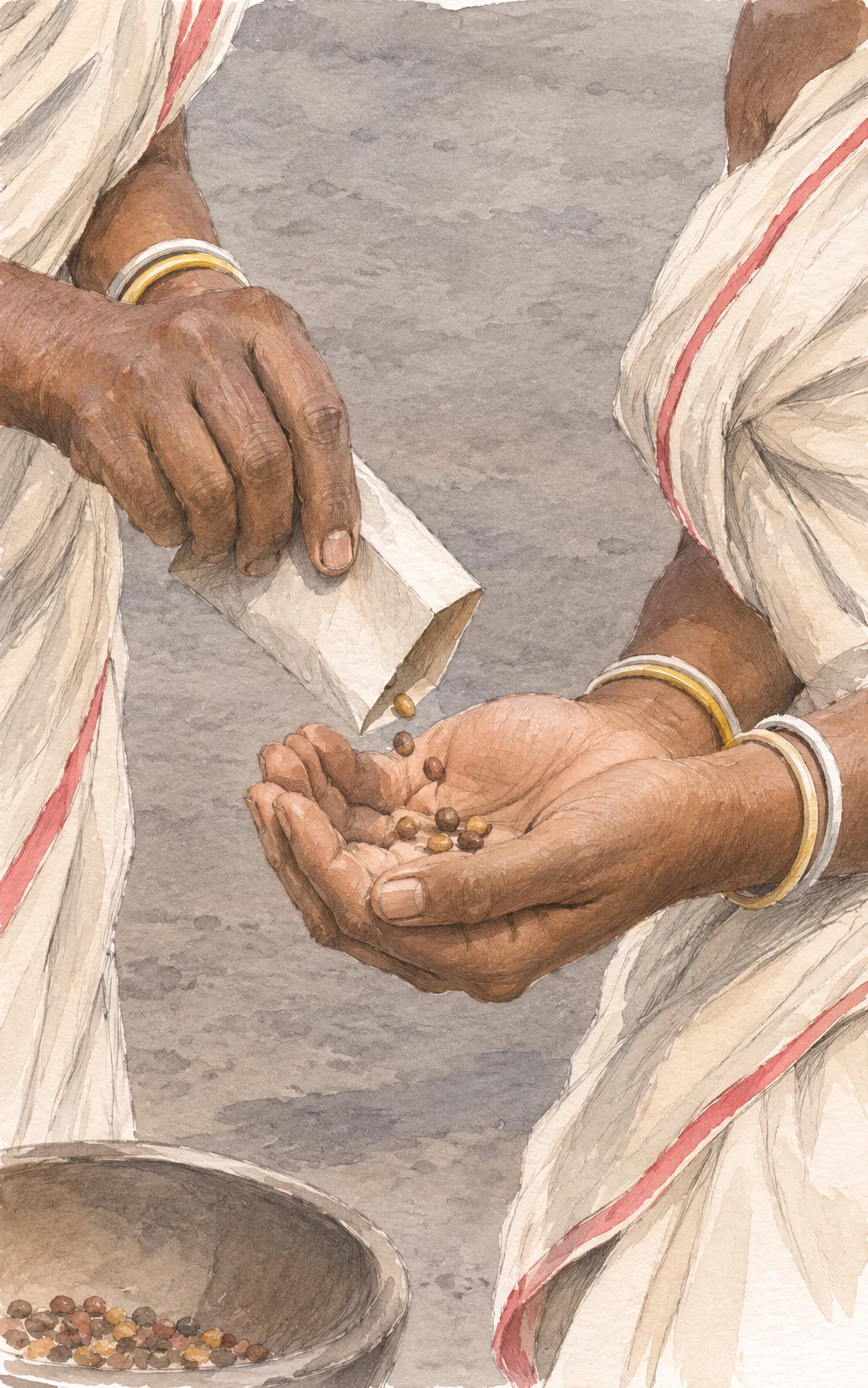
Hands tipping seeds from a folded packet into a cupped palm - an interpretive illustration. The exchange is imagined; no seed variety is identified.
In Manipadma Jena’s July 2015 report, Dasara Kadraka of Kadaraguma described her concern about millet varieties disappearing from local fields. Jena described Dongria Kondh priestesses travelling between villages to obtain seeds for cultivation at home. Finding a seed began with finding someone who still grew it.1
A stored seed still needs a grower. Keeping it in use means planting, tending the crop and retaining enough of the harvest for another season.
Finding and sharing
Jena described priestesses, known as bejuni, visiting a village where a sought-after variety survived. Seeds brought home were divided among five families. After harvest, recipients repaid the seed in grain at twice the quantity received, according to Jena’s account. Members of the neighbouring Dom community carried news about where seeds could be found. Jena also describes priestesses asking about varieties at weekly markets and village gatherings: the search depended on conversation as well as travel.1
The 2015 report located sought-after seeds in two villages: khidi janha, described as related to sorghum, in Jangojodi, and kanga-arka, described as a form of foxtail millet, in Sagadi.1 These are reported local crop names, rather than botanically verified identities.
Jena describes a particular exchange arrangement in 2015, rather than a rule for every village.
Keeping a collection alive
In Abhijit Mohanty’s 2017 reporting, Ghana Majhi, identified as a Dongria farmer from Sindhbahal, recalled his family growing twelve millet varieties. Raibari Sisaka, whose village the report does not specify, described retaining part of the harvest for seed and exchanging seeds with neighbouring farmers.2
In Sonali Prasad’s December 2018 Mongabay account, Gatri Kadraka of Rodango displayed seeds of millets, pulses and vegetables.3
Prasad also described families in Hundijali retaining seed for future planting and helping households that lacked it. Her account of Bijun Parab describes women cleaning seed and making baskets before bringing it to a priestess. Kumtadi Sikoka of Hundijali explained the prayer as seeking the deities’ favour before sowing.3
Prasad’s photograph caption names three people from Hundijali: farmer Drambu Jakesika, priestess Kumtadi Sikoka and messenger Sanyasi Takri. Keeping those names beside their roles makes visible the different work involved in cultivation, ritual and carrying news.3
Seeds across cultivation years
Roland Hardenberg’s account, based on intensive fieldwork in 2001–03, describes pulses being planted in a plot’s first cultivation year and millets in the following year. He places sowing around the monsoon rains, followed by weeding and crop protection, with harvests running from October or November into January.4 Seed needs followed the cultivation sequence and the rains. This historical account does not establish a current calendar for every village.
When cultivation contracts
Seed saving also depends on space in the fields. In Deepanwita Gita Niyogi’s November 2022 reporting, Wane Jakesika of Gandili described a shortage of seeds alongside the reduction in millet cultivation. In the same village, Singari Jakesika explained that her household had shifted land towards horticultural crops to earn more money.5
Having seed available and choosing to plant it are connected decisions. The earlier accounts of exchange and revival can coexist with later shortages: they concern different households and years, not a measured trend across Niyamgiri.
Making room for another crop
A collection kept for planting and a field given to another crop can exist in the same landscape. These accounts do not establish a current variety count. They show why keeping seed requires continuing relationships: someone must know where it can be found, someone must share it, and someone must make room to plant it.
Further reading
Dongria life in Niyamgiri · Forest foods and home gardens · Niyamgiri and cultivation
Footnotes & Sources
Adapted illustration: Project Odisha. CC BY-SA 4.0. Clothing reference: photograph by Pillai Sree Vidya, CC BY-SA 4.0. Imagined composition; portrait adaptation for this edition.

-
Manipadma Jena, Tribal Priestesses Become Guardians of Seeds in Eastern India, Inter Press Service, 22 July 2015, “An intricate ritual.” Historical reporting; variety-loss recollections are not a botanical inventory. ↩ ↩2 ↩3
-
Abhijit Mohanty, The Dongria Kondh are reviving their indigenous foods, Intercontinental Cry, 12 October 2017, “Reviving indigenous crops”; credited republication of VillageSquare reporting. Page updated 2 February 2026; that is not a new observation date. Ghana Majhi’s twelve-variety figure is a recollection, not an inspected inventory. Raibari Sisaka’s village is not specified. Full republication inspected; original article link could not be retrieved. ↩
-
Sonali Prasad, Photos: The Dongrias of Niyamgiri revive climate-resilient heirloom seeds, Mongabay India, 20 December 2018, Rodango account, “A bejuni’s prayer” and the Hundijali group photograph caption. Photographs credited to Indrajeet Rajkhowa; none reproduced here. The reporting is distinct from a current seed survey. ↩ ↩2 ↩3
-
Roland Hardenberg, “Dwelling in an Animated Landscape: Forms of Attachment Between Environment and People in Eastern India,” in Martin Bartelheim, Leonardo García Sanjuán and Roland Hardenberg, eds., Human-Made Environments, Tübingen University Press, 2021. Printed p. 25 / PDF p. 27: fieldwork dates; printed p. 26 / PDF p. 28: cultivation sequence and seasonal cycle. Relevant text read; cultivation page visually inspected. The chapter’s publication date is not its fieldwork date, and the passage does not provide a named-household crop inventory. ↩
-
Deepanwita Gita Niyogi, Superfood Millets Need Revival at Home, The Citizen, reproduced by the International Women’s Media Foundation, 19 November 2022. Wane Jakesika’s seed-shortage account and Singari Jakesika’s crop-choice account, Gandili. Full IWMF reproduction inspected; the original Citizen link returned 403. These are attributed household accounts, not a seed inventory or an independently measured regional trend. The same report is used elsewhere in this series and is not additional independent corroboration. ↩