
Odia cinemaA Shared Storytelling World
Bijay Mishra: People, Plays and the Work of Cinema
In this article
A playwright’s attention to people, his learning among filmmakers and the voices that continue to take up his work.
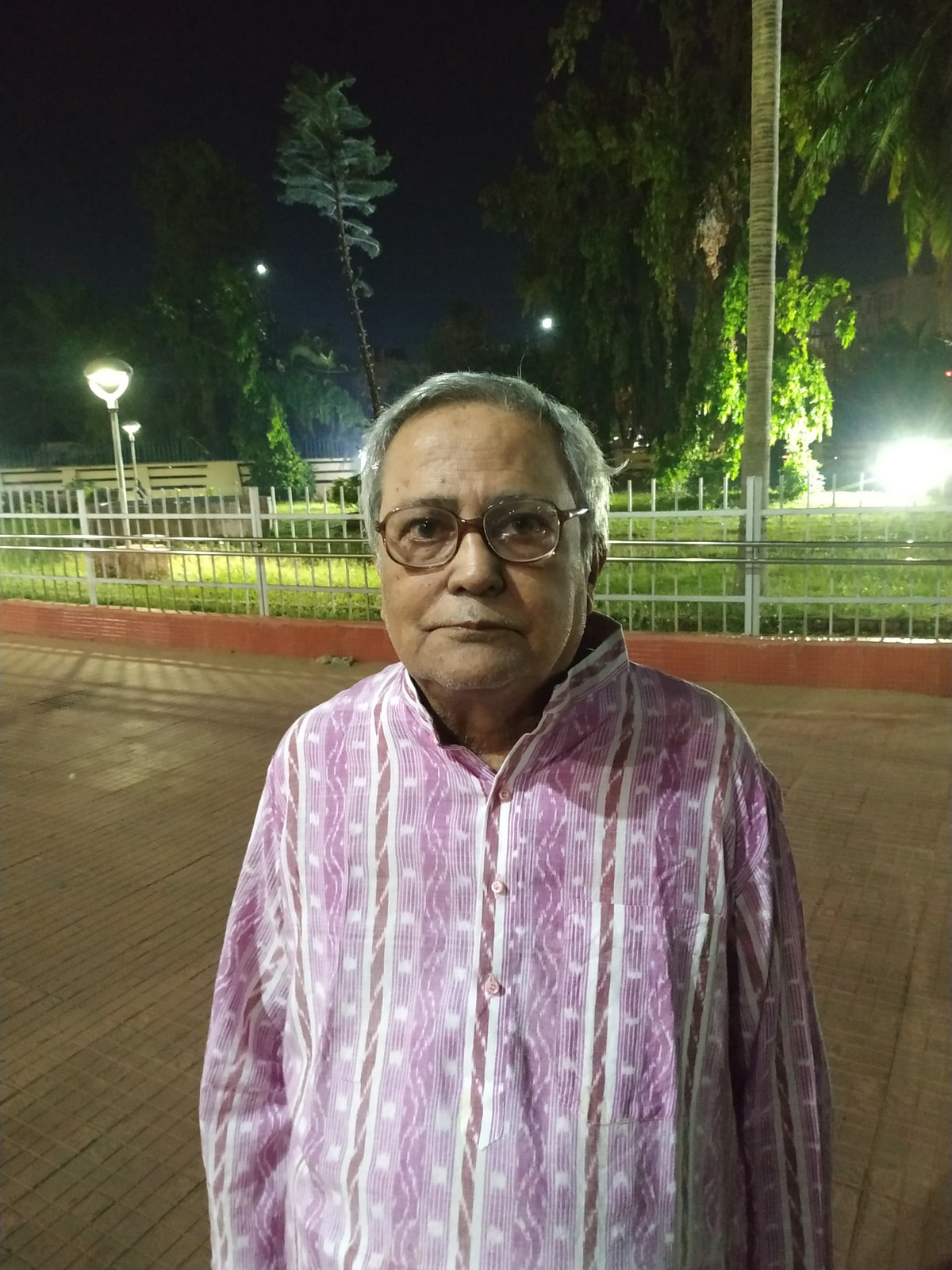
Bijay Mishra remembered observing people at railway stations and travelling in general compartments during his government-service years.1 His recollection begins with attention to ordinary lives.
For readers arriving through cinema, his name opens a path back towards theatre. A screenplay is one form of writing; a play has another life, returning whenever performers take up its words. Mishra’s work allows us to follow both without losing sight of the writer between them.
From poetry to a first play
In a 2013 interview, Mishra recalled beginning with poetry, then writing short stories and novels before his first play, Janani, in 1960. He described his characters as ordinary people facing struggles. More than five decades later, he spoke of the recently staged Bhanga Aina, concerned with live-in relationships and senior citizens.2
His account places a first play and contemporary urban relationships within one continuing practice of writing for performance.
Learning among collaborators
He recalled learning screenplay writing from Shyamal Mukherjee during ଯାଯାବର (Jajabara), which he co-directed with Hemanta Das and Akshaya Mohanty as Trimurty.1
The Akshaya Mohanty reading follows another member of this collaboration through songs and voices. Learning Cinema Together gathers further accounts of introductions, assistance and shared practice.
A play keeps its own life
His play Banaprastha received the Sahitya Akademi Award for Odia in 2013.3 It offers a literary starting point alongside the films associated with Mishra’s name.
His work also travelled into other theatrical productions. The National School of Drama’s festival programme identifies Nirmaan se Nirvaan Tak as based on his Tat Niranjana.4 A named source keeps the earlier writing visible within a new production. It gives a reader or spectator somewhere else to turn after the performance ends.
Other voices take up the words
In June 2026, Pradeep Pattanayak reported four groups performing Mishra’s plays at Shruti Natak Utsav in Bhubaneswar, organised by the Odisha Sahitya Akademi and Odisha Natya Sangha. Canmass of Paradip presented Taari Laagi; Sobha Ebang Kalakar of Balasore, Last Train; Swara of Sambalpur, Ekada Labanya; and Damayanti Kala Parishad of Kotpad, Janta. The performances used live dialogue without elaborate costumes, lighting or props.5
Gopal Chhotray’s story offers another passage through writing made for voices. Mishra’s plays invite a further encounter of their own: choose a title, seek a text or performance, and listen for the people it brings into conversation.
Words passed between voices.
Footnotes & Sources
-
Bijay Mandal’s interview with Mishra, OrissaPOST, 24 December 2019. ↩ ↩2
-
“Future of theatre looks bright now,” interview with Mishra, The Times of India, 19 July 2013. ↩
-
Sahitya Akademi, Odia awards list, 2013: Banaprastha, play; author listed as Bijoy Misra. ↩
-
National School of Drama, Nirmaan se Nirvaan Tak, festival programme and source-play attribution. ↩
-
Pradeep Pattanayak, “Four theatre groups stage Dr Bijay Mishra’s plays at Shruti Natak Utsav in Bhubaneswar,” Kalasanskruti, 21 June 2026. ↩
Credit: Hellohappy. Source · CC BY-SA 3.0 Display crop. ↩

Further reading
Suggest an update: share a publication record, performance programme or precise correction. GitHub submissions are public; omit private contact details and consent documents.