
Odia cinemaA Shared Storytelling World
Gopal Chhotray: Words Made for Voices
In this article
A radio play, a literary adaptation and shared film credits reveal a writer making words for other voices.
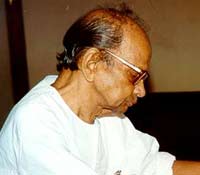
A playwright has found fame with a drama drawn from a beggar-girl’s life. But what has become of her? That is the question in a 1957 radio programme notice for Sova, a play by Gopal Chhotray scheduled on AIR Cuttack for 8 April.1 Even in this brief introduction, the person behind the successful story asks for our attention.
Born in Puranagarh in 1916, Chhotray made Cuttack the centre of his working life. His association with AIR Cuttack began in 1948. The archive of that life holds plays, stories, translations and unpublished scripts.2 The radio notice catches one moment within a much longer movement of words between reading and performance.
A story finds another company
Odia Bibhaba’s collection identifies ଶ୍ରୀମତୀ ସମାର୍ଜନୀ (Srimati Samarjani) as Chhotray’s opera adaptation of Fakir Mohan Senapati’s short story Patent Medicine.2 A work of fiction had become something that singers and performers could take up together.
Fakir Mohan’s story and Chhotray’s musical play remain available as two encounters with the work. The AIR Cuttack chapter follows the writers and performers who gave such exchanges a home.
Room for humour
Chhotray’s Hasyarasara Natak received the Sahitya Akademi award in 1982.3 The recognition gives readers a particular work to seek out, with humour at its centre.
Learning from other languages
The Library of Congress notes Chhotray’s translations from Hindi, Marathi and Gujarati.4 Odia Bibhaba’s catalogue includes his translation Natasamrat in a 1994 edition.2 Translation was another strand in a career that continued across forms and decades.
Words within a film
In ଶ୍ରୀଜଗନ୍ନାଥ (Sri Jagannath, 1950), the Gour–Parbati archive credits Chhotray for dialogue and C.R. Mitra for screenplay and direction.5 For ମାଆ (Maa), Chhotray shares the dialogue credit with Biswajit Das; Nitai Palit is credited with screenplay and direction.6
The literature-and-cinema reading follows more of these connections between originating stories and the people who transform them. Chhotray belongs to that story as a working collaborator, moving between the possibilities of a stage, a microphone and a film.
Return to a voice
The Library of Congress offers Chhotray’s readings from Pheria, Parakalama and Sei phula.4 They provide a direct route into the author’s voice alongside the written works.
Begin with an excerpt that interests you. Where a matching text is available, place it beside the recording and notice the pace of the spoken passage. The digitised works also offer a separate route into the writing.
The question from Sova stays with us: what becomes of the person whose life gives a successful story its shape? It belongs beside our admiration for the playwright. Chhotray’s words can still be heard, and the people within them can still ask something of us.
Read and listen
- Gopal Chhotray’s literary readings at the Library of Congress — author readings, distinct from original AIR drama broadcasts.
- Digitised works in the Odia Bibhaba collection.
Room for another voice.
Footnotes & Sources
-
The Indian Listener, 7 April 1957, PDF p. 10, “The Week’s Listening”; scheduled programme for AIR Cuttack, 8 April. ↩
-
Gopal Chhotray collection, Odia Bibhaba/Srujanika. The catalogue lists a 1974 edition of Srimati Samarjani. ↩ ↩2 ↩3
-
Recipients of the Kendra Sahitya Akademi Award, Odisha Annual Reference, 2005. ↩
-
Gopal Chhotray, Library of Congress author profile and recordings. ↩ ↩2
Credit: Brij Mahajan / Library of Congress, South Asian Literary Recordings Project. Source. Online preview cropped. ↩
Further reading
Suggest an update: share a publication record, recording credit or precise correction. GitHub submissions are public; omit private contact details and consent documents.