
Odia cinemaA Shared Storytelling World
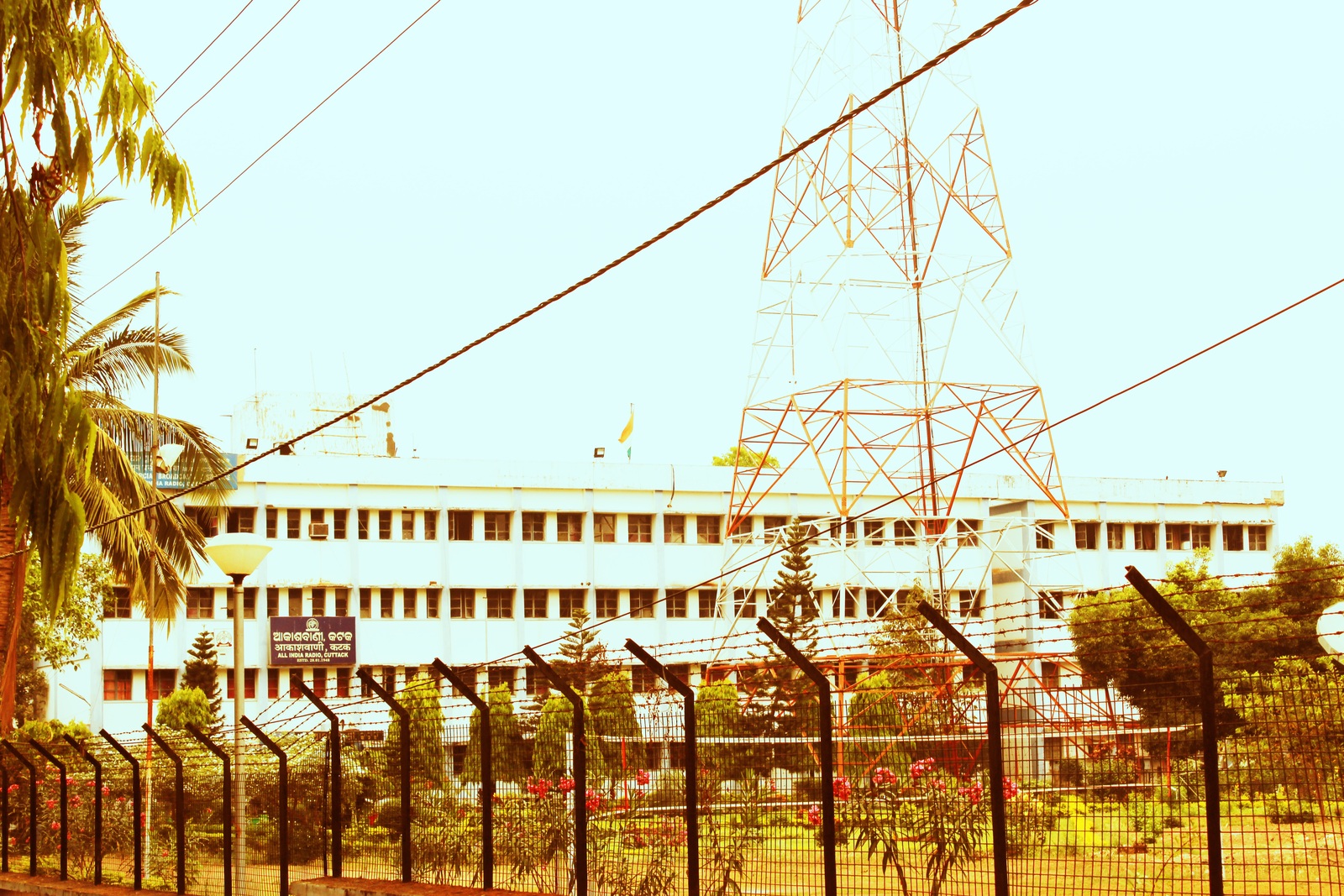
ଆକାଶବାଣୀ କଟକ | AIR Cuttack: where stories found another voice
In this article
Stay with the shared creative worlds behind the screen, and turn to writers, performers and radio.
A radio play gives the listener no stage to look at. A voice must establish who has entered; a pause can change the meaning of a reply. Music can carry a transition that a film might show through an image. The listener supplies a room, a face, a distance. This makes radio an art of collaboration between people making sound and people imagining what it means.
AIR Cuttack belongs within the history of Odia storytelling for that reason. Its importance reaches beyond the installation of a transmitter. It offered another place for writers, actors and musicians to work, and another form in which a story could meet its audience.
Before Cuttack had its own station, Odia drama had a place in AIR’s programme listings. For 22 April 1939, Calcutta 2 scheduled କେଦାର ଗୌରୀ (Kedar-Gouri), an Odia playlet. The listing credits Adwaitya Chandra Mohanti with writing and production, Nittyananda Sarma with music, and Abani Mukherjee with musical effects.1 Writing, music and the shaping of sound were being planned together.
1948: a new institution in a city of stories
All India Radio’s Cuttack station opened in 1948. The district administration’s history places its early establishment in the old Madhupur building.2 Radio enthusiast Jose Jacob’s account of an engineer-guided visit dates the inauguration to 28 January 1948: a temporary studio at Madhapur House and a small transmitter at Killa Fort.3
ସୀତା ବିବାହ (Sita Bibah) appeared in 1936, before AIR Cuttack. The cinema history follows its earlier stage connections.4
What followed was an overlapping history. A writer could work for theatre and broadcasting, then contribute dialogue to a film. A literary work could become a musical play. These movements are more revealing than a simple sequence in which one medium replaces another.
Gopal Chhotray: the writer between the media
Gopal Chhotray connects this history with theatre and cinema. The Library of Congress recognises his contribution to reviving Gitinatya, the verse-based musical-play tradition.5
The Gour–Parbati film archive credits him with dialogue for ଶ୍ରୀଜଗନ୍ନାଥ (Sri Jagannath, 1950). The same record names C.R. Mitra for direction and screenplay.6
For a dramatist, dialogue is more than information. It must reveal a relationship, sustain an exchange and give an actor something to do with a line. The same writer’s presence in different media gives us a way to investigate how those skills travelled.
A short story becomes a musical play
Odia Bibhaba’s Chhotray collection identifies ଶ୍ରୀମତୀ ସମାର୍ଜନୀ (Srimati Samarjani) as an opera adapted from Fakir Mohan Senapati’s short story Patent Medicine.7
Senapati opens with a household rule: Chandramani may take a short walk, but must remain within his wife’s sight. Chhotray turns that confinement into a musical complaint. In the printed play’s opening, Chandramani sings about his predicament; Sulochana enters and asks whether he is crying. He insists that he is singing. His lament has become an argument between two voices. Chhotray explains in his preface that the play is led by song, with much of its dialogue also written in song metre. A story has acquired another way to meet its audience.8
Pala, Daskathia and Prahallad Nataka have their own performance arrangements and histories. They offer further ways to listen for the relationship between narration, song and an audience.
From stage response to studio recording
Radio musicians also helped make performances that listeners could not see. Recalling programmes organised by Cuttack’s Kumar Utsav Samiti, dancer Kumkum Mohanty describes students from Kala Vikash Kendra and the National Music Association joining AIR artists. Gobind Tej was among the scriptwriters guiding Kelucharan Mohapatra’s choreography; Bhubaneswar Mishra composed the music, while AIR staff played violin, flute and harmonium. The dance belonged to the stage. In her account, AIR recorded and broadcast only the music.9
Lyricist Devdas Chhotray gives a performer’s view of the difference. In an interview conducted by Shyamanuja Das in 2018, he contrasts studio singing with a stage performance shaped by immediate audience response. Devdas recalls that his first recorded ghazal was composed and sung by Akshaya Mohanty for AIR Cuttack, and explains that such songs were placed under the programme category adhunika.10
For Devdas, a newly recorded song also had to find a place within the station’s listening life.
A stage performer can notice a response and extend a phrase. A recording fixes a particular performance for another listening situation. That difference helps explain why the same song or dramatic passage can acquire another rhythm when it moves between media.
Who had the opportunity to be heard?
The history also needs the experiences of women performers. In an interview with David Dennen and Amir Kumar Jeetendra Nayak, Shyamamani Devi recalled opposition from relatives to a girl singing publicly, alongside encouragement within her family. She remembered becoming an Akashvani child artist in 1950; the cited recollection does not identify a station, so it belongs here as a wider broadcasting connection.11
A transmitter could carry her voice only after she had found a way to sing. The encouragement and opposition she remembers belong within broadcasting history as surely as the studio and its equipment.
Making room for musicians
Programme leadership could help creative work find a home. In a 2020 retrospective, Shyamanuja Das credits station director P.V. Krishnamoorthy with encouraging lighter music and convening informal exchanges among musicians and lyricists at AIR Cuttack. Das draws on published recollections and artists’ accounts. The contribution was to make space for collaboration; the singers, composers and writers remained its creators.12
The work behind the voice
Jacob’s 2008 visit account describes specialised rooms in the studio complex opened in 1977: spaces for talks, drama, music, dubbing and playback. He observed computers alongside reel-to-reel tapes. His account also recalls transmission disruption during the 1999 cyclone and the effort to restore service.3
These are dated observations, but they help recover a less visible part of cultural history. A broadcast depends on technical work as well as a script or singer. Recording, editing, scheduling and transmission determine whether a performance can reach a listener at all. Preserving that history means remembering engineers and programme staff alongside the names printed on books and records.
Listening now, preserving what remains
The listening continues. Akashvani’s official Cuttack page provides dated Odia news bulletins online.13
The Gopal Chhotray profile offers a route into the writer’s work, with links for reading and listening. Listening to an author read, we meet the pace and grain of a voice. The next chapters follow songs into that intimate space between a performer and someone listening.
A voice finds a listener.
Watch and explore
- Literary audio catalogue: Gopal Chhotray at the Library of Congress. Author readings, not original AIR drama broadcasts.
- News audio listings: Akashvani Cuttack bulletins. Browse dated bulletins; not a complete historical radio archive.
Footnotes & Sources
-
All India Radio, The Indian Listener, 7 April 1939, p. 578, Calcutta programme for 22 April. ↩
-
Cuttack district administration, History, 1948 and the old Madhupur building. ↩
-
Jose Jacob, “A visit to AIR Cuttack & others”, February–March 2008 visit account, pp. 1–2. ↩ ↩2
-
Kapilas Bhuyan, PIB/IFFI cinema retrospective, 22 November 2010, first-feature chronology. ↩
-
Gopal Chhotray profile, Library of Congress. ↩ ↩2
-
Gour–Parbati archive, Sri Jagannath (1950), film credits. ↩
-
Gopal Chhotray collection, Odia Bibhaba. ↩
-
Fakir Mohan Senapati, Patent Medicine, opening, Odia Wikisource transcription; Gopal Chhotray, Srimati Samarjani, Granthamandir, first edition, September 1974, preface and pp. 1–4; scan: Srujanika/Odia Bibhaba. ↩
-
Kumkum Mohanty, interview with Madhur Gupta, “Learning with Kelucharan Mohapatra”, Sahapedia, 2018, Kumar Utsav recollection. ↩
-
Shyamanuja Das, “In Conversation with Odia Lyricist Devdas Chhotray”, Sahapedia, interview conducted September 2018, Parts II–III. ↩
-
David Dennen and Amir Kumar Jeetendra Nayak, “Shyamamani Devi on Odissi Music and Her Life as a Singer”, mirrored interview, opening section. Interview date and station unspecified in this passage. ↩
-
Shyamanuja Das, PV Krishnamoorthy and modern Odia songs, OdishaBytes, 16 October 2020. Retrospective. ↩
-
Akashvani News, Cuttack bulletins, dated Odia bulletins. ↩
Credit: Kamalakanta777, Wikimedia Commons. Source · CC BY-SA 3.0 ↩

Further reading
Suggest an update: share a precise programme credit, dated schedule or archive reference. GitHub submissions are public; omit private contact details and consent documents.