
Odia cinemaMaking the Next Film Possible
Beyond One Successful Film: Building Odia Cinema Together
In this article
Practical possibilities for government, industry and audiences to support artistic quality, wider access and sustainable film businesses.
I began this journey wanting literature to reach more people and more of its value to return to writers. The films and lives in these pages have widened that question. A script needs time; a finished film needs a screen; a copy kept for decades may need restoration before anyone can see it again.
The return of Maya Miriga, the working lives recalled here and the films that found new audiences give us specific achievements to build on. The question about source authors’ compensation remains open in the records we examined. I want it to stay part of the conversation, alongside the practical work of making and showing the next film.
Start with people and the work
Quality cannot be reduced to a prize, a production budget or one preferred genre. A comedy, a thriller, a children’s film and a formally adventurous drama can each be made with care. For a production team, useful questions are concrete: does the screenplay earn its turns, can we hear the dialogue, does the performance fit the scene, and does the finished film reach the audience it was made for?
The series already contains histories of initiative. Gour Prasad Ghose brought collaborators into productions; Parbati Ghose carried literary material into film; Nirad Mohapatra worked through teaching and film societies. These examples offer different starting points. Each joins individual initiative to a wider circle of collaborators, learners and viewers.
Before the camera begins
A producer and writer can agree on the script stages, feedback process, payment schedule, adaptation rights and credits before a shoot is announced. Rehearsal, location research and conversations with people whose lives inform the story belong in preparation. Using a person’s private experience calls for their informed agreement, as well as attentive listening.
There are existing Indian models to learn from. NFDC’s Screenwriters’ Lab describes mentorship, screenplay development and preparation to pitch to producers and investors. Its Work-in-Progress Lab brings directors and editors into discussion of a rough cut with advisers.12 An Odia initiative could adapt that attention to writing and editing at a scale it can sustain; each participating team would still need to develop its own work and release plan.
Books can enter a film conversation before a screenplay exists. NFDC’s 2022 Book to Box Office brought publishers, agencies and authors before prospective buyers and producers. MAMI’s 2024 Word to Screen rules described open pitches and one-to-one meetings with rights-holders, without guaranteeing a deal.3 These public and industry initiatives offer complementary examples for an Odia gathering: readers and translators could help introduce books, while authors and relevant rights-holders or their authorised representatives meet filmmakers. An introduction would leave the participants to decide what to develop together, with recognition and terms for the source author distinct from the screenwriter’s and translator’s contributions.
An early-career assistant needs someone to learn from, a real role and compensation. A production might need an experienced sound practitioner, an editor willing to discuss a rough cut, or paid time to rehearse. Support becomes useful when it meets the particular work in front of the team.
Build with the people already beside us
Co-creation can begin before anyone knows the finished film. A writer brings a story; a director brings experience of performance; another person knows a place well enough to question how it is being represented. What they choose to make may change as they listen to one another.
Saras Sarasvathy’s five principles of effectuation offer a way to think about such beginnings.4 Bird in Hand begins with available knowledge, skills and relationships. For a film, that might mean a story its author is willing to discuss, rather than a distant idea waiting for unlimited resources. Affordable Loss asks what each participant can afford to lose while exploring it. Someone else’s unpaid labour cannot simply be counted as our affordable risk.
With Crazy Quilt, partners contribute something real and help shape the undertaking: a producer might fund development, a theatre group offer agreed rehearsal space, a film society arrange a licensed screening. Lemonade leaves room to use a surprise—a response at a reading might suggest a form or an audience the makers had not considered. Pilot in the Plane places attention on choices people can make together, while recognising that they cannot command the market or a viewer’s response.
These are possibilities for working with uncertainty, not a recipe for a hit or a description of how every filmmaker in this book worked. Their value here is in the invitation to begin thoughtfully, share responsibility and let new commitments change what becomes possible.
The voices already around us
A film can begin with a remembered voice. In ନାନୀ ମା (Nani Ma, 2022), filmmaker and language archivist Subhashish Panigrahi records the songs and stories of his grandmother, Musamoni Panigrahi, in Balasore. His English-language documentary The Volunteer Archivists (2022) follows Srujanika’s work preserving Odia publications, bringing the labour of Nikhil Mohan Pattnaik, Puspashree Pattnaik and their colleagues into view. Padmaja Sahoo’s part in proofreading, editing and compilation reminds us that an archive grows through patient work on individual pages.5 Spoken memory and printed literature offer different beginnings for a film; both give us people whose work we can follow.
Another connection leads back to Prahallada Nataka. In 2018, Prateek Pattanaik documented performances with photographer Debendra Pattanayak and theatre artist Arjun Samantaray. Prateek credits Subhashish with lending a camera and advising on videography and production; community contributions helped fund the work.6 A camera, a performer, someone who knows the tradition, and people willing to help: this is one concrete way shared care can take shape.
The collaborations extend into other films. O Foundation’s 2021 treatment credits Prateek as co-cinematographer of Remosam.7 The released trailer of Shankhajeet De’s Ramaleelas of Odisha credits Prateek and Puloma Pal for additional script, research and subtitles.8
For a new collaboration, the invitation could be to listen first—to a remembered song, a living performance or the people caring for books. Agree with participants how their voices will be recorded, credited and shared. Their knowledge can help shape what the film becomes.
A public foundation people can use
Odisha’s 2019 State Film Policy set out support for film production, shooting permissions, cinemas and film infrastructure. Its official policy page also links training and scholarship guidelines.9 The framework is a starting point for examining public support, not proof that a particular incentive is currently open or that announced benefits were paid.
A useful next step would be a clear public service record: which schemes are operative, who can apply, what documents are needed, how long decisions take, and the sums actually disbursed. Applicants should be able to distinguish a sanction from a payment and a policy intention from an available service. Existing rules and eligibility would need checking before any producer budgets for assistance.
Public support could help where a small production struggles to act alone. A modest development fund could support research, writing, translation and rehearsal through published criteria and independent selection. A separate finishing fund could help promising films complete sound, colour, subtitles and delivery materials. Clear selection, declared conflicts of interest and an account of the work supported would give people a basis for trust. These are proposals, not newly announced schemes.
Studios and shared facilities should be judged through usable access: clear rates, functioning equipment, booking availability, trained personnel and completed productions. The economics chapter places Kalinga Studio and private services in that history. New buildings matter when people can afford and reliably use them.
Public support should also preserve variety. A film need not serve as a tourism advertisement to contribute to cultural life. Small-language audiences, children, documentary work and less commercially obvious subjects deserve consideration alongside productions with larger markets. At the same time, public funding needs transparent limits and evidence of what it accomplishes.
Let a success help the work continue
The commercial-successes reading gives us achievements to examine; the economics reading asks what returns after the costs and contractual deductions. A headline collection cannot answer that second question on its own.
A producer who knows what has actually returned can decide what to undertake next. Sharing comparable, consented figures through an industry body could help others plan, while protecting commercially sensitive details. A prospective streaming sale still needs an agreement; a promise of income cannot pay a crew.
Reinvestment remains a choice. A profitable film might help pay for another script, an apprenticeship or a smaller production. Agreed wages and clear terms give people a basis for taking part. Those involved could also choose to share how the collaboration developed—what helped a script take shape, or gave a newcomer useful experience—without disclosing private financial details.
Reach audiences beyond Odisha without leaving Odisha behind
Plan translation and access while the film is being made. Good subtitles need editing, contextual judgement and testing with viewers who do not know the language. Translation subtitles, captions for deaf and hard-of-hearing viewers, and audio description serve different purposes. India’s Ministry of Information and Broadcasting issued OTT accessibility guidelines in February 2026 with an implementation schedule; producers and distributors need to check the applicable requirements.10
A release plan could then identify separate routes: cinemas within Odisha, selected cities elsewhere in India, licensed diaspora screenings, festivals, television and streaming. Each needs its own rights, delivery materials, publicity and realistic cost. A festival encounter can begin a distribution conversation. A licensed screening abroad can help a team learn about a particular audience. Sales and further bookings would then need to be secured on their own terms.
A few well-supported screenings with local partners could help filmmakers meet viewers beyond familiar audiences. Conversations afterwards may reveal how people found the film, whether the subtitles carried its meaning, and whether they would welcome another screening. The costs and receipts matter too: reaching people should leave the team able to consider what comes next.
Preserve the film while planning its release: retain masters, sound elements, subtitles, credits, stills and the rights information needed for future use. The Maya Miriga chapter shows why a film’s later life belongs in its history too.
What audiences and communities can do
People can choose authorised screenings and services, recommend a film with a useful description, and pay for work they want to see continue. They can also offer specific criticism. Thoughtful disagreement belongs in that support: it gives filmmakers a clearer account of what moved, puzzled or disappointed a viewer.
Colleges, libraries, cultural groups and diaspora associations could organise licensed screenings followed by discussion. NFAI’s Film Distribution Library provides an existing institutional model for educational and film-society access, with borrowing conditions that vary by title.11 A local programme would still need to establish which films are available and secure the relevant screening permissions.
At the 2023 Dhwani festival in Bhubaneswar, people with disabilities joined other viewers for screenings and discussion. Its rules required English subtitles and provided for half of any prize money to go to a disabled performer playing the main role.12
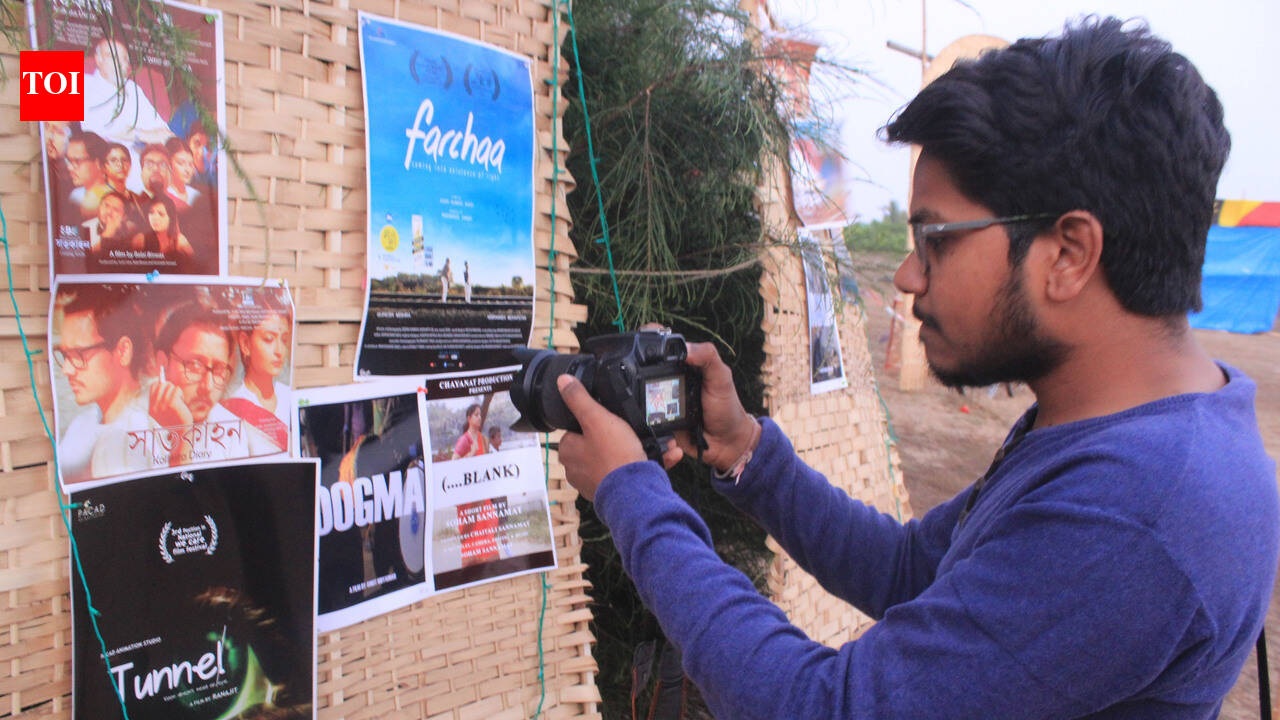
In Puri, the Bring Your Own Film Festival (BYOFF) gave filmmakers another place to meet an audience. A 2005 report described a gathering without a selection process, jury or awards: Sammit Das’s short At the Midnight Hour had screened the previous year, and Pankaj Advani contributed to the festival fund. In 2015, its organisers described meeting costs through registrations, crowdfunding and state or corporate sponsorship.13 Showing a film and helping sustain a place to see it are different contributions to the same encounter.
Children can also help make the films a community gathers to watch. In 2022, students from schools in Balangir, Rayagada and Jajpur joined Kallola filmmaking workshops. Aaina’s report records around 47 participants working in groups to produce nine short films about climate change, presented in Bhubaneswar that November through its partnership with UNICEF.14
An earlier Kallola-Junior screening in 2016 included Aji Thu Ekathi, made by students of St Xavier’s High School, Khandagiri. Aaina’s 2023–24 report also names Nagabali Ra Abhiman, made by students of Pitamahal Ashram School.15 What stories might children choose to tell about the places they know?
A children’s or family screening could let younger viewers encounter Odia as a language of imagination. Beside an adaptation, there could be a book to borrow, a passage to hear, an author or translator to discover. A film audience may include the next reader. Making that encounter welcoming is something a library, a film club or a group of families could try.
At a screening, the conversation could include the writer behind the story or the weaver whose cloth appears on screen. Invite them to speak about their choices, agree on payment, and help viewers find their work afterwards. A name in the credits could become a book to read, a textile to seek out, a person whose work we follow. We can give our affection for Odisha this practical form: helping its makers be seen and heard.
Begin with the next encounter
“ଏକା ହାତରେ ତାଳି ବାଜେ ନାହିଁ”—one hand cannot clap.16
The saying offers a way to think about the relationship between a maker and an audience. A story needs someone willing to tell it and someone willing to give it attention. Around that encounter stand the people who write, perform, record, edit, translate and arrange a screening.
For the maker, give a story time to develop, and plan to pay the people who help tell it. For the viewer, give the work a fair encounter: watch, question, recommend, return. A film that stays with us may send us towards a book, a voice or a life we had scarcely noticed.
The restored Maya Miriga reached another audience because people carried the work forward. A story can remain close to home and still welcome someone from far away. Its language, its humour, the particular lives and places within it can become reasons to enter.
We need not know in advance which film will travel furthest. We can choose the care with which we make it, the fairness with which we work, and the welcome we extend to an audience. The next beginning may be a comedy, a searching independent film, a child’s adventure—or a few pages someone has quietly been writing.
There is room at this table. What story will we help one another bring to the screen?
Footnotes & Sources
-
NFDC, Screenwriters’ Lab, 2025 programme description; edition-specific application terms apply. ↩
-
NFDC, Work-in-Progress Lab, rough-cut feedback and editing programme. ↩
-
NFDC, Annual Report 2022–23, p. 44; MAMI, Word to Screen 2024 rules, p. 1. ↩
-
UVA Darden, Effectuation; Effectuation.org, The Five Principles of Effectuation. Cinema applications proposed here. ↩
-
O Foundation, Nani Ma and The Volunteer Archivists; 2023 released version. ↩
-
Prateek Pattanaik, “How we documented the Prahallada Nataka of Ganjam”, 2018 documentation account. ↩
-
O Foundation, Remosam: treatment, 12 February 2021, p. 3. ↩
-
ShankhaTalks, Ramaleelas of Odisha: long trailer, credits at 2:40. ↩
-
Invest Odisha, Odisha State Film Policy 2019, policy and operational-guideline index. ↩
-
Ministry of Information and Broadcasting, OTT accessibility guidelines announcement, 27 March 2026, reporting guidelines issued 6 February 2026. ↩
-
NFDC–NFAI, Film Distribution Library, membership, screenings and title-specific borrowing conditions. ↩
-
Aaina, 2022–23 report, pp. 18–19; Dhwani 2023 rules, pp. 2–3. ↩
-
Sumit Bhattacharya, “A hatke film fest!”, Rediff, 16 February 2005; Team BYOFF interview, IndiEarth, 15 February 2015. ↩
-
Aaina, Reflections: Annual Report 2022–23, pp. 21–22. ↩
-
“Short films raise voice against discrimination”, OrissaPOST, 4 September 2016; Aaina, Annual Report 2023–24, pp. 11–12. ↩
Further reading
Suggest an update: share a documented initiative, production experience or precise correction. GitHub submissions are public; omit private contact details and consent documents.