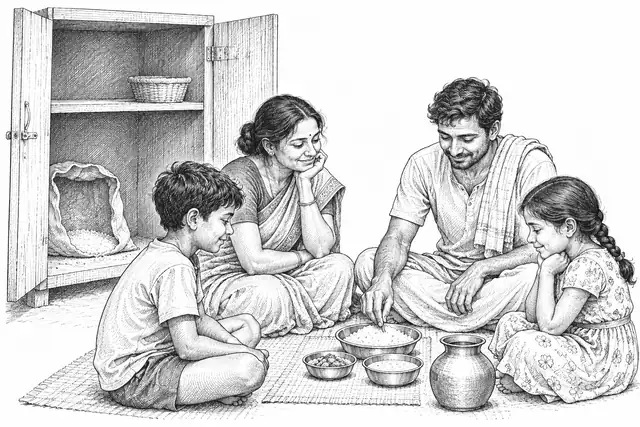
When there is [food], a tiger’s fare; when there is none, a snake’s fare.
What it means
The saying contrasts plentiful eating when food is available with scarcity when it is not. The change from a tiger’s fare to a snake’s fare marks the change in circumstances.
When you might use it
Original imagined example: A household uses its food stores freely when they are full and later has very little left. Someone recalls the contrast between fare in plenty and fare in scarcity.
Cultural context
The paired ଥିଲେ and ନଥିଲେ give the contrast its compact form: availability on one side, absence on the other.
An imagined meal sits beside the prospect of a leaner store.